
A Resistance History of the United States

written by Tad Stoermer, published by Steerforth Press
About the book:
The traditional narrative of American history often frames the founding of the United States as a definitive victory for human liberty. We are taught that the Revolution secured freedom, but the reality is much more complicated. In truth, the founding of the nation did not guarantee liberty for everyone. Instead, it opened a door that could lead either to freedom or to deep oppression, creating a system where the full benefits and protections of citizenship were intentionally limited to white men.
In his book, A Resistance History of the United States, public historian Tad Stoermer argues that this exact tension—the constant friction between the ideals of resistance and the realities of institutional power—is what truly defines the American story. It is this struggle, far more than the Enlightenment ideals written into the Declaration of Independence and the Constitution, that has shaped the country from its very beginnings.
Rather than relying on abstract political theories, Stoermer uses powerful, narrative-driven storytelling to ground his argument in the lived experiences of everyday people. He focuses on pivotal, yet frequently overlooked, moments in the American past to show how ordinary individuals and marginalized groups routinely stood up against the powers that be.
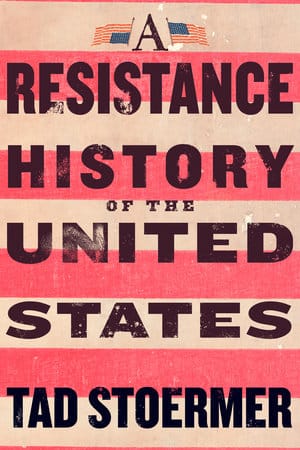
The book spans centuries of dissent, examining how different eras birthed distinct forms of opposition. For instance, Stoermer takes readers back to 1676 to look at the chaotic intersections of class, race, and power during Bacon’s Rebellion and Metacomet’s War. He moves through the institutional paranoia of the Salem Witch Trials in 1692, and later highlights the complicated choices of the Black Loyalists in 1783, who shook the foundations of the revolutionary era by seeking their freedom through the British military. By the time the narrative reaches the organized defiance of the Underground Railroad in 1850, a clear pattern emerges: the fight for justice has always required active, deliberate resistance against unjust laws.
Each era Stoermer uncovers highlights a specific principle of defiance meant to challenge and inspire people living in the modern world. By bringing these stories to light, the book deliberately dismantles the comfortable mythologies that often pass for objective American history. Stoermer confronts the curated nostalgia, the moral evasions, and the deliberate institutional silences that have been used for generations to protect abusive power structures and hide the nation's flaws.
What he leaves us with is a vital, clear-eyed examination of our collective past. Ultimately, A Resistance History of the United States serves as an essential tool for the present, showing how we can draw practical lessons from historical struggles to better understand, and effectively confront, the systemic injustices we face today.