
Biological War

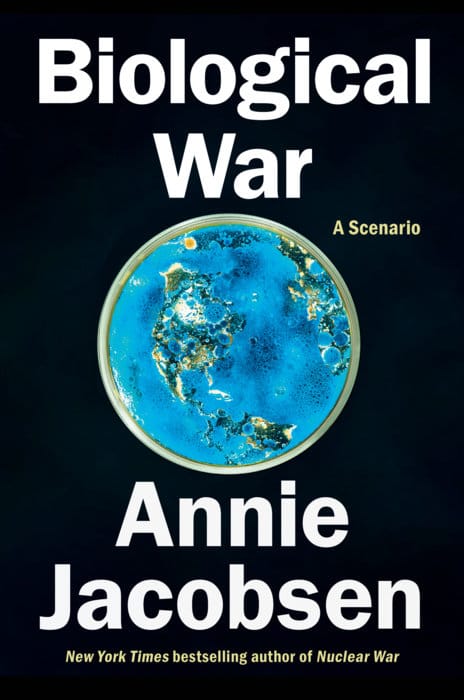
Annie Jacobsen does not write speculative fiction. Her work occupies a narrow intersection between investigative journalism and national security documentation, built on hundreds of hours of interviews with men and women who spent their professional lives staring down worst-case scenarios inside the Pentagon, the Department of Energy, and high-containment laboratories. In her previous work, Nuclear War: A Scenario (which you should absolutely read – it'll scare the you-know-what out of you), she mapped out the horrifying geometry of a thermonuclear exchange minute by minute, stripping away political abstraction to expose the raw mechanics of destruction. With her latest book, she turns her lens toward a threat that is in many ways more insidious because of its invisibility: a catastrophic biological event.
Where a nuclear strike announces itself with a blinding flash, a thermal pulse, and a shockwave that flattens a city in seconds, a biological crisis begins in near silence. It enters the world quietly—a vial smuggled across a border, an accidental containment breach in a high-security facility, or an engineered pathogen designed to exploit the very hyper-connected infrastructure that modern society relies upon. Jacobsen approaches this scenario as an operational reality mapped out through the experiences of government officials, military planners, epidemiologists, and emergency management experts who have quietly gamed out these exact parameters behind closed doors.
The structure of the book relies on a ticking-clock framework, tracking the collapse of human society across hours, days, and weeks following the release of a biological agent. It is a grueling, systematic examination of how thin the veneer of civilization actually is. In the opening hours, the pathogen moves undetected through transit hubs, office buildings, and grocery stores. Normal life continues while the invisible baseline of public health quietly shatters. By day three or four, hospitals are past capacity, triage protocols fail, and the basic supply chains that feed metropolitan areas begin to fracture as truck drivers, utility workers, and emergency responders fall ill or stay home to protect their families.
What Jacobsen documents is not merely a medical crisis, but a total systemic failure. The infrastructure built to sustain modern life—power grids, municipal water treatment, food distribution networks, and financial systems—is dependent on an uninterrupted chain of human labor and digital coordination. When that chain breaks under the weight of mass casualties and widespread fear, the response mechanisms designed by the state are forced into a defensive posture of containment.
The interviews underpinning the book reveal a sobering consensus among high-level officials: the systems in place are fragile. Decades of globalization, centralized supply chains, and lean manufacturing have optimized economic efficiency at the direct expense of systemic redundancy. When a major metropolitan area loses its medical infrastructure within a week, the resulting cascade doesn't stop at the city limits. Panic spreads faster than the pathogen itself. Law enforcement and military units, stretched thin and exposed to the same environmental hazards as the civilian population, face impossible choices about quarantine enforcement, civil unrest, and resource allocation.
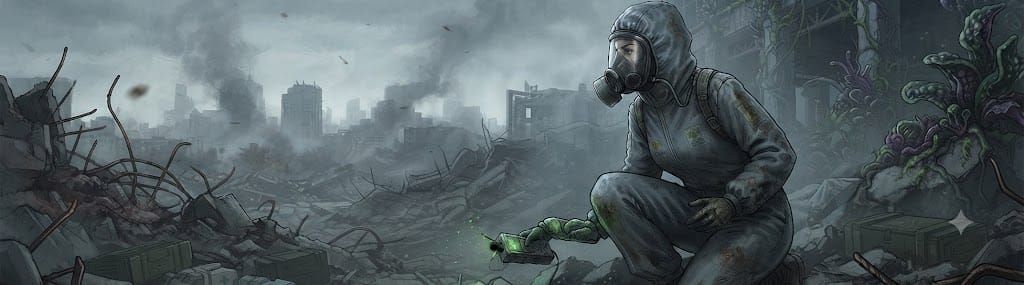
Jacobsen’s reporting pulls no punches regarding the aftermath. What remains in the wake of an unmitigated biological disaster is a landscape characterized by isolation, localized insurrection, and the rapid erosion of public trust in governing institutions. The social contract dissolves when the state can no longer guarantee basic physical security or medical support. It is a descent into a plague-ravaged wasteland where survival depends entirely on self-reliance and proximity to resources.
Yet, the true value of Jacobsen's investigation lies in its utility as a document of preparedness. By refusing to soften the edges of what government experts know is possible, the book serves as a vital diagnostic tool. It strips away the comforting assumption that advanced technology and modern medicine make society immune to ancient vulnerabilities.
The release of a biological agent, whether born of geopolitical conflict or accidental laboratory escape, tests the structural integrity of human civilization in a way no other disaster can. Jacobsen has constructed a rigorous, highly detailed roadmap of that collapse, forcing the reader to look directly at the vulnerabilities we have engineered into our daily lives. It is unsparing, meticulously researched journalism that demands to be read not for shock value, but as a sober accounting of the risks we live with every single day.