
Happiness Included: Jan Brady and Beyond


Eve Plumb has spent five decades as a cultural Rorschach test for the American middle child, but the career that started at age six was never as simple as a sitcom trope. Before she was cast as the girl permanently trapped in Marcia’s shadow, she was a veteran of the national commercial circuit and a fixture on the guest star rotation for the heavy hitters of sixties television, from Gunsmoke to Lassie. By the time the Brady station wagon parked itself in the national consciousness, Plumb was already a professional who understood the mechanics of the industry better than most of the adults in the room.
The transition from the sanitized hallways of the Brady house to the grit of the late seventies was a deliberate execution of the sweet-girl image. At seventeen, she took the lead in Dawn: Portrait of a Teenage Runaway, a dramatic pivot that required a parental discretion warning and effectively killed off the Jan persona through sheer dramatic friction. She followed it with Alexander: The Other Side of Dawn, proving she could command high ratings without the safety net of a laugh track. The subsequent decades were a steady diet of the working actress’s life, navigating the procedural machinery of everything from Love Boat to Law and Order: SVU before taking her experience to the New York stage for extended runs off-Broadway.

Outside the orbit of the reruns that keep her ten-year-old self frozen in time, Plumb established a parallel life as a visual artist with her oil paintings showing in galleries across the U.S. and Europe. Her memoir provides the unvarnished ledger of this journey, moving from the set of Here’s Lucy to the solitude of the canvas.
Published in hardcover by Kensington under the Citadel imprint on April 28, (ISBN 9780806545035), the book documents a six-decade trajectory that managed to outlast the very industry that tried to box her into a suburban stereotype. It is the record of an actress who outlived the archetype.
by Radical Grammar
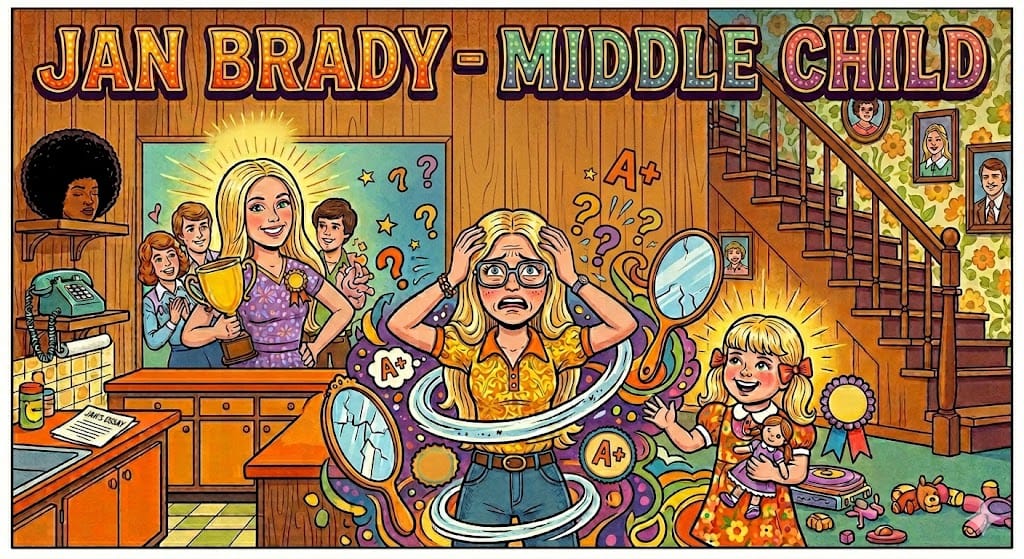
Jan Brady was the only person in that house who wasn't a biological automaton programmed to smile at all times. While Marcia moved through life with the unearned confidence of a girl whose hair had its own fan club, Jan was left to simmer in the flyover country of the birth order. She was the grit in the gears of a machine that produced nothing but moral platitudes and backyard AstroTurf. Marcia got the trophies, Cindy got the lisp-induced immunity, and Jan got a front-row seat to her own obsolescence.
The George Glass incident wasn't a teenage whim. It was the frantic action of a girl drowning in plain sight. If the real world wouldn't look at her, she’d build a better one out of thin air and hope no one noticed the imperfections. She bought a black curly wig just to see if a different silhouette would register on her parents' radar, only to find that in the Brady house, you were either the eldest or an extra. Mike and Carol navigated the hallways like they were reading from a teleprompter that only Jan could see, their parental instincts replaced by a series of architectural analogies and benign neglect.
She spent years watching Marcia’s shadow grow long enough to swallow the entire living room. Every decent grade Jan earned was just a footnote to a Marcia milestone. Every attempt at an identity was met with the kind of distracted nodding you give a waiter when you're waiting for the real food to arrive. Jan wasn't just bitter; she was the only one paying attention. She lived in a world where her vision was literally failing her—she refused to wear those glasses—because the reality of her situation was too blurry and cruel to see in high definition. She sat in that shared bedroom, staring at the ceiling, waiting for the day the set would finally be struck and she could walk off into a world that didn't demand she be a backup singer for her own sister.
Tim
Tim Lowe is a writer, book expert, retired sailor, retail worker, and renaissance man.
He is currently traveling the country and working on his forthcoming book.