How Fascist Dictators Actually Died: Crushing the Myth of Absolute Power

The thing nobody tells you about the twentieth-century dictator is that their entire existence is a gamble on the concept of permanence, and they almost always lose the bet in the most embarrassing way possible. If you build a political brand around the idea that you are a living god—an untouchable, marble statue of pure will who doesn't need to sleep or answer to anyone else —you are setting yourself up for a terrible final act. Because human biology is completely indifferent to your propaganda department. History shows us that fascist regimes don't wind down like a normal, boring democracy. They don't have a transition team or a library groundbreaking. They end with a sudden, violent thud, usually in a ditch or a basement, while the rest of the world watches on television with a mix of horror and profound exhaustion.
Let’s start with Benito Mussolini, because his exit is the absolute blueprint for what happens when the theater of fascism completely collapses. For over twenty years, this guy was Il Duce. He spent his afternoons posing with a chin stuck out so far it looked like an architectural feature, telling the Italian public that he was going to rebuild the Roman Empire. But by April 1945, the Allied forces are moving up the peninsula, the local partisans are everywhere, and Mussolini’s grand empire has shrunk down to the size of a villa in northern Italy. So, what does the living god of Rome do? He doesn’t lead a glorious, tragic cavalry charge into the history books. He puts on a German military overcoat that’s three sizes too big, shoves a Luftwaffe helmet over his face, and hides in the back of a retreating convoy truck like a teenager trying to sneak into a drive-in theater. It didn't work. Some communist partisans pull the truck over near Lake Como, look under the helmet, and realize they’ve caught the guy who started the whole corporate-state experiment. They take him out to a stone wall the next day and shoot him.
But the real cultural shift happens twenty-four hours later in Milan. The partisans dump Mussolini’s body, along with his mistress and a few other party loyalists, into the middle of the Piazzale Loreto. This is the exact same square where the fascists had executed fifteen partisans a year earlier, so the crowd that gathers isn't exactly in a forgiving mood. They beat the corpses, they throw things at them, and eventually, to keep the crowd from completely disintegrating the remains, the local police hang them upside down from the metal girders of a half-built Standard Oil gas station. There is a strange, dark irony to that. You spend your whole life trying to become Julius Caesar, and you end up looking like a side of beef dangling from an American oil company's roof while people eat sandwiches below you. It was the ultimate de-mythologization. He was no longer a leader, he was a gnarly roadside attraction.
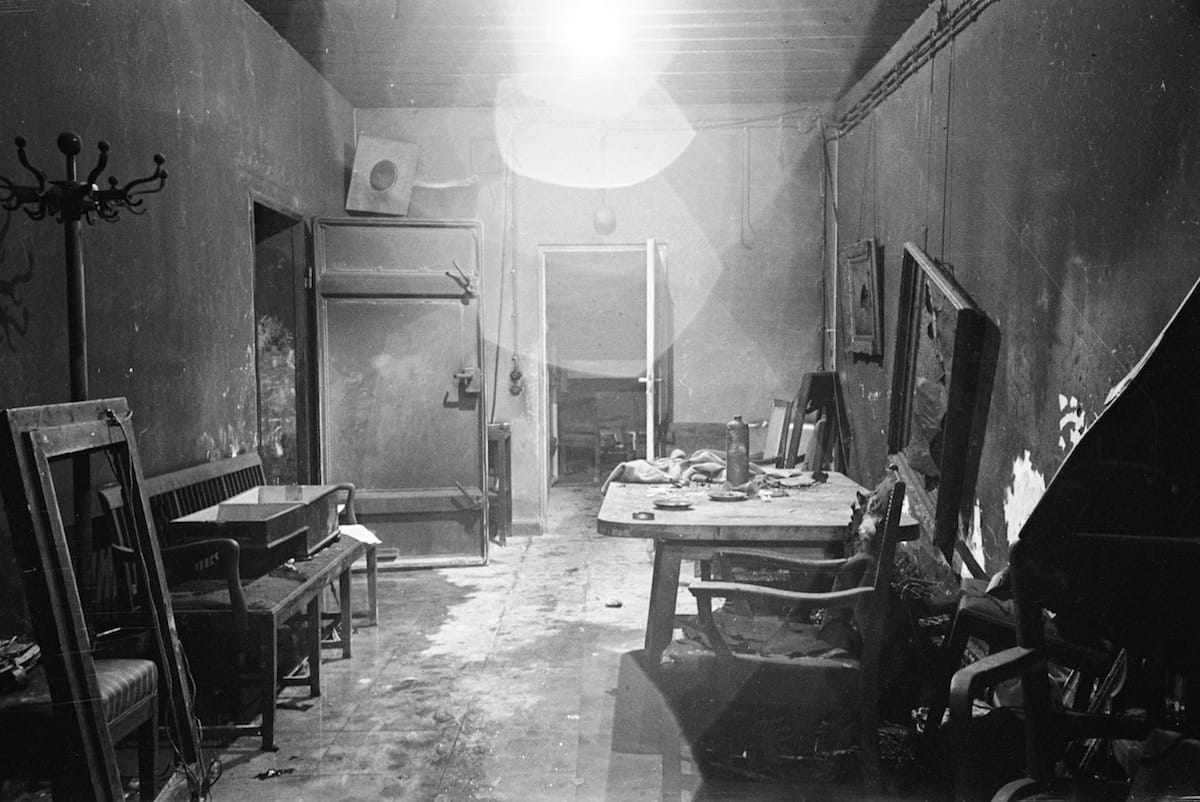
Adolf Hitler saw what happened to Mussolini, and it terrified him more than the entire Red Army. Mussolini’s death was a public performance; Hitler chose total cognitive isolation. By the end of April 1945, he’s living fifty feet beneath the Berlin pavement in the Führerbunker, which is basically a highly reinforced concrete subterranean apartment complex. If you look at the accounts of Hitler’s final days, it reads like the backstage diary of a rock band whose tour has gone horribly wrong. He’s suffering from massive tremors, his skin is gray, and he’s spending hours staring at maps of cities that have already been flattened, commanding military divisions that literally do not exist anymore. He is totally untethered from reality, which is the inevitable logical conclusion of living inside your own cult of personality for twelve years. On April 30, with Soviet troops literally close enough to hear them digging through the debris upstairs, Hitler and Eva Braun go into their private sitting room. Braun takes cyanide, and Hitler shoots himself in the head.
But the most telling part is what happens next. Hitler’s staff didn't leave the body out for a monument. They carried the corpses up to a bleak, shell-cratered garden, poured two hundred liters of gasoline over them, and set them on fire while Soviet artillery was raining down on the city. They burned him until there was almost nothing left, then buried the ash in the mud. Think about the psychological displacement required there. The Third Reich was supposed to last for a thousand years; it ended up lasting twelve, and its creator’s final act was ensuring that his physical body was turned into carbon before anyone else could look at it. It’s the ultimate act of historical cancellation. He didn't want to face the reality of his own defeat, so he took himself out.
Then you have Francisco Franco in Spain, who is the weird outlier in the fascist ecosystem. Franco looked at Hitler and Mussolini, decided that getting involved in a world war was a bad business model, and managed to keep his dictatorship running all the way into the mid-1970s through a mix of ruthless internal repression and Cold War utility to the United States. Because he didn't lose a war, Franco didn't get a dramatic ending. He got the worst thing that can happen to an aging autocrat: the slow, agonizing, highly medicalized intervention of the state. By October 1975, Franco has Parkinson’s, his heart is failing, and he’s experiencing a series of massive coronary events. In a normal world, an eighty-two-year-old man in that condition is allowed to slip away. But in a fascist state, the leader is the state. If Franco dies before the succession plan is locked down, the whole apparatus risks falling apart. So, a team of doctors essentially turns him into a science experiment. They keep him alive for weeks on artificial ventilation, pumping him full of blood transfusions, performing invasive operations on a body that is already functionally dead. He finally dies on November 20, 1975. They bury him in the Valley of the Fallen, this massive, ominous basilica that he forced political prisoners to carve out of a mountain. For forty years, he lies there under a giant stone slab, the last fascist. But history has a very long memory. In 2019, a democratic Spanish government decided they were done hosting a tourist attraction for dead authoritarians. They brought in a crew, lifted the stone, exhumed Franco’s remains, and moved him to a boring, private family plot next to his wife. It took forty-four years, but the democracy eventually caught up with him. It proves that even if you manage to die in a bed surrounded by doctors, you don't get to control the narrative once you're gone.
For the second-tier dictators—the guys who rode the coattails of the major regimes—death came with a gavel and a clipboard. Look at Ion Antonescu in Romania or Vidkun Quisling in Norway. These guys weren't mythic figures; they were regional branch managers for a larger corporate evil. When the war ended, the newly restored governments didn't hang them from gas stations or let them burn in gardens. They put them through standard, somewhat tedious legal trials. They read the indictments, they brought out the evidence binders, and then they marched them out to prison yards and shot them via firing squad. There is something inherently un-fascist about a trial. The whole point of fascism is that the leader’s word is the law. Being forced to sit in a wood-paneled room while a prosecutor reads your tax records and war crimes out loud is the ultimate demotion. It reduces the terrifying dictator back down to what he always was: a criminal with a title.
When you look at the whole trajectory, the lesson of twentieth-century fascism isn't that these men were invincible monsters. It’s that they were uniquely fragile. Because their entire system is built on the illusion of absolute strength, they cannot handle a single loss. A democracy can lose an election or an economy can crash, and the system changes shape and keeps moving. But when a fascist leader loses his grip, the whole reality machine shatters. Whether it’s an upside-down hanging in Milan, a gasoline fire in Berlin, or an eviction notice from a state monument in Madrid, the end is always a reminder that the statue you built of yourself was always made of clay.