The Arrogance of the Superman: Leopold, Loeb, and the Fatal Flaw of the "Perfect" Crime (Part 1)

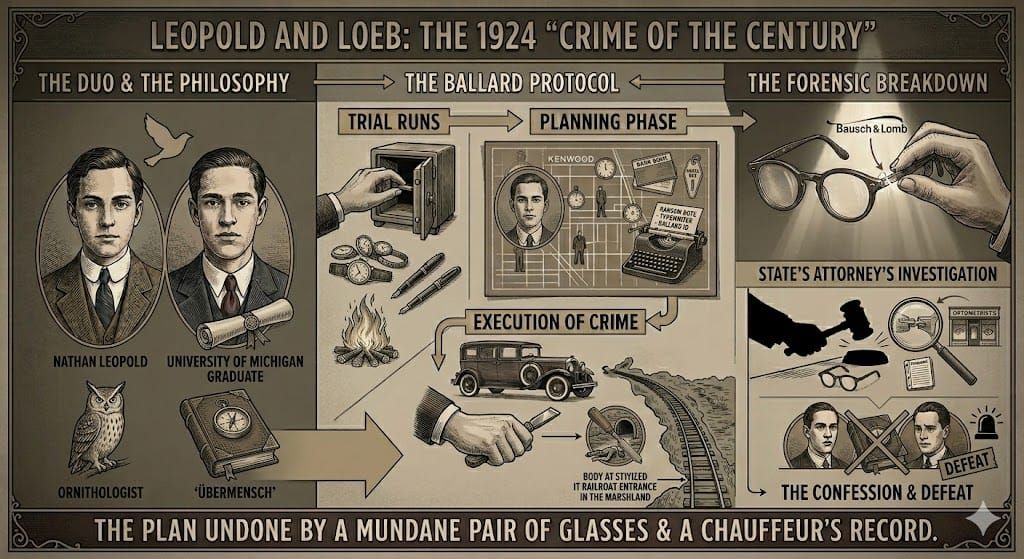
In 1924, Chicago was defined by the physical distance between the South Side’s industrial centers and the private wealth of the Kenwood district. Nathan Leopold and Richard Loeb lived within a self-contained social ecosystem where high IQ and significant inherited wealth created a total detachment from the city’s legal and social norms.
Nathan Leopold was a nineteen-year-old ornithologist who approached his environment through a strictly taxonomic lens. He viewed human interaction as a data-gathering exercise. Richard Loeb, eighteen, was his social counterpart—the youngest graduate in the history of the University of Michigan with a personality designed to navigate elite social circles. Their relationship was centered on a specific interpretation of Friedrich Nietzsche’s Übermensch. They operated under the belief that their intellectual status exempted them from the laws governing the general population.
The Ballard Protocol
Their progression into violent crime began with a series of trial runs. They broke into fraternity houses to steal fountain pens and watches to test their ability to remain undetected. They set fires in empty lots to observe the emergency response of the Chicago Fire Department. These acts served as proof of concept for their logistical immunity.
By the spring of 1924, they initiated a months-long planning phase for a kidnapping-murder. They evaluated several Kenwood teenagers based on their family's net worth and the predictability of their daily routines. Bobby Franks, a fourteen-year-old neighbor, was selected because he was walking home from a baseball game at the specific time their plan required a target.
To facilitate the abduction, they established a false identity. The "Morton D. Ballard" alias was supported by a bank account, a hotel residency, and a rented Willys-Knight automobile. They purchased a portable typewriter and developed a stuttering typing style to prevent the ransom note from being mechanically linked to the machines in their homes.
On May 21, 1924, they invited Bobby Franks into the car to discuss a tennis racket. As Leopold drove toward the marshlands near Wolf Lake, Loeb killed the boy with a chisel. They placed the body in a railroad culvert, obscured the physical features with hydrochloric acid, and returned to the Leopold mansion for dinner.
The Ransom Logistics
The $10,000 ransom demand was the primary focus of the evening. Jacob Franks, the boy's father, was forced to follow a precise timeline. He received a series of phone calls from an individual identifying himself as "George Johnson." These calls directed him to a pharmacy, then to a specific seat on a Michigan Central train, and finally to a signal flag near the 63rd Street station. Instructions were concealed in cigar boxes at various points along the route. For Leopold and Loeb, the coordination of the father’s movements was the central objective of the crime.
While the city mobilized a search, the two men remained in their social circles. Leopold discussed the case with law school colleagues, theorizing on the potential errors made by the killers. However, they had overlooked a physical variable. While moving the body, a pair of horn-rimmed spectacles fell from Leopold’s pocket. The glasses contained a patented "Bausch & Lomb" hinge sold by a single Chicago optometrist, Almer Coe. Only three individuals in the city had purchased that specific frame.
The Forensic Breakdown
State's Attorney Robert Crowe identified the glasses within days. When brought in for questioning, Leopold provided an alibi involving a night of driving in Lincoln Park. This claim was directly refuted by the Leopold family chauffeur, who produced a maintenance log showing the car was in the garage for repairs on the night of the murder.
In the interrogation room, Leopold reacted with clinical disbelief rather than remorse. He analyzed the evidence as an intellectual failure. Loeb was the first to confess, followed by Leopold; both men attempted to shift the physical act of the murder onto the other. The plan had been undone by the mundane specifics of a chauffeur’s record and a hinge on a pair of glasses.
Tomorrow: The trial.