
The Lost Founder


James Wilson and the Forgotten Fight for a People's Constitution
James Wilson stands as a haunting paradox in the American narrative: he was an architect of the nation’s foundation, yet his name remains largely absent from the common litany of the Founding Fathers. A brilliant legal mind and a fierce intellectual combatant, Wilson helped frame the very bedrock of the United States. His life was a dramatic ascent from humble beginnings to the pinnacle of revolutionary power, followed by a tragic, precipitous decline into obscurity and disgrace. In The Lost Founder, author Paul Wegman rescues this essential figure from the shadows, presenting a compelling portrait of a man whose prescient vision for American democracy feels strikingly urgent in our own fractured time.
Born in Scotland, Wilson arrived in the colonies on the eve of revolution, an immigrant who would eventually grasp the meaning of American liberty more clearly than many of his peers. While others debated the nuances of colonial rights, Wilson took a bold, early stand for independence. In a celebrated essay, he laid out a rigorous case for the sovereignty of the American people, articulating concepts that would soon echo through the halls of history. It was Wilson’s profound belief in the dignity of the individual that arguably helped shape the intellectual atmosphere from which the famous words “We hold these truths to be self-evident, that all men are created equal” would emerge.
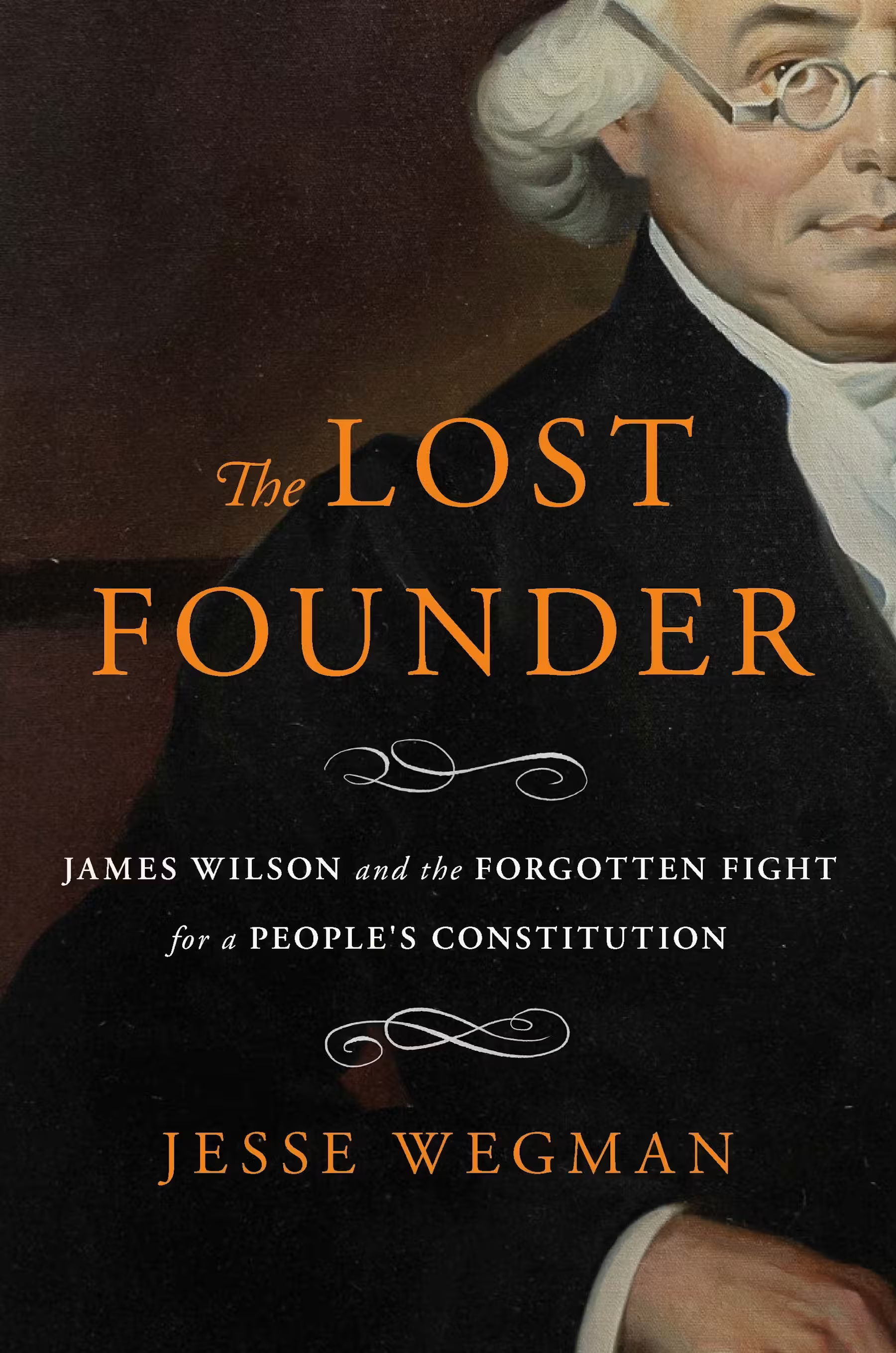
When the time came to secure the future of the new nation, Wilson was indispensable. He served on the Committee of Detail at the Constitutional Convention, tasked with the monumental burden of drafting the first version of the Constitution. While history has often spotlighted James Madison—the so-called "Father of the Constitution"—Wilson was an equal, and in many respects, a more radical force in those closed-door sessions. He was the most vocal advocate for the principle that the people—not the states, not the elites—were the ultimate source of all legitimate government power.
Wilson’s vision was ahead of its time. He argued for a strong, unified central government and a robust, independent presidency capable of executing the people’s will. Even more daringly, he fought for democratic mechanisms that his contemporaries were not yet ready to accept. He pushed for a direct, popular vote for the President and for the members of the Senate, envisioning a system far more democratic than the one that ultimately emerged. Had his colleagues listened, the American political landscape might have evolved into a more direct reflection of the public will much earlier in our history.
Yet, Wilson’s brilliance was matched by a profound personal and professional volatility. His life was undone not by his political enemies, but by his own restless, reckless ambition. Caught up in the speculative fervor of the late 18th century, Wilson entangled himself in massive land deals that eventually collapsed under the weight of debt and financial mismanagement. As a justice on the first Supreme Court of the United States, he found himself a fugitive from his own creditors, forced to live in a state of constant, undignified flight to avoid imprisonment. The end was as grim as his rise had been meteoric: he died of malaria in the back room of a small North Carolina tavern, alone and hiding from the men who sought to hold him to account.
Because of this ignominious fall, Wilson was effectively purged from the sanitized pantheon of American history. He became a cautionary tale, a brilliant mind relegated to the footnotes. Wegman argues that this omission is a grave error. The Lost Founder does not shy away from the scandals that defined Wilson’s final years, but it insists that those failures should not overshadow the substance of his contributions. Wilson was a complicated, flawed, and profoundly human figure, but he was also the most visionary patriot of his era.
By re-examining Wilson, Wegman highlights the relevance of his ideals in a modern era marked by institutional distrust and political alienation. Wilson believed in an America that was held together by the strength of its citizens' commitment to one another and to the integrity of their government. His story is a poignant reminder that the foundations of our democracy were laid by people as fallible as we are, yet capable of forging a framework meant to last for ages. To remember James Wilson is to remember the boldest aspirations of the American project, and perhaps, to find a clearer path toward fulfilling them.