The Mitigation Strategy: Clarence Darrow and the Invention of the Modern Defense (Part 2)

The legal reality for Leopold and Loeb was defined by the public mood of 1924 Chicago. State’s Attorney Robert Crowe possessed a complete confession, physical evidence linked to the defendants, and a motive rooted in cold intellectual vanity. Under Illinois law, the standard outcome for the premeditated murder of a minor was the gallows. The families of the defendants responded by hiring Clarence Darrow, a man whose career was built on defending the unpopular and the condemned.
Darrow’s first move was a tactical withdrawal. He discarded the possibility of a "not guilty" plea. A jury trial in Cook County would have functioned as a public theater for Crowe’s evidence, likely ending in a death sentence driven by community outrage. Instead, Darrow entered a plea of guilty. This bypassed the jury entirely and placed the fate of the defendants in the hands of a single man: Judge John R. Caverly. The objective shifted from proving innocence to a clinical argument for mitigation.
The Psychiatric Audit: Hulbert and Bowman
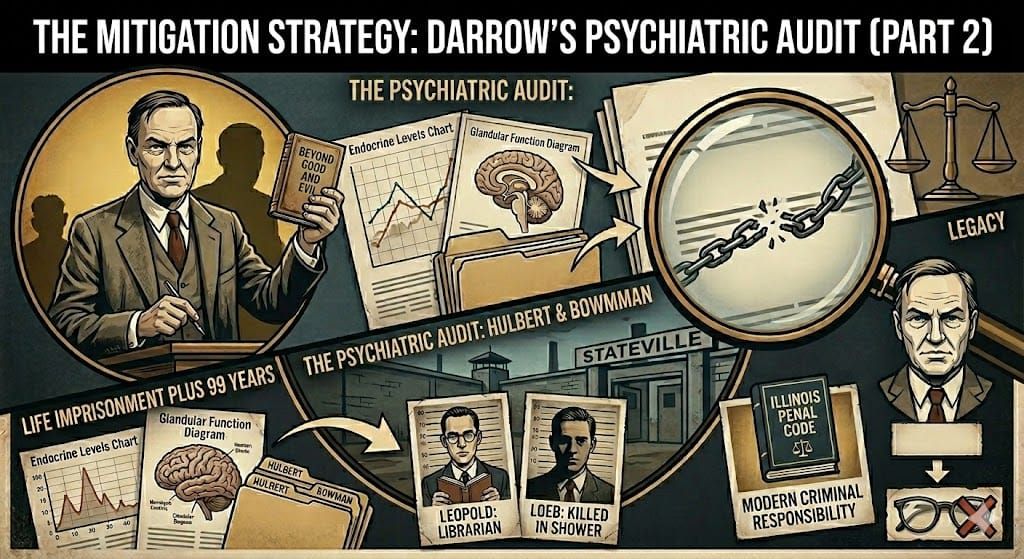
The defense was built on the introduction of "mitigating circumstances." Darrow did not argue that the defendants were insane in the legal sense—that they were unable to distinguish right from wrong. Instead, he argued that their mental state was "diseased." He commissioned a team of alienists, including Dr. Harold Hulbert and Dr. Karl Bowman, to conduct a granular audit of the defendants' upbringings and biological predispositions.
The resulting "Hulbert-Bowman Report" was a document of unprecedented scope in an American courtroom. It didn't focus on the night of the murder, but on the decades preceding it. The alienists conducted physical examinations to check for endocrine imbalances, metabolic rates, and glandular functions. They were searching for a biological cause for the defendants' lack of empathy. They mapped Leopold’s history of social isolation and his obsessive-compulsive tendencies, and they documented Loeb’s pathological need for excitement, which they traced back to the influence of a governess who monitored his every move.
This was the first time psychiatric testimony was used to explain the mechanics of the mind rather than to prove a total break from reality. Darrow presented the defendants as being in a state of "arrested emotional development." While their IQs were in the top percentile, their emotional responses were categorized as those of children. This discrepancy was the core of the mitigation argument.
The Deterministic Framework
Darrow’s argument was rooted in the philosophy of determinism. He held the view that human behavior was the inevitable result of heredity and environment. In the courtroom, he presented the defendants as products of forces they could not control. He argued that Leopold’s obsession with Nietzsche and Loeb’s obsession with detective stories were the results of their specific biological and social configurations.
This approach was an assault on the traditional legal concept of free will. Crowe countered by arguing that if every criminal was merely a product of their environment, the legal system would cease to function. He presented the crime as a choice made by two highly intelligent men who believed they were above the law. The trial became a debate between the old-world view of moral responsibility and the new-world view of psychological conditioning. Darrow argued that the environment of extreme wealth and intellectual pressure in Kenwood had produced a "poisonous growth" in the minds of the boys.
The Tactical Use of Precedent
To provide Judge Caverly with a legal "exit," Darrow and his team performed an exhaustive search of Illinois sentencing records. They presented the judge with data showing that in the history of Cook County, no teenager who had pleaded guilty to murder had ever been executed. Darrow was providing Caverly with the statistical cover necessary to avoid the death penalty without appearing to be soft on the defendants.
He reinforced this with a technical analysis of the Illinois penal code. He argued that the purpose of the law was not simply retribution, but the protection of society and the potential for rehabilitation. By pleading guilty, the defendants had surrendered their right to a trial, and Darrow argued that this act of submission should be met with a sentence of life imprisonment rather than death. He was framing the decision as a choice between a primitive urge for blood and a modern, enlightened application of the law.
The Closing Argument
The summation lasted twelve hours. Darrow did not focus on the evidence of the crime, which he had already conceded. He focused on the history of capital punishment. He spoke to the judge as a representative of a maturing civilization. He described the gallows as a tool of vengeance that had no place in a modern society.
He invoked the age of the defendants, pointing out that at eighteen and nineteen, they were still legally and biologically in a state of development. He cited the psychological reports to show that while their IQs were high, their emotional maturity was stunted. The argument was an analysis of the futility of the death penalty. Darrow wasn't asking for mercy in the emotional sense; he was asking for a sentence that aligned with the deterministic view of human behavior.
The Caverly Ruling
On September 10, 1924, Judge Caverly delivered the verdict. He acknowledged the horror of the crime and the validity of the state’s evidence. However, he also noted the youth of the defendants and the precedent against executing teenagers who had pleaded guilty. He sentenced Nathan Leopold and Richard Loeb to life imprisonment for the murder, plus ninety-nine years for the kidnapping.
The gallows were avoided. Darrow had shifted the legal standard from the act itself to the mind behind the act. The trial of Leopold and Loeb did not change the facts of what happened at Wolf Lake, but it fundamentally altered the way the American legal system processed the relationship between psychology and criminal responsibility.
The Long-Term Trajectory: Joliet and Stateville
The sentencing was not the end of the data set. The lives of Leopold and Loeb following the 1924 verdict provide the final analysis of Darrow’s "mitigation" theory. They were moved to Joliet Prison and later to the Stateville Penitentiary. In prison, the two men who had viewed themselves as "supermen" were forced into a strictly regulated environment where their intellectual status provided no structural advantage.
Richard Loeb’s trajectory ended abruptly in 1936. Despite his charm and his ability to navigate social hierarchies, he was unable to manage the internal politics of Stateville. He was killed in a prison shower by another inmate, James Day, who claimed Loeb had made unwanted sexual advances. Day was later acquitted on grounds of self-defense. Loeb’s death was a violent conclusion to a life that had been defined by a search for sensation and a disregard for the agency of others.
Nathan Leopold’s path was more complex. He became the prison’s librarian, reorganized the education system, and worked in the prison hospital. During World War II, he volunteered for the Stateville Penitentiary Malaria Study, allowing himself to be infected with the disease to test experimental treatments. He approached his incarceration with the same taxonomic discipline he had once applied to ornithology.
Leopold was paroled in 1958, after serving thirty-three years. He moved to Puerto Rico, where he earned a master’s degree, taught at the university level, and worked for the Brethren Service Commission. He died in 1971. His post-prison life is often cited by legal scholars as proof of Darrow’s argument regarding the capacity for rehabilitation, though Leopold himself remained a deeply analytical and somewhat detached figure until his death.
The Legacy of the 1924 Verdict
The case of Leopold and Loeb remains a foundational data point in American jurisprudence. It marked the moment the legal system was forced to integrate the emerging science of psychology into the sentencing process. The trial didn't just save two men from the gallows; it dismantled the idea that a crime can be analyzed in isolation from the mind of the perpetrator.
The story ends not with a "perfect crime," but with a series of mundane realities: a pair of dropped glasses, a chauffeur's log, and a half-century of institutionalization. The "Superman" philosophy was ultimately defeated not by a superior intellect, but by the steady, clinical application of the law and the passage of time.