
Our World in Ten Buildings

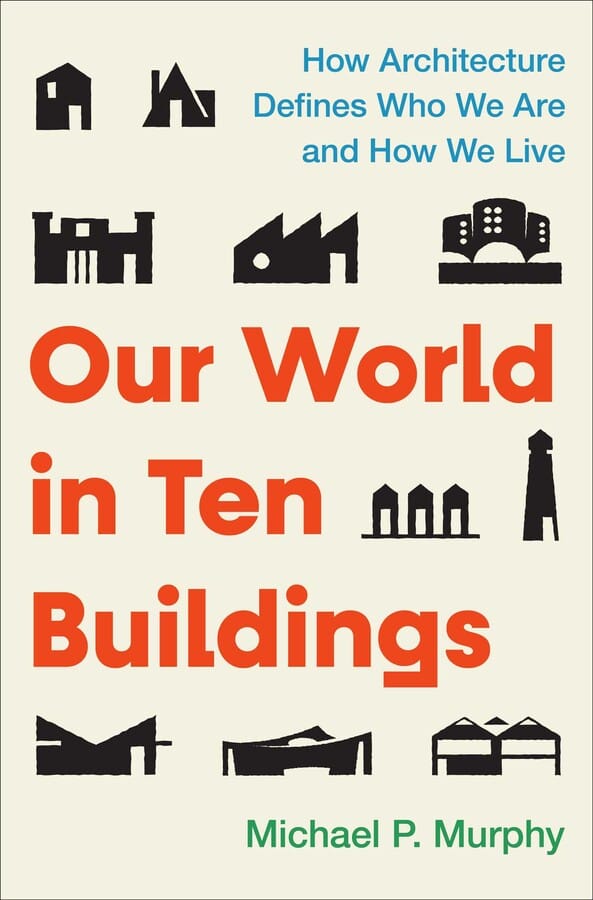
How Architecture Defines Who We Are and How We Live
Walk into any room and ask yourself a question you've probably never thought to ask: why does this space feel the way it does? Why does the ceiling height make you want to whisper or shout? Why does the hallway make you want to hurry past, and the courtyard make you want to linger? Most of us move through buildings the way we move through weather—as something that simply happens to us, rather than something anyone chose. Our World in Ten Buildings, the new book from architect and author Michael Murphy, argues that this passivity is exactly the problem, and it sets out, with clarity and conviction, to fix it.
The book opens with a quiet provocation: we have been taught to think of thoughtful, purposeful design as a luxury good. A beautifully proportioned library, a hospital that actually calms the people inside it, a school building that seems to invite curiosity rather than suppress it—these, we assume, are the province of the wealthy, the well-connected, the fortunate few who can commission an architect the way others might commission a painting. Murphy dismantles that assumption in the first chapters and never lets it back in. Every space we occupy, he insists—rich or poor, urban or rural, celebrated or forgotten—was designed by someone, for some purpose, with some set of values baked into its walls. The only real choice we have is whether we understand those values or remain oblivious to them.
That argument would be interesting as pure theory. What makes Our World in Ten Buildings genuinely compelling is that Murphy doesn't argue from theory alone. He argues from the inside. As the founder of a globally recognized architectural practice, he has spent his career designing memorials, hospitals, schools, and civic spaces that sit at the exact intersection of politics, health, and human dignity. Ten of these projects form the spine of the book, and through them Murphy takes readers somewhere very few architecture books ever go: behind the renderings and the ribbon-cuttings, into the rooms where decisions were actually made—and unmade, and fought over, and remade again.
This is where the book distinguishes itself from the genre it belongs to. Architecture writing often falls into one of two traps. Either it becomes a hagiography of famous buildings, all soaring photographs and reverent captions, or it becomes so technical that only practitioners can follow it. Murphy avoids both. He writes as a working architect who has sat across the table from grieving families, public health officials, government bureaucrats, and community members who didn't ask to have their neighborhood redesigned but will live with the consequences regardless. He is candid about the compromises, the politics, and occasionally the failures embedded in even his most celebrated projects. That honesty is rare, and it's what gives the book its authority. This isn't a victory lap. It's a working architect's field notes from the messy, contested, deeply human process of deciding how the built world should function.
The ten buildings themselves become a kind of survey course in the hidden curriculum of design. Through them, Murphy shows how the placement of a window can affect a patient's recovery time, how a memorial's geometry can shape a nation's willingness to reckon with its own history, how a school's layout can either reinforce a hierarchy or dissolve one, and how the built environment has, for over a century, played an active and often underappreciated role in public health—sometimes protecting us from disease, sometimes accelerating its spread. These aren't abstract case studies plucked from architectural history for illustrative convenience. They are Murphy's own projects, meaning readers get something closer to a memoir of professional conscience than a textbook.
That braiding of personal narrative and architectural history is the book's real innovation. Murphy moves fluidly between explaining how, say, nineteenth-century sanitation reform reshaped urban design and describing the specific afternoon he stood in a half-built structure and realized the design needed to change to serve the community using it. The history illuminates the present project; the present project brings the history to life. Readers come away not just with facts about architecture but with a genuine intuition for how design decisions get made—and who gets to make them.
That last question—who gets to make them—runs underneath the entire book like a current. Murphy is not shy about the political dimension of his work. Buildings encode assumptions about whose comfort matters, whose safety is prioritized, whose history is honored, and whose labor is made invisible. A hospital designed without input from the nurses who staff it will function differently than one designed with them. A memorial built without consulting the descendants of those it commemorates tells a different story than one built in partnership with them. Murphy treats these as design problems as real as load-bearing walls, and he shows, project by project, what happens when they're taken seriously and what happens when they aren't.
For all its intellectual ambition, Our World in Ten Buildings remains remarkably readable. Murphy writes with the instincts of a storyteller, not just a professional explaining his trade. Each chapter has the pacing of a story worth telling—stakes, obstacles, turning points—rather than the flat chronology of a portfolio review. It's the kind of book you can hand to someone with no background in architecture and watch them come away newly attentive to the world around them, and it's equally the kind of book that design professionals will find themselves underlining.
Perhaps the highest compliment you can pay a book like this is that it changes how you see something you look at every single day. After reading it, you may find yourself noticing the width of a sidewalk, the height of a ceiling, the placement of a bench, and asking, for the first time, what someone intended by it. That shift—from passive occupant to informed observer—is exactly what Murphy is after. Our World in Ten Buildings makes the case, convincingly and with real feeling, that the spaces shaping our lives are not neutral, not inevitable, and not someone else's concern. They are everyone's inheritance, and understanding them is the first step toward demanding better ones.
For readers curious about architecture, public health, urban policy, or simply the quiet forces that shape daily life, this book offers a rare combination: the sweep of history, the intimacy of memoir, and the urgency of a call to pay closer attention. It's a book that respects its readers enough to show them the seams—the compromises, the politics, the hard-won victories—rather than presenting architecture as effortless genius. In doing so, Murphy gives us something more valuable than admiration for beautiful buildings. He gives us the tools to ask better questions about every space we will ever enter.