
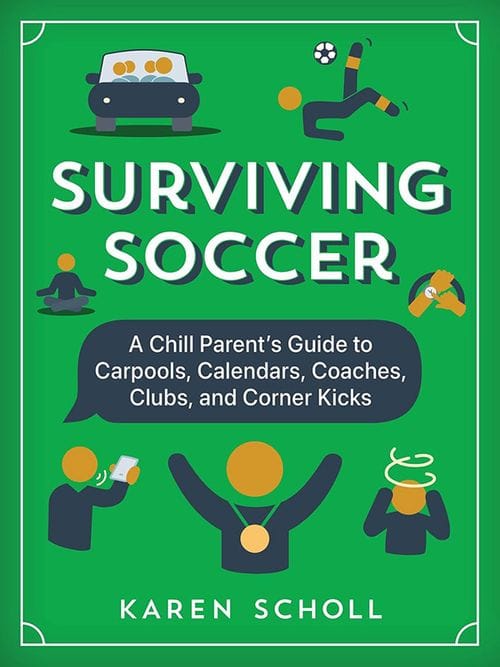
Author Karen Scholl


You talk about the "youth sports industrial complex" in the book. When did it finally click for you that "Elite" is just a marketing buzzword used to separate parents from their money rather than a real description of how an eight-year-old plays?
As someone who’s worked in marketing for 30 years, I’m embarrassed to say that I was pretty far down the path with my kids before I started to see through the jargon. But we didn’t sign up for club because we thought our kids were going to be elite players. We made the move with each kid when they told us their rec program wasn’t challenging or rigorous enough. They loved soccer and wanted to play more and have real coaches—not just someone’s mom or dad who got suckered into the commitment.But over the years I did start to notice how terms like “elite” were super-vague. It felt like a lot of families surfed from club to club trying to find the best one. The few times we considered moving, I checked out their websites and all you have to judge them by are how well they spin buzzwords.
Every sideline has that weird, unspoken social ladder. How do you keep your head down and avoid the groupthink without becoming the person everyone whispers about at the neighborhood block party?
I talk about this with a diagram included in Surviving Soccer—about what you can learn about a parent based on where they sit. More years than not, I stayed what I called “socially distanced.” So I’m pretty sure I was the one they whispered about. Either because I didn’t join in with the screaming at the kids or the refs, or because I didn’t socialize with them. The moment I realized I didn’t have to attend those team dinners at sports bars where it’s crowded and noisy and the parents drink too much and the kids are unsupervised, I stopped going. So, I was a bit of an outcast, especially once I had my soccer-parent legs under me.It did help when I found another parent on the team I could be friends with. Maybe I just didn’t feel as much like an outcast then? But more often than not, I did keep my head down—well, focused on the game, or in a book. I tried to sit pretty far down the sideline, or, during high school, in a different part of the stands, from the noisiest parents. I decided my sanity was more important than my popularity.
You focus a lot on the administrative nightmare of being a soccer parent. In all your digging, did you find that a more complicated registration process usually leads to better coaching, or is it just more paperwork for the sake of paperwork?
The only time where I was overwhelmed with paperwork was when I got suckered into being the team admin. Getting copies of everyone’s birth certificates, club forms, liability waivers, tournament applications, and player cards nearly made me lose my mind. But in terms of just registering for the season, maybe I’ve blacked that part out, but there wasn’t too much to do. I certainly don’t remember it correlating with coaching.
We’ve all dealt with a "Kaylee’s Dad." How did you manage to stay honest about those personality clashes while knowing you still have to run into these people in the produce aisle at the local market?
I think “honest” is the operative word here. As much as I could, I tried to just be nice. If I didn’t think I could do that, I tried to make sure I was never sitting next to them at a game. Here’s where my habit of keeping a book with me at all times helped. It doesn’t block sound, but it usually keeps people from talking to you. Occasionally, if I was at a game without my husband, I’d put earbuds in and listen to music while I watched the game, drowning out the things the parents were yelling at the field or even saying to each other.I did get mad at another mom once, very early in my soccer parent career. I’d been sitting at a game with my mom, chatting, catching up on my kids’ lives. I told her a story about something that happened to my son at school, something not great. I just wasn’t thinking about how other parents on the sideline could hear me. After the next practice, my son said that one child, the one he always butted heads with, said something really mean to him, which had come out of the story I’d told my mom. Next time I saw that kid’s mother, I told her what I thought of her overhearing something and then sharing it with her son—mind you, the boys were maybe 10 years old at the time. She started screaming at me and I have avoided her ever since.
The book covers the prep work, but let’s talk about the car ride home. How do you handle that "debrief" when the kid is thrilled but the adults are just shell-shocked from the logistical mess of the morning?
Actually, the car ride portion was what inspired me to write my book—the car ride there and the ride home. Rides after games usually started with my kid re-living two or three plays, but then we’d settle into everything else—school, friends, weird life questions. I wrote a separate article called Driving Is the New Dinner, because, well, it was true. And then part of that made it into the book. Instead of dreading all the driving, I really valued car time with them—especially when they’d tuck their phones away, always a huge win for me.
You mention the cost doesn't always equal the benefit. What is the big red flag that tells a parent they’re paying for a dream the club is selling rather than something their kid is actually getting out of it?
One year when I was the admin, one of the other moms, who was newer to club soccer, made a comment to me about how they’d decided to go the club route—pay such high fees—because it would pay off when the kid got a college scholarship. Now, I don’t know if the club sold her that or she just came into it with that belief, but it’s not that uncommon. And yet the reality of kids actually playing in college, let alone getting a scholarship, is super-rare. So, clubs that promise that, well, that’s a red flag to me.That being said, I think as parents we need to rethink what it is we want our kids to get out of the experience—because for most, it’s not a path to the pros, or even college. But my kids learned so many amazing life skills, all while they were playing a game they loved.For example, I’ve heard parents say it’s wrong for kids to try out and get cut or get put on different teams, where some are considered better than others. My kids, now in their 20s, are comfortable with reaching for things and being ok if they don’t get it. They can appreciate someone who’s better than them—whether that’s soccer or in the field they work in. Another example: Each one was at times the star of his team and a leader, and at other times the kid who rode the bench. Both scenarios taught them so many life lessons.
There’s a specific suburban paranoia in your writing that feels a lot like The 'Burbs. Do you think this obsession with hyper-organized sports is just a way for parents to feel like they have some control over a world that feels increasingly chaotic?
Great question. I hadn’t thought of it that way, but yeah, it definitely could be. When I was in the thick of it as a parent, it didn’t seem so strange because that’s what everyone around me was doing, not just with sports, but with play dates and birthday parties and swim lessons and other hobbies. Basically any time our kids weren’t in the classroom we had something for them to do.Also, I’m a Gen X’er who grew up being kicked out of the house in the morning and coming home when the streetlights came on. My life was almost the complete opposite of what my kids experienced. Like them, I played soccer from Kindergarten through high school. But I have just as many, if not more, memories from playing pick-up games in my backyard with the kids on our street as I do from the actual teams I played on.
Your humor comes from just being blunt about how ridiculous this all is. Did you have any stories from your "field research" that were so over-the-top you actually had to cut them because they felt too unbelievable?
The craziest experiences that didn’t go into the book were mostly the bad, not funny.There was one mom on our team who let me know that she always had a gun on her. This was probably around 2015 or 2016. I remember being terrified to be anywhere near her. She also always had an infant with her. I later learned she was a police officer. Not sure if that made me feel better or not.There was a dad who was so upset with how his son played at practice—the boys were probably 8-9 years old—that he left him at the park. Just took off. A couple of us had to stay late with him and get a hold of the mom to come pick him up.My older son was on an “elite” team for a few years that traveled sometimes as far as 8-10 hours away by bus, and parents were discouraged to attend. One of his teammates broke his arm three different times—compound fractures. One arm, then the other, then back to the original, over the course of less than two years. I’m pretty sure I would have made my kid stop playing after the second break, if not the first—they were gruesome.Beyond that, some of the terrible things that parents yelled from the sidelines still make my stomach knot up. I don’t know what was worse, when they yelled at their kid, the coach, the ref, or my kid. But that ability (?) to just shout mean things to people doing their job still baffles me. I used to fantasize about going to their workplace and yelling at them for jamming the printer or reading the slides while they gave a presentation.
A lot of people become "Soccer Mom Zero" because they accidentally said yes to one small thing. What’s the move for a parent who wants to be helpful but is deathly afraid of being trapped on the travel committee?
Befriend the team admin. Because the admin is always swamped, and you can take one thing off their plate—or bring them a surprise latte when you pick up your drink before the game—and make them so happy. You can make their day and it lets them know that you know how much work they do.
The book ends on that high of leaving the final game. How do you deal with that immediate pressure to sign up for the winter league or the "seasonal withdrawal" that hits the second the trunk is finally empty?
That pressure is real. Though it usually starts mid-season, long before the last game. Who wants to sign up for indoor together? Who wants to split a private coaching session? Who wants to guest play for this other team at an away tournament the one weekend your team has off? There is the friendship aspect of this—your kid’s friends are doing it, and you don’t want yours to miss out. And also, the implied reasoning that if your kid wants to stay as sharp as everyone else, they need to do these extras as well. Ultimately, I tried to just listen to my kids. What they were saying and even what they weren’t. There were times when they were so hungry to play, so if we could swing it, we let them sign up. But there were times where I could just see how exhausted they were—physically from the season or emotionally from their teammates—which made it easier to say no thank you.While I was always relieved when the season came to an end, I always missed having the opportunities to watch my kids play the game they loved. Especially as kids get older, they don’t let us watch them do stuff anymore. And for my kids, soccer brought them to life in ways other things didn’t, so I always had a tinge of regret at the last game of the season. But then I’d quickly recover knowing that my car would be clear of stinky field socks and half-empty Gatorade bottles, at least for a few weeks.
Author website: https://www.karenschollwriter.com/