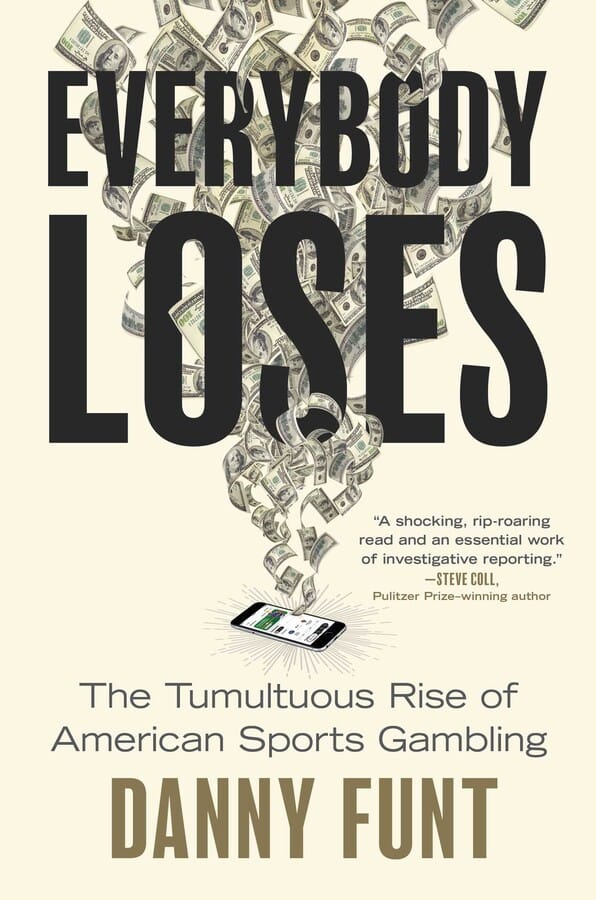
Everybody Loses


The Tumultuous Rise of American Sports Gambling
Look around you today and you will see a world that has completely shifted under our feet. Every commercial break, every pregame show, and every scroll through social media is now plastered with point spreads, prop bets, and oversized bonus offers. It feels like it happened overnight, but it was carefully designed. Danny Funt has stepped into this arena with Everybody Loses, delivering the first deep, unflinching look into the machinery of America's modern sports gambling complex. This is not just a book about people placing bets. It is a chronicle of a massive cultural engineering project aimed at turning a nation of casual sports fans into a nation of active gamblers. Funt didn't just watch from the sidelines; he got the people who built this machine to open up, and what they have to say is nothing short of staggering.
Think about the executives who run these massive sportsbooks. These are the public faces of a multi-billion-dollar industry, yet behind closed doors, the reality of what they are selling is incredibly cynical. Funt managed to get former executives to drop the corporate mask and admit the core truth of their business model. One of them openly admitted that the entire industry is built on selling an illusion. They are selling the idea that you can win, even though they know you can't. The math is rigged against the player from the start, but the marketing is designed to make you feel like a genius who is just one smart bet away from a massive payday. They track user behavior, slice the data, and adjust the experience to ensure that the house always maintains its crushing edge, all while projecting an image of fun, casual entertainment.
Then you have the VIP hosts, the ground troops in this war for the consumer's wallet. These are the people whose entire job is to manage relationships with the biggest players, which in this industry almost always means the biggest losers. Funt dives into the shadowy world of these hosts, who reveal the shocking lengths they will go to keep a losing gambler hooked. When a customer loses a fortune, the solution isn't to let them step away and cool down. Instead, the hosts swoop in with extravagant perks. They hand out free luxury hotel stays, front-row tickets to major sporting events, and massive digital betting credits. It is a psychological trap masquerading as premium customer service, designed specifically to ensure that the moment someone hits rock bottom, they are given just enough incentive to dig themselves even deeper.
The betrayal extends far beyond the gambling companies themselves, reaching into the highest offices of American sports leagues. For decades, the NBA, the NFL, the NHL, and Major League Baseball stood united against the legalization of sports betting, claiming it would destroy the integrity of the games we love. Funt exposes the hypocrisy of this stance by taking readers into the secret meetings where that resistance completely evaporated. He documents the exact moments when league executives sat down with data analysts and consultants to look at the numbers. Once they saw the staggering projection of just how much money their leagues stood to make through partnerships, data rights, and increased viewership, their moral objections vanished. The love of the game took a backseat to the sheer volume of cash on the table, and the leagues instantly pivoted from gambling's fiercest opponents to its biggest partners.
None of this could have happened without the political gears being greased, and that is where the lobbyists come into the story. Funt details the relentless political campaign that took place in state houses across the country. Lobbyists walked into rooms filled with skeptical politicians who were worried about the social costs of widespread gambling. Armed with promises of massive tax revenue and economic growth, these lobbyists systematically dismantled the opposition. They turned hesitant lawmakers into enthusiastic cheerleaders for the gambling industry, fast-tracking legislation with very little regard for the long-term consequences on public health or addiction rates.
What we are left with is a narrative that should deeply worry anyone who cares about sports, families, or the ethical fabric of our society. Everyone Loses shows us that the current landscape is not a natural evolution of fandom, but a manufactured dependency. The odds are stacked against the public, and the social fallout is only just beginning. Funt gives us the tools to finally understand why gambling is suddenly absolutely everywhere, and warns us that if we do not look closely at the damage being done, the problems trailing in its wake will soon spin completely out of our control.