
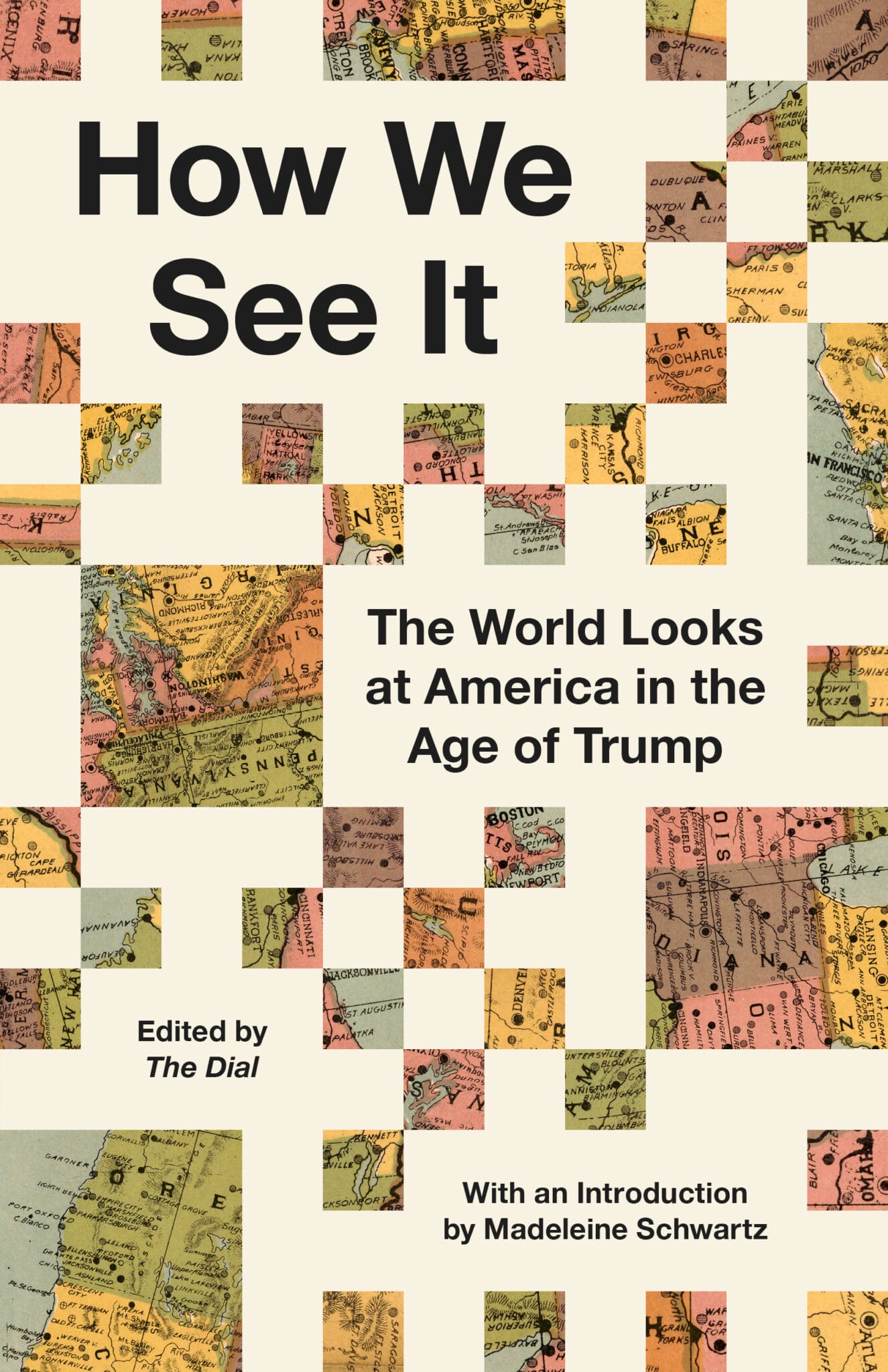
How We See It:


The World Looks at America in the Age of Trump
Edited by The Dial, published by The New Press
Living inside the American media bubble right now feels like being trapped in a group chat where everyone is shouting at the same time, the notifications never stop, and the main main character changes every five minutes. Ever since the 2024 presidential election wrapped up, the domestic news cycle has been running at a relentless, exhausting clip. It is easy to get so caught up in the local drama that we forget the rest of the planet is also watching this show, treating our political landscape less like an isolated civic event and more like a massive, unpredictable season finale that actively rewrites the rules of their own daily lives. Every policy shift, tweet, and cabinet appointment sends out a shockwave that distorts global trade, scrambles migration patterns, and alters the calculus of national security from Taipei to Buenos Aires.
That is where the new essay collection, How We See It, enters the conversation. Instead of relying on the usual cable news talking heads who view the entire world through a strictly Washington-centric lens, this anthology hands the microphone to twelve of the sharpest international journalists working today. Originally commissioned by the award-winning magazine The Dial, these writers offer a perspective that feels less like a sterile academic briefing and more like getting the real, unvarnished truth from a friend who just got back from living abroad. They step back from the immediate American outrage machine to ask a much bigger, more fascinating question: what happens when the rest of the world looks at the United States under the current Trump administration, and what does that view reveal about our collective future?
The answers they find are as varied and compelling as a prestige television lineup, jumping across borders to show how American influence operates on the ground. Take the essay on Turkey, which uses that country’s own recent political history as a dark, cautionary mirror for America’s current drift toward autocracy. It reads like a psychological thriller, charting how quickly democratic norms can erode when institutional guardrails turn out to be made of paper. Meanwhile, the scene shifts to Argentina, a country with a century-long, complicated obsession with the U.S. dollar, exploring how their economic survival tactics are mutating under the pressure of new American trade realities. It is a brilliant look at how a currency can become a cultural character in its own right, dictating the rhythm of everyday life thousands of miles away from Wall Street.
The collection also digs into the weirder, more personal friction points of global coexistence. One essay tackles the rising tide of anti-American tourism sentiment in Italy, exploring what happens when local culture collides with the relentless march of influencer-driven vacationing and changing political dynamics. Another writer takes aim at the bizarre myths and ideological projections that right-wing Americans frequently map onto South Africa, dismantling those talking points with the casual precision of a seasoned critic deconstructing a poorly written script.
The stakes get remarkably high when the collection turns its attention to geopolitical flashpoints. The essay on Taiwan reads with the white-knuckle tension of a political drama, capturing the quiet anxiety of a nation trying to decode the ambiguous, transactional foreign policy signals coming out of the White House while staring down the constant threat of a Chinese invasion. Even our closest neighbors are not immune to the shift; the book details the newly fraught, deeply nervous vibe emanating from Canada, a country currently forced to re-evaluate its relationship with a superpower that feels less like a predictable partner and more like an eccentric, volatile roommate.
By collecting these distinct voices, the book manages to do something rare in political journalism: it completely shatters our internal echo chamber. It forces us to realize that the 2024 election was not just a domestic milestone, but a fundamental pivot point for global history. Looking through these international eyes gives us a heavy dose of self-awareness, showing us that the fallout of American politics is a reality the entire world has to inherit, whether they voted for it or not.