
In Praise of John Cusack

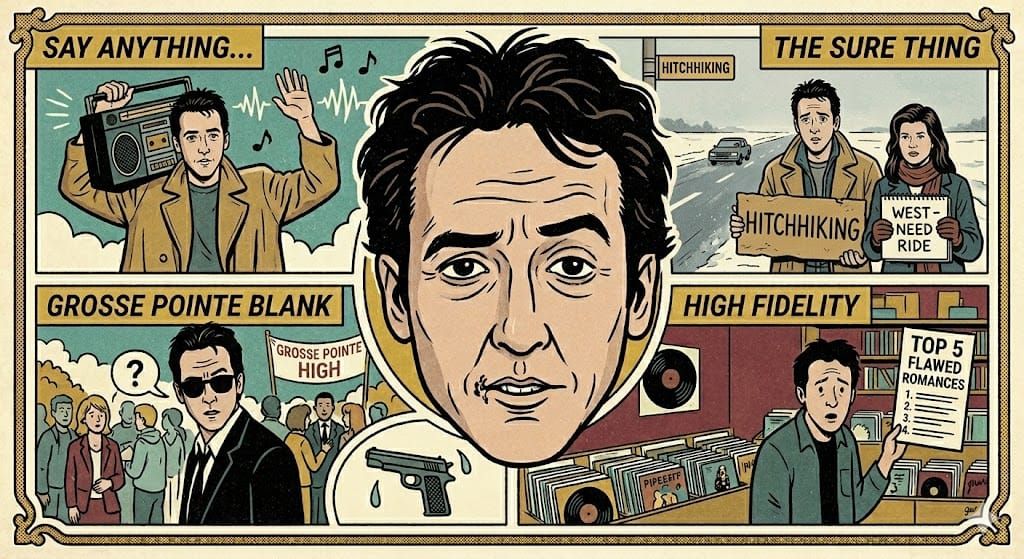
John Cusack has always looked like a man who just remembered he left the oven on, and frankly, that’s exactly why he’s one of the few actors who feels like a person rather than a piece of high gloss corporate hardware. While his contemporaries were busy sculpting their abs into granite and signing multi-picture deals to play superheroes or spies, Cusack was busy playing the guy who’s just a little bit too smart for his own good and deeply, painfully aware of how ridiculous that makes him.
He arrived in the eighties looking like he’d been dragged backward through a hedge, mop of hair perpetually in his eyes, radiating an energy that wasn't quite "hero" and wasn't quite "nerd." He was just… there...in the best way. For several years he was the guy all the guys wanted to be, and all the girls wanted to be with. He was the guy at the party standing near the record player, trying to figure out if it was better to leave early or stick around to see if things got interesting. In The Sure Thing or Say Anything..., he didn’t command the screen with a booming presence; he negotiated with it, usually through a series of facial expressions that suggested he was having a very long, very complicated argument with his own conscience.
Everyone points to the boombox scene in Say Anything... as the defining moment of his career, which is a bit of a disservice because it ignores the actual, jagged work he did to get there. It’s become a cliché, a shorthand for romance that has been parodied so often it’s lost its bite, but if you actually watch the film, the moment isn't about grand cinematic triumph. It’s about the sheer, naked anxiety of a kid who has absolutely no plan and is terrified that his grand gesture is going to end in him standing on a lawn looking like a lovelorn idiot. Cusack played Lloyd Dobler not as a romantic conqueror, but as someone who was honestly shocked that the girl hadn't laughed him out of the room yet.
Then he grew up, or at least he learned how to make his neuroses more dangerous. In the nineties, he stopped being the guy who just wanted the girl and started being the guy who didn't quite trust himself to always do the right thing. The Grifters was the pivot point. He played a con man with a cold, hollow core, and for the first time, you realized that the frantic, intelligent energy he’d been using for rom-coms could be turned into something genuinely predatory. It was a nasty, brilliant turn that showed there was a much sharper, more cynical mind behind the mop of hair. It should have gotten him an Oscar nomination.
And then, he did what almost no one in Hollywood has the sense to do: he started making his own adventures. Grosse Pointe Blank is, quite frankly, the only movie about a high school reunion that doesn't make you want to throw your laptop out the window. It’s a ridiculous premise—a hitman going back to his hometown to reconnect with the girl he left behind while simultaneously trying to dodge an assassin who wants to put a bullet in his head—but Cusack plays it with such weary, deadpan precision that you buy in completely. It’s the perfect distillation of that middle-aged suspicion that your life hasn't turned out quite how you expected, and you might actually be the bad guy.
He followed that with High Fidelity, which is basically a two-hour sermon on the dangers of being a music snob who treats women like they’re the flip side of a record you don't think you like anymore. It’s a better movie than it was treated, and it feels real in a way that most big budget scripts never manage. When he talks directly to the camera—breaking the fourth wall with that look of Johnny Cusack exasperated enlightenment—he’s not lecturing you; he’s dumping his internal monologue on your lap and hoping you can help him sort through the mess.
The thing is, Cusack never bothered with the vanity project circus. He doesn't do the frantic PR circuit where you have to pretend your new action movie is the most important cultural event since the invention of the wheel. He’s spent a lot of his career choosing projects that seem to be picked based on nothing more than "this looks weird and I think I might be good at it." He gets grumpy, he drops off the map for years, and he doesn't seem to care one bit about whether or not his Wikipedia page is up to date.
He represents something that’s rapidly disappearing from the modern world: the right to be a bit of a headache. He is intelligent, he is (allegedly) difficult, he is clearly overthinking absolutely everything, and he seems perfectly comfortable with the fact that he doesn't fit into a tidy little box. In a culture that demands we all be brand ambassadors for our own lives, there is something remarkably refreshing about a guy who just wants to go home, listen to some obscure post-punk records, and wait for the world to stop being so loud. He isn't the movie star we wanted, but he is certainly the one we deserved.
Tim
Tim Lowe is a writer, book expert, retired sailor, retail worker, and renaissance man.
He is currently traveling the country and working on his forthcoming book.