
New Management, Same Circus

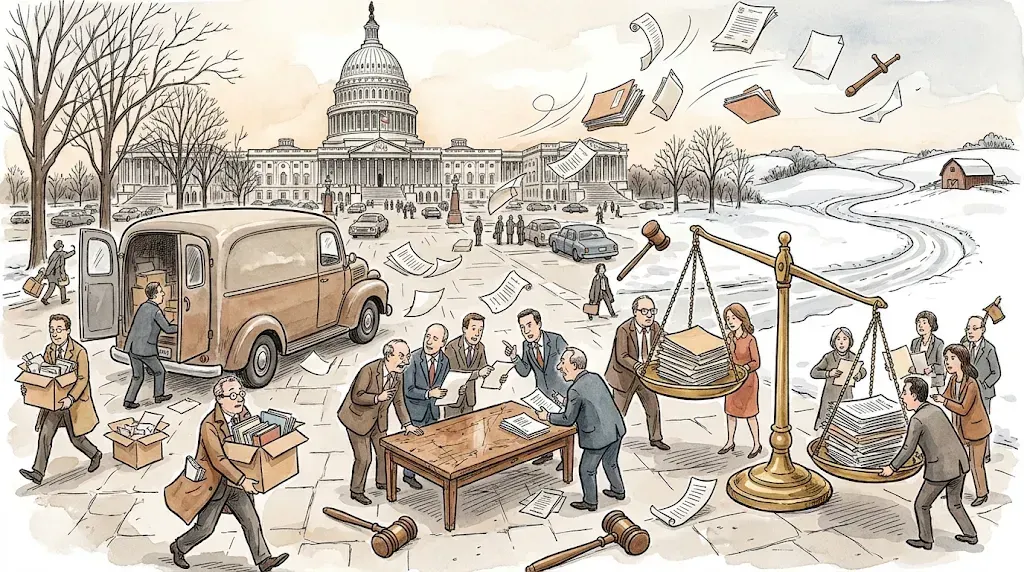
If you want to understand American politics right now, picture a moving van double-parked outside the Capitol while two people argue over who scratched the coffee table. We are two weeks past the November 2026 midterms, and Washington is stuck in that awkward stretch of the calendar where the voters have already fired the management, yet the old staff still gets to keep the keys until January.
On November 3, voters handed Congress back to the Democrats in a wave big enough to make political scientists dizzy. Democrats flipped both chambers, picking up nine Senate seats to build a 56–44 majority and increasing their numbers in the House by more than 250 seats. It was the biggest midterm Senate haul for either party in nearly seventy years. States that usually give Democratic strategists ulcers—Mississippi, Alaska, Iowa, Ohio—went blue, alongside governor's mansions from Kansas to Georgia. Meanwhile, Donald Trump still sits in the White House for the back half of his term, staring down a Congress that has zero interest in passing his wish list.
Both parties are nursing entirely different hangovers this week.
For Democrats, winning back power feels a bit like catching a stray bowling ball. It is thrilling for three seconds, right up until you realize your wrists hurt and you have to carry it somewhere. After wandering around in the political wilderness since 2024, party leaders and newly elected senators have spent the past few days huddling in Washington for orientation, trying to figure out how to govern a coalition that stretches from progressive firebrands in Michigan to moderate winners in deep-red states. House Democrats are set to make Hakeem Jeffries the first Black Speaker of the House on January 3, a historic milestone that comes with the thankless job of keeping 250-plus egos pointed roughly in the same direction.
Republicans are busy staging the classic post-midterm circular firing squad. In Washington, victory has a thousand fathers, and losing nine Senate seats has a thousand guys on cable news insisting it was someone else's fault. Party insiders are already grumbling out loud about leadership and strategy. Because Trump is constitutionally barred from running again in 2028, the GOP's internal gravity is shifting by the day. Every ambitious Republican governor, senator, and cabinet official is suddenly pretending to offer sober post-election analysis while quietly checking bus rental rates for an Iowa caucus campaign.
Nothing of lasting consequence is getting done on Capitol Hill between now and New Year's, though there will be plenty of noise. Outgoing majorities treat a lame-duck session the way college seniors treat finals week. Everybody is exhausted, half the room already has another job lined up, and nobody wants to do heavy lifting unless a government shutdown deadline forces them onto the floor at midnight.
Jump ahead twelve months to November 2027, and the place will look less like a governing body and more like an industrial-grade subpoena factory.
The legislative calendar will grind to a polite, predictable halt. Divided government in modern Washington runs on a simple loop: the House passes messaging bills the Senate won't touch, the Senate confirms judges and passes must-have spending bills at the eleventh hour, and the President keeps a fresh box of Sharpies handy for veto threats. Major domestic policy overhauls are dead on arrival. Instead, the real action moves into the committee rooms. Armed with gavel power and subpoena authority for the first time in two years, Democratic committee chairs in both chambers will spend 2027 digging through every corner of the administration's first two years, from agency staffing and tariffs to regulatory rollbacks. Washington's cottage industry of white-shoe defense lawyers is about to have a banner year.
At the same time, the 2028 presidential primary will already be running at full boil a full year before a single ballot is cast. The invisible primary always starts the morning after the midterms, and with an open race in both parties for the first time in over a decade, 2027 turns into an endurance test of awkward diner visits in New Hampshire and state fair pork-chop photo ops in Des Moines. Republican hopefuls will spend the year performing a delicate high-wire act, praising the sitting president's legacy while explaining why voters should hire them instead of his preferred successor. Democrats, flush with a new bench of governors and senators, will spend 2027 auditioning on national television to see whether the economic pitch that worked in November 2026 holds up on a presidential stage.
Keep an eye on the state capitals, too. With Democrats now holding 30 governor's offices and having broken long-standing GOP supermajorities in several legislatures, many of the sharpest fights over voting rules, data-center regulation, healthcare, and taxes won't happen in Washington at all. They will play out in statehouses from Raleigh to Juneau, creating a patchwork country where your zip code dictates your regulatory reality more than ever.
If all of this sounds exhausting, take comfort in how the whole machine was built. The American system moves slowly on purpose so no single election lets anyone remodel the house overnight. Twelve months from now, the cable news chyrons will still be flashing red, the fundraising emails will still claim democracy ends at midnight unless you chip in fifteen dollars, and Congress will still be fighting over a last-minute budget extension right before Thanksgiving. The cast changes, the committee chairs swap seats, and the subpoenas fly in the opposite direction, yet the show itself never gets canceled.
-30-