
Stop Romanticizing the Struggle: Why Your Soul-Sucking 9-to-5 is Actually the Ultimate Creative Hack

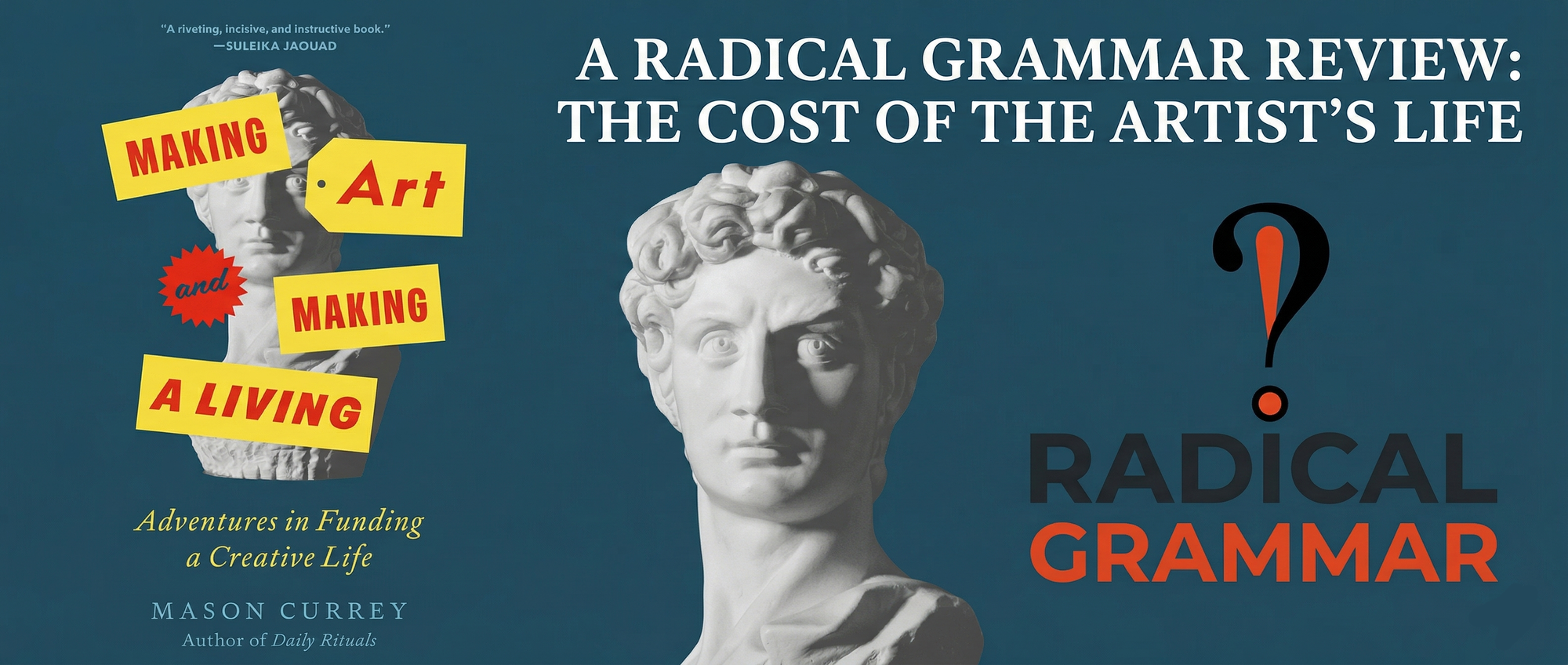
Review of Making Art and Making a Living: Adventures in Funding a Creative Life by Mason Currey. Copyright 2026 by Mason Currey. All rights reserved.

Mason Currey’s Daily Rituals was a voyeur’s delight, a collection of the weird tics and caffeine-fueled manias that sustained everyone from Balzac to Maya Angelou. It was the ultimate productivity book for people who actually hate productivity culture but love knowing that Francis Bacon worked in a room that looked like a landfi ll. Now comes the sequel we didn't know we needed: Making Art and Making a Living. If the first book was about how artists spent their hours, this one is about how they paid for them. It is a ledger of the soul, and frankly, it is a relief.
We have this romantic, slightly toxic notion that great art must be birthed in a vacuum of poverty, or perhaps funded by a mysterious, gout-ridden uncle in the countryside. Currey gently, then firmly, disabuses us of that notion. He introduces us to the day job—not as a tragic distraction, but as a scaffold. Take T.S. Eliot. We like to imagine him wandering the desolate shores of
The Waste Land, but for years, he was a banker at Lloyds. He wasn't just doing time; he was arguably the most efficient foreign-document evaluator the bank had. There is something deeply humanizing about the idea that the man who redefined modern poetry also had to worry about his pension contributions.
The book is structured like a series of brief, punchy biographies, though I must confess that Currey’s brevity occasionally borders on the criminal. Just as you are settling into the gritty details of a writer’s financial desperation, he snaps the book shut and moves to the next gallery. It is less of a narrative and more of a series of appetizers; you meet the bureaucrats like Franz Kafka, who spent his days at the Workers’ Accident Insurance Institute, and the hustlers like Andy Warhol, who understood earlier than most that being good at business is the most fascinating kind of art. Even the inclusion of someone like Salvador Dalí feels like a bit of a chore—I’ve always found his calculated eccentricity more exhausting than enlightening—but here, seeing even that mustache-twirling narcissist grapple with the cold reality of a commission gives him a shred of relatability I usually find lacking.
In an era where everyone is told to monetize their passion until their passion feels like a chore, Currey’s book feels like a cool cloth on a fevered brow. He does not preach. He does not offer a five-step plan to creative freedom. Instead, he offers a messy, contradictory, and ultimately hopeful history of how people have balanced the ledger between the creative spark and the grocery bill. There is a particular wit in Currey’s prose—a dry, observant quality that honors the absurdity of the artist’s life.
He captures the irony of Wallace Stevens, a vice president at an insurance company, who composed poems on slips of paper during his walk to work. Stevens did not want to be a professional poet; he wanted to be a man who lived in the world and happened to see it through a kaleidoscopic lens.
What makes this book feel like it was written by a person and not a program is the focus on the friction. Currey lingers on the moments of exhaustion—the writers who were too tired after a shift at the pharmacy to look at a typewriter. He records the resentment and the small victories. Money is a kind of poetry, Wallace Stevens once said, and Currey shows us that for many, the poetry was in the survival itself.
Making Art and Making a Living is essential reading for anyone who has ever felt guilty for having a nine-to-five. It is a reminder that the distractions of life—the rent, the taxes, the dental appointments—are the very things that tether art to reality. Currey has given us a book that is as practical as a checkbook and as inspiring as a manifesto. It turns out that the secret to a creative life isn't necessarily a cabin in the woods; sometimes, it is just a steady paycheck and a very disciplined lunch hour. If you are looking for a way to justify your own un-artistic daily grind, buy this book. Just do not quit your day job to read it all in one sitting—unless, of course, your day job is reviewing books. In which case, you have hit the Currey jackpot.
Order the book here.
Tim
Tim Lowe is a writer, book expert, retired sailor, retail worker, and renaissance man.
He is currently traveling the country and working on his forthcoming book.