
The Gospel According to Hobby Lobby


The Green family, the architects behind the Hobby Lobby empire, have long projected the image of a benevolent, family-owned business. With more than a thousand craft stores scattered across the American landscape, they are a fixture of suburban retail, known for their mid-century-styled signage and a quiet, steadfast commitment to closing on Sundays. However, as Michael Blanding expertly documents in The Gospel According to Hobby Lobby, this carefully curated veneer of normalcy hides a far more aggressive and consequential enterprise. Beneath the surface of discounted yarn and seasonal décor lies a multibillion-dollar engine of political influence, meticulously engineered to reshape the United States in the image of a specific, uncompromising evangelical vision.
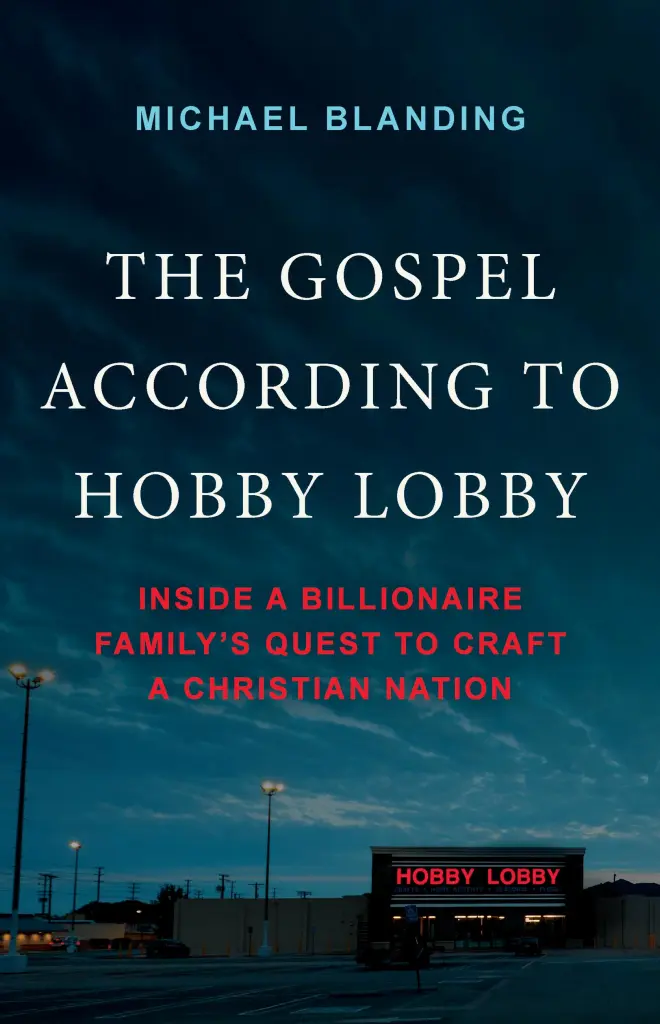
This is not a story of accidental power or serendipitous growth. It is a calculated, revelatory account of how the Greens have leveraged their vast retail fortune to dismantle the traditional boundaries between church and state. They have spent decades funneling massive capital into a singular, overarching mission: establishing an evangelical interpretation of the Bible as the absolute, non-negotiable authority behind our laws, our public education, and our societal norms. For the Greens, the ledger book and the prayer book are inseparable, and they have proven remarkably adept at using the former to impose the latter.
Blanding’s investigation strips away the craft-store facade to reveal a political pipeline that stretches from small-town boardrooms to the chambers of the Supreme Court. The scope of their influence is staggering. It is not confined to the pulpit or the private home; it is built into the very infrastructure of American life. The Greens have pioneered a new model of political activism, one that bypasses the erratic nature of traditional lobbying in favor of deep, long-term investments in "cultural infrastructure."
Consider, for instance, their approach to public discourse. While other families might donate to political action committees or traditional party organs—which are often subject to the whims of election cycles—the Greens have opted for the long game of ideological saturation. They have funded expansive, wide-reaching advertising campaigns designed to inculcate biblical values directly into the American consciousness, regardless of the political climate. They have systematically propped up the burgeoning evangelical education sector, donating both massive sums of money and prime tracts of land to institutions that prioritize religious dogma over secular curriculum. In doing so, they have effectively seeded the next generation with a worldview that views the secular state not as an obstacle to be overcome.
Perhaps the most public—and most controversial—manifestation of this ambition is the Museum of the Bible. Situated just blocks from the United States Capitol, the museum is a grand, stone-and-glass monument to the Greens’ grand project. But as Blanding meticulously details, the museum is more than a cultural institution; it is a declaration of intent. It serves to legitimize a narrow historical narrative, one that asserts the Bible as the foundational document of American democracy, implicitly arguing that the nation’s survival depends on a return to that specific root. Even more troubling is the origin of the museum’s collection. Blanding tracks the acquisitions process with clinical precision, revealing that the Greens’ hunger for biblical legitimacy led them to procure thousands of artifacts through questionable channels, eventually resulting in the discovery that much of their prized collection consisted of looted, stolen, or forged antiquities from the Middle East. It is a biting irony: in their attempt to "save" the Bible for the nation, they fueled a black market that stripped other cultures of their own history.
The Greens’ influence, however, is not merely symbolic or confined to museums. They have demonstrated a chilling willingness to utilize the highest levels of the American judiciary to codify their beliefs into law. The landmark Supreme Court case Burwell v. Hobby Lobby Stores, Inc. remains the definitive example of this trajectory. By successfully arguing that a corporation could exercise religious freedom—specifically, the right to deny employees insurance coverage for contraception—the Greens fundamentally shifted the landscape of corporate rights. It was a victory that signaled a new era of jurisprudence, one where the private religious conscience of an owner could effectively supersede the health and autonomy of their employees.
But that victory was merely a proof of concept. Blanding maps how the Greens have funneled millions into a network of organizations and legal groups working toward the dismantling of reproductive rights and the systematic erosion of LGBTQ protections. They have understood, far better than most, that political power is built on institutional endurance. By funding the groups that bring the cases, write the model legislation, and train the judges, they have ensured that their influence persists long after the initial check is written. They have institutionalized their ideology.
The Gospel According to Hobby Lobby is a deep-dive investigation into the mechanics of this influence. It is essential reading for anyone trying to understand how a single family has moved the goalposts of American politics, providing the fuel and the infrastructure for the country's most uncompromising nationalist movements. Blanding does not resort to histrionics; he relies on the weight of the evidence. He exposes how a massive retail chain became the primary financier of a revolution against the secular, pluralistic foundations of the United States.
Ultimately, this book forces a confrontation with an uncomfortable reality: in contemporary America, religious conviction and massive private wealth have fused to create a force that is as potent as it is opaque. The Greens have transformed the culture wars into a corporate enterprise, and in doing so, they have fundamentally altered the relationship between private capital and the public good. To read this book is to see the gears turning in the background of American life, driving a transformation that is as quiet as it is totalizing. Whether one views their efforts as a righteous stewardship of national values or a dangerous encroachment of theocracy, the facts remain the same: the Greens have succeeded in their mission to turn their checkbook into a compass for the American right. And as Blanding concludes, the cost of that influence is being paid by the integrity of our laws and the diversity of our public life. The project continues, and the reach of their empire only grows longer.