The Greatest Legal Heist in American History

How One Fraudulent Sentence Stole Your Future
The math of modern American life doesn’t add up. You look at the bank statement, you look at the grocery bill, and then you look at your father’s old W-2s—the ones he kept in a rusted biscuit tin in the garage—and the numbers just don’t square. He worked forty years at the plant, built a life on one salary, and sent his kids to college. You work two jobs, you’ve got the degrees, and you’re still counting pennies to cover the rent.
It’s easy to look for a villain in the rear view mirror. We’ve been trained to point fingers at the folks living three doors down, or the immigrant family trying to find a foothold, or the phantom "welfare queen" that politicians have been dangling like a carrot on a stick since the seventies. We’ve spent a century bickering over the crumbs while the whole table was being stolen from under us.
But the fix didn’t happen in a smoky backroom last week. It didn’t start with the latest round of corporate lobbying or a tax loophole written into a midnight budget bill. The rigging of the American dream began with a single, dirty, audacious lie. It happened in the quiet, dusty chambers of the Supreme Court in 1886.
There is a story we are told in law school, and that story gets repackaged into high school civics classes until it’s taken as gospel: that the Supreme Court of the United States ruled that corporations are "persons" under the 14th Amendment. We are told this is the bedrock of our economic life, a settled precedent that grants these massive, soulless entities the same constitutional protections as a human being.
Except, it never happened.
In the case of Santa Clara County v. Southern Pacific Railroad, the Supreme Court issued its ruling, but it didn't mention corporate personhood at all. The Chief Justice at the time, Morrison Waite, actually opened the argument by telling the lawyers to stop wasting time on the question of whether a corporation is a person; the Court didn't want to hear it. They ruled on the case, and they left the question of corporate rights untouched.
But then came J.C. Bancroft Davis.
Davis was a former railroad president turned court reporter. He was the guy responsible for writing the "headnotes"—the summaries that appear at the beginning of a case to tell you what the court decided. Before the decision was even published, Davis wrote a note to the Chief Justice, essentially asking if he could insert a little sentence saying the court had decided corporations were persons. The Chief Justice replied, essentially, that the court had avoided that question entirely, but he wouldn’t stop Davis from writing whatever he wanted in the headnote.
So, Davis wrote it. He slipped one sentence into a summary that held no legal weight, and he presented it to the world as the law of the land.
That was the heist. One man, one sentence, and one profound, deliberate act of fraud.
That single, illicit stroke of the pen launched a hundred-and-forty-year project of corporate supremacy. It wasn’t just a clerical error; it was the foundation for the systematic dismantling of the middle class. Once the legal system began treating corporations as "persons," the floodgates opened. If a corporation has the rights of a person, then donating millions to a campaign isn't bribery—it's "free speech." If a corporation is a person, then its profit margins are more important than the wages, health, or security of the actual, living, breathing people who work for them.

Think about the wreckage. This is the mechanism that crushed the unions, stripping away the collective power that once allowed families to bargain for a fair shake. This is the logic that paved the way for shipping manufacturing jobs overseas, chasing the cheapest labor on the planet because the bottom line became a higher constitutional priority than the survival of an American town. This is the engine that slashed taxes for the wealthy, convincing us that if we just let the billionaires keep enough, they might accidentally sprinkle some of that prosperity on the rest of us.
It’s a shell game. For over a century, while we were told to hate our neighbors, the oligarchs were busy rewriting the rules of the game. They turned the American legal system into a private security detail for their own bank accounts. They eroded our democracy by treating the ballot box like a board room.
But here is the thing about a lie: it requires constant maintenance. The truth is heavy, but it’s real. And people are starting to wake up to the fact that they’ve been sold a bill of goods.
Across this country, a different kind of conversation is starting to happen. It isn't a conversation about blaming the person next to you. It’s a conversation about accountability. People are passing local ordinances to challenge the reach of corporate power. They are organizing for constitutional amendments to strip away the fiction of corporate personhood.
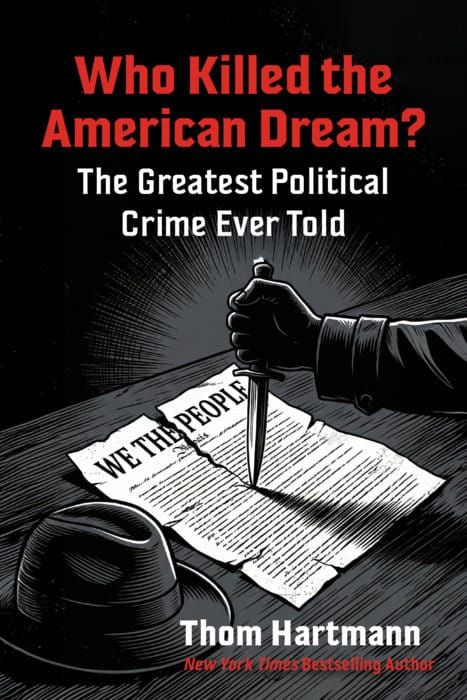
The history of this heist—the story of how we were dispossessed of our own democracy—is finally coming into the light. In his essential book, Who Killed the American Dream, Thom Hartmann pulls back the curtain on this fraud, names the culprits, and maps out the long, necessary work of taking our power back.
The rigged game is losing its grip. The question is no longer who did this to us, but what we are going to do now that we know.