
The Ladder Is a Lie


Why You Need to Stop Being a "Tryhard"
You’ve been sold a bill of goods. You know it, I know it, and if you’re honest with yourself, you’ve known it for a long time. You’ve got the title, the corner office, the steady paycheck, and the relentless, gnawing burnout to match, yet you’re still waiting for that elusive "happiness" that was promised to arrive with your next promotion. You followed the instructions. You played by the rules. You traded your youth, your hobbies, and your sanity for performance indicators and "executive presence," and now, sitting at your desk at 7:00 p.m. on a Tuesday, you have to ask: what the hell was it all for?
In Tryhard, Laura Mayer finally calls it. She pulls the curtain back on the whole charade, and she doesn't do it with the sterile, soulless tone of a LinkedIn influencer or a leadership consultant. She does it with the kind of sharp, self-deprecating honesty that only comes from someone who spent thirty years running as fast as she could, only to realize the race itself was the problem.
Mayer was born a "girlboss," if we’re going to use that term, though it’s a label she’s clearly spent a lifetime outgrowing. While other kids in suburban Illinois were busy being children—dreaming of pop stardom or athletic glory—little Laura was playing "V.P. of Sales" in her bedroom. She wasn't just playing; she was performing, dictating memos to her twin brother as if they were binding legal contracts and trading the standard childhood literary diet of Judy Blume for the buzzing, high-octane business books of the era. She didn't want to live; she wanted to climb. She was a natural-born corporate acolyte, a true believer in the gospel of the ladder.
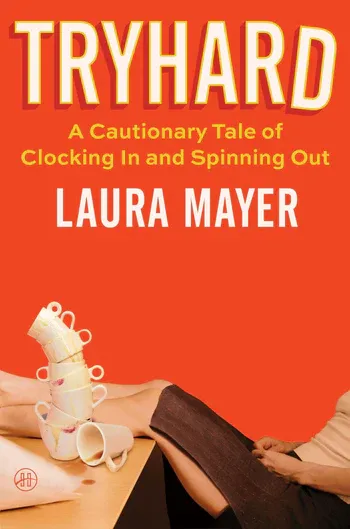
Fast forward thirty years, and she was sitting on a dizzying, cloud-high perch on that very ladder. As an Executive Producer of Podcasts at ABC News, she was the engine behind some of the most influential audio storytelling in the country: Revisionist History, Bad Blood, Happier with Gretchen Rubin. She had reached the destination. She had the resume, the accolades, and the identity shaped by annual reviews and the exhausting maintenance of a corporate persona. And from that vantage point, she realized that the ladder was just a prop. It wasn't leading anywhere meaningful. The identity she had so carefully constructed—that amalgamation of performance metrics and "presence"—was hollow. She was a top-tier producer of other people's stories, but she had lost her own.
Tryhard is a gonzo memoir for every 9-to-5 devotee who has spent their entire adult life treating their job description like a holy text. It’s for the people who have read every C-suite-or-bust instruction manual ever printed, only to find themselves staring at a computer screen feeling absolutely empty. If you’re a type-A personality, a high-achiever, or someone who treats every project like a life-or-death mission, this book doesn't just see you; it dissects you with a scalpel and then stitches you back together with a joke.
This isn't another "hustle culture" manual telling you how to squeeze twenty-five hours out of a twenty-four-hour day. It isn't a guide to "optimizing" your workflow to achieve a peak state of corporate nirvana. In fact, it is the exact opposite. It is a necessary intervention. It is a deeply personal, poignant, and often hilarious examination of the why—why we race, why we sacrifice our personal lives for companies that would replace us in a week, and why we’ve allowed our professional worth to define our human value.
Mayer detangles the mess of priorities we’ve created for ourselves. She looks at the "boss-at-any-cost" culture—that intoxicating, destructive drive to be the best, the hardest working, the most indispensable—and she rejects it. She doesn't just reject it; she invites us to laugh at the absurdity of it all. There is something profoundly cathartic about watching someone who achieved the pinnacle of success admit that the game is rigged and, more importantly, that it isn't worth the cost of admission.
Throughout the narrative, Mayer offers the modern office worker a different path forward. She doesn't provide a list of "ten steps to work-life balance," because she knows as well as you do that those lists are part of the problem. Instead, she provides something more valuable: her own messiness. She shares her revelations, her failures, and her hard-won enlightenment. She tells the story of her transformation from a high-performance automaton into a person who can finally look at a mountain of work and decide, for the love of God, to just chill out a little bit.
This is a one-of-a-kind sightseeing trip on the Great American hamster wheel. It is heart-wrenching in its vulnerability and consistently entertaining in its execution. It is the story of someone who was the ultimate "tryhard," someone who believed that if she just worked hard enough, she would finally be enough. And in reading it, you might just find the permission you’ve been waiting for: the permission to stop trying so damn hard to be everything to everyone, and to start being something to yourself.
If you’re tired of the constant motion, if you’re exhausted by the performance of productivity, and if you’re ready to stop reading the propaganda that got you into this cycle in the first place, then pick up Tryhard. It’s time to stop climbing a ladder that leads nowhere and start figuring out what you actually want to do once your feet are back on the ground. You might find that the world keeps spinning even if you aren't the one pushing the wheel. That realization alone might be the most liberating thing you learn all year.