
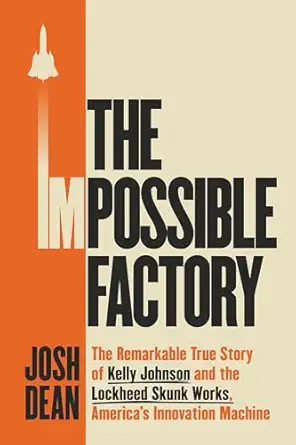
The Impossible Factory:

The Remarkable True Story of Kelly Johnson and the Lockheed Skunk Works, America's Innovation Machine
The history of American industry is a graveyard of good ideas that were strangled in the crib by committees, middle managers, and the paralyzing fear of failure. It is a long, tedious record of projects that arrived years late, millions over budget, and stripped of the original vision by the very people tasked with protecting it. But there is an exception to this grim rule. It is a story that begins in a set of rented circus tents parked next to a foul-smelling plastics factory in Burbank, California, during the height of the Second World War.
Clarence Leonard Johnson did not set out to change the world; he set out to build an airplane without the interference of people who did not know how to hold a wrench. He was a man who measured his life in the friction between an idea and a finished prototype. When the U.S. Army Air Forces came to Lockheed in 1943 desperate for a jet fighter that could challenge the German Me 262, they expected the standard treatment. They expected a paper trail that stretched across the continent, endless progress reports, and a timeline that accounted for every possible failure in corporate diplomacy. Instead, they got Kelly Johnson.
Johnson did not play the game. He took a handpicked group of engineers and production craftsmen, dragged them into the chaos of that makeshift facility, and closed the door to the rest of the company. He called it the Skunk Works, a name borrowed from a rowdy location in a popular comic strip, but within the walls of that tent, the atmosphere was more akin to a monastery for the mechanically obsessed. He was creating a vacuum where speed was the only currency, and mediocrity was the only sin.
The fourteen rules he established were not just guidelines; they were a manifesto against the rot of modern management. He mandated that the group remain small, autonomous, and shielded from the prying eyes of the bureaucracy. He required that the customer have only one point of contact, ensuring that the mission never got diluted by competing voices. He demanded simple drawings, flexible specifications, and a level of trust that was entirely alien to the aerospace industry. In 143 days, that ragtag team delivered the XP-80 Shooting Star. They did it ahead of schedule and under budget, effectively ending the debate over whether traditional corporate structures were actually necessary to produce high-end technology.
The success of the Shooting Star was not a fluke; it was the birth of a new standard. Johnson understood that the greatest threat to innovation was not technical difficulty, but the human tendency to overcomplicate the process. He kept the facility lean, he kept the lines of communication open, and he kept the engineers on the floor where they could actually see what they were building. He knew every person in the shop by name, and he spent his days walking the floor with a notebook, hunting for the small inefficiencies that eventually lead to catastrophic failure. He was a curmudgeon, a taskmaster, and arguably the most talented engineer of the twentieth century, and he managed his team with the fierce, protective instinct of a parent for his children.
When the world turned cold and the U-2 spy plane became a necessity to peer behind the Iron Curtain, the CIA did not go to the board of directors; they went to Johnson. He told them he could do it, and he did it with a level of secrecy and technical brilliance that would eventually make the U-2 the most recognizable silhouette in the history of aerial reconnaissance. Then came the SR-71 Blackbird, a machine so far ahead of its time that it still looks like it arrived from the future. It was a craft built of titanium when the world did not even know how to weld the stuff. It moved so fast that the only way to avoid a missile was to outrun it.
Johnson did not just invent the machines; he invented the culture that made them possible. He built an environment where a design error was a reason to fix it, not a reason to hide it. He fostered a sense of urgency that was fueled by the belief that their work could be the difference between peace and a global catastrophe. He treated his rivals like prey and his team like a combat unit. He refused to let the corporate masters in the front office dictate the reality of the work being done in the shop.
When Kelly Johnson finally retired, he left behind a ghost story that every tech giant in Silicon Valley has spent the last forty years trying to recreate. They build their open-plan offices, they hang their posters about agility, and they talk about disruption, but they almost always miss the point. You cannot manufacture an innovation machine by changing the office furniture or adding a ping-pong table to the breakroom. You create it by stripping away the layers of vanity, the obsession with metrics that mean nothing, and the fear that keeps people from taking the risk of being wrong.
This is the account of how one man turned a small, renegade operation into the greatest engine of innovation in the history of this country. It is a look at how to build something that lasts when the rest of the world is paralyzed by the desire to be safe. It is the story of the fourteen rules, the men who lived by them, and the machines they left behind. If you have ever wondered why some people get it done while the rest of the world is still holding a committee meeting, this is the story you need to read. It is a reminder that the best work is done when you stop managing the people and start trusting the work itself. The Skunk Works was never just a building; it was an argument for the supremacy of human talent over the dead weight of the system.