The Judicial Wrecking Crew:

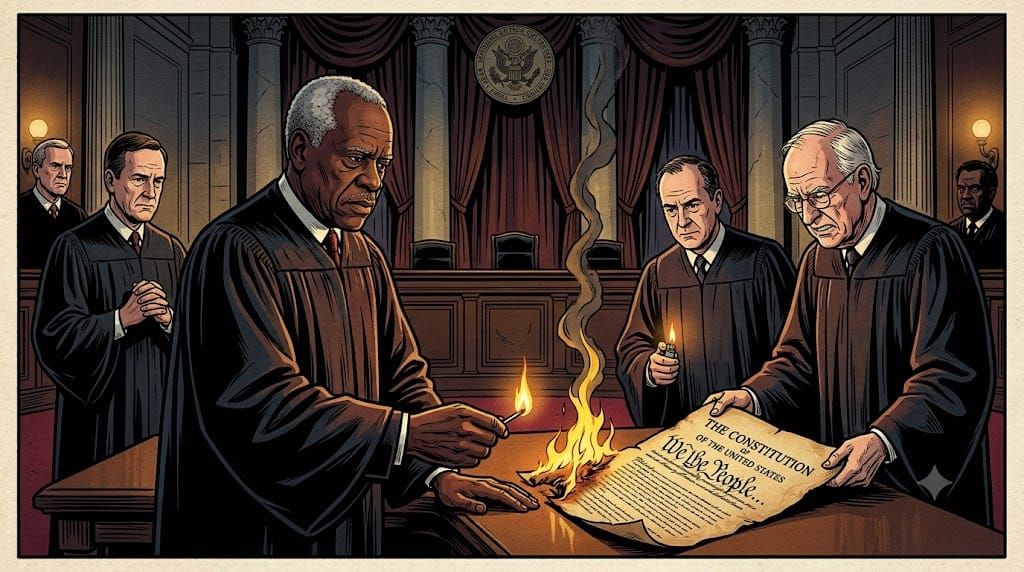
How the Supreme Court Abandoned the Rule of Law for Partisan Power
For the better part of a decade, the Supreme Court has operated less like a bench of impartial jurists and more like an ideological wrecking crew. We aren’t talking about the usual conservative-liberal tug-of-war. We are witnessing the systematic, and at this point, nearly complete dismantling of the institutional guardrails that once kept the federal government from devolving into a playground for the executive branch and corporate interests.
The latest term has been the final nail in the coffin for the idea that the judiciary acts as a check on power.
Look at the Court's recent decision in Trump v. Slaughter. With one stroke, the majority gutted ninety years of precedent, effectively ending the independence of federal agencies like the FTC. Since 1935, the Humphrey’s Executor ruling ensured that commissioners at agencies meant to police the marketplace couldn't be fired simply because they disagreed with the President’s ideology. That protection was the only thing preventing the White House from turning consumer protection into a political weapon. Now? That’s gone. The President can fire agency heads at will for being "inconsistent" with his priorities.
This isn't "constitutional interpretation." It is the institutionalization of an imperial presidency. The Court has handed the executive the keys to the entire administrative state, ensuring that no regulatory body can survive if it dares to prioritize the public interest over the administration's political agenda. They’ve signaled clearly: independence is a bug, not a feature.
Then, turn your attention to Monsanto v. Durnell. This was a masterclass in judicial corporate shielding. The Court ruled that federal EPA labels preempt state-level lawsuits against pesticide manufacturers, essentially stripping everyday citizens of their right to hold chemical giants accountable for failures to warn about health risks.
Think about the implications. If the EPA—an agency the Court is simultaneously stripping of its independence—hasn't mandated a specific warning, then a company like Monsanto is legally bulletproof, regardless of the science or the harm caused to citizens. The Court is essentially telling the American public that if a corporation has the right regulatory capture at the federal level, they are untouchable in every courtroom in the country. It’s a protection racket disguised as "statutory construction."

It is hard to view these outcomes as anything other than a coordinated effort to strip away the mechanisms of democratic accountability. When you combine the death of Chevron deference with the new, absolute executive control over independent agencies and the preemption of state-level liability, the message is clear: the Court is creating a landscape where the government is paralyzed, the presidency is unchecked, and the corporation is king.
The "shadow docket" remains the Court's favorite weapon for this transformation. They continue to reshape massive areas of public life—immigration, reproductive rights, election maps—without the transparency of oral arguments or full, reasoned opinions. It is the antithesis of democratic transparency. When you are deciding the fundamental rights of millions, you owe the public a full accounting of your reasoning. Instead, they choose the midnight order, the emergency injunction, and the quiet decree. It is the behavior of a political entity that fears the sunlight.
Beyond the specific rulings, there is the matter of the justices themselves. We have become accustomed to the headlines about luxury travel, financial entanglements, and intimate ties to political donors. In any other professional environment, this would be a scandal. On the Supreme Court, it is met with a defensive, dismissive posture. When the highest court in the land insists that it is the sole judge of its own conduct, it invites a level of cynicism that the judiciary may never recover from.
They operate with a sense of entitlement that ignores the reality of their position. They aren't kings; they are public servants. When their duty to the law is clearly secondary to their ideological grooming and personal comfort, the credibility of the entire federal judiciary evaporates.
The consequences of this era will be felt for generations. You cannot simply flip a switch and repair an institution that has spent years burning its own reputation. The legitimacy of the Court depends entirely on the consent and trust of the governed. When that trust is gone, the Court is just a collection of unelected officials imposing their own worldview on the country.
The public’s current demands—for term limits, for ethics enforcement, for structural reform—aren't radical. They are a desperate, reactionary response to a Court that has stopped acting as a neutral arbiter and started acting as a partisan warrior. People are starting to see the bench not as a firewall against political excess, but as a catalyst for it.
The irony is that this Court likely views itself as a defender of "original intent" or "constitutional fidelity." In reality, they are tearing the system apart. They have replaced the predictable, incremental evolution of precedent with a reckless volatility that keeps the nation on edge. They have traded the stability of the law for the thrill of the ideological win.
There is no path back to normalcy without a reckoning. The Court needs to be reined in. The unchecked power they have granted themselves, the insulation they have provided the executive, and the contempt they have shown for the administrative process—these are not features of a healthy republic. They are signs of a system that has jumped the tracks.
The Court may still possess the authority to issue rulings, but they have squandered their moral weight. They are no longer a neutral branch of government; they are a political faction wearing robes. The history books will not be written by the justices, but by the public they have alienated and the democracy they have weakened. By the time they realize the damage they’ve done, it may be too late to fix it. We are living through the erosion of a vital institution, and unfortunately, the people responsible for the demolition seem to believe they are building something great. They are mistaken. They are merely presiding over the slow-motion collapse of the public’s faith in the American legal system. There is no coming back from that without a fundamental change in how the bench conducts its business and who gets to sit in those chairs. Until then, we are left with a Court that serves only itself, leaving the rest of the country to navigate the wreckage they’ve left behind.