
The Night the Lights Went On in Major League Baseball

Excerpt from Cramer's Choice: Memoir of a Baseball Card Collector Turned Manufacturer by Mike Cramer.
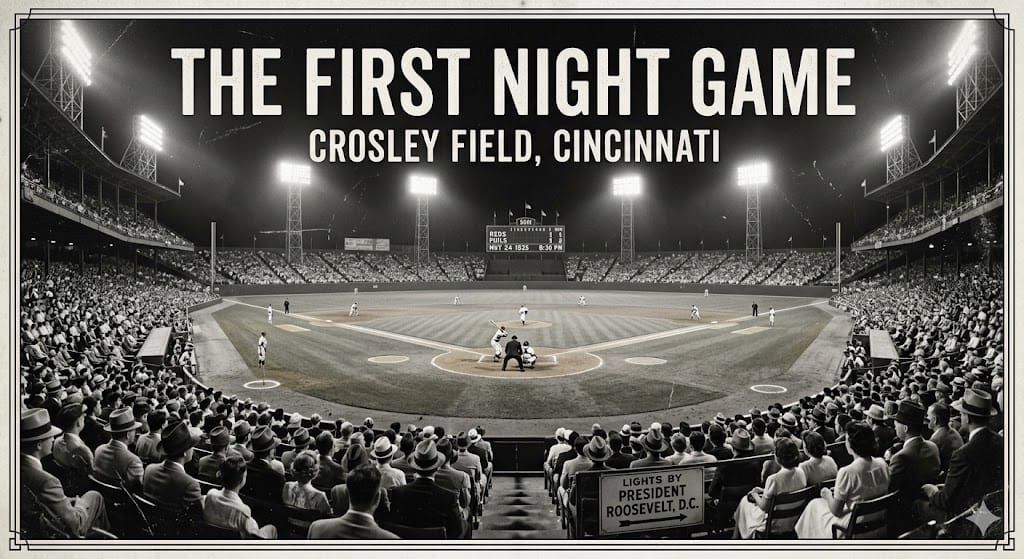
Many a president has thrown out a ceremonial first pitch. On May 24, 1935, Franklin D. Roosevelt threw a ceremonial first switch. Roosevelt's action at 8?30 p.m. at the White House transmitted a signal by telegraph to Crosley Field in Cincinnati. There, the Reds' general manager, Larry MacPhail threw the switch that actually turned on the lights in the ballpark - 632 lamps of 1,500 watts each, on towers that were 115 feet tall - for the first night game in Major League Baseball.
The game had been scheduled for May 23, but it was rained out. On the 24th, the inaugural night game drew 20,422 fans despite chilly, threatening weather that may well have depressed the crowd. But it was a huge turnout for the Reds, who drew 2,000 fans the previous game and 2,085 the day after.
It was a milestone that nearly did not happen. At the 1934-35 winter meetings, National League owners had approved a limited number of night games, but Commissioner Kenesaw Mountain Landis told MacPhail, "Young man...not in my lifetime or yours will you ever see a baseball game played at night in the Majors." He was wrong, of course, perhaps swayed by the economic realities of the Great Depression that were pressing on baseball. He soon allowed the Reds to play seven night games in 1935. And it was a gigantic boon; the Reds averaged 18,260 fans for their seven night games, 4,607 for their 69 day games at home.
That amounted to a lot of money. The Reds drew about 98,000 more fans to those night games than seven average day games would have. The top ticket cost $1.75. If you figure the average ticket was $1.2, that is $122,500 more revenue than from an equal number of day games. If concessions brought in another $100,000 - roughly a dollar per customer - and you deduct the estimated $50,000 it cost to install the lights, that's a total of $172,000, or nearly $4 million in 2024 dollars. Take off a little more for the electric bill.
Other teams surely noticed, but none of them followed suit immediately, worried that night baseball would harm attendance at day baseball, according to Charlie Bevis' Baseball Under the Lights: The Rise of the Night Game. In 1936 and '37, the Reds remained the only Major League team to play home games under the lights, with continued attendance gains despite terrible teams. In 1936, the Reds averaged 18,188 for the seven night games, 6,759 for their day games; in 1937, it was 15,668 for the night games, 4,188 for the day games.
In 1938, another team finally leaped into night baseball - the Brooklyn Dodgers, who were then being run by...MacPhail, who, though a nighttime pioneer, remained wary of a heavy night schedule. On June 15, Brooklyn turned on the lights for a game against the Reds that became historic; it was Johnny Vander Meer's second consecutive no-hitter. The Dodgers reaped even greater rewards than the Reds had, averaging 26,254 for eight night games compared with 6,970 for home day games.
Perhaps it was no coincidence, but the Reds and the Dodgers both flourished on the field a few years after they began raking in the money from playing night games. MacPhail invested in players in both cities, and the Reds won the pennant in 1939 and the World Series in 1940, and the Dodgers captured the pennant in 1941.
The Major Leagues' reluctance to play at night was generally over by then. In 1939, an American League team, the Philadelphia Athletics, another bottom feeder with poor attendance, added lights. By 1942, 11 of the 16 teams had lights. When World War II ended only three teams did not have lights - the Boston Red Sox, the Detroit Tigers and the Chicago Cubs. Although the Cubs had bought the equipment to install lights for the 1942 season, they donated it to the war effort and remained a steadfast day-game team until 1988. (It may be merely a coincidence, but the conservative Red Sox and Tigers were the last two teams to integrate their Major League rosters. The Red Sox introduced lights in 1947, the Tigers in 1948. Boston integrated in 1959; Detroit, 1958.)
MacPhail's involvement in night baseball was no surprise. He owned the Columbus Red Birds, a St. Louis Cardinals farm team, in 1932 and, as was later the case in Cincinnati and Brooklyn, had a franchise with low attendance and financial problems. MacPhail arranged the team's first night game, but it was delayed by some unusual shenanigans, according to a history of Columbus baseball stadiums. Branch Rickey was the general manager of the Cardinals, and he wanted to acquire a shortstop from the minor league St. Paul Saints, Jimmie Reese. So he traded the rights to play in the first night game to the Saints - who would share in the gate receipts - for Reese. That meant the game could not be played until St. Paul came to town, which was two weeks later. Then, history.
As eventful as it was, MacPhail's introduction of night baseball in Columbus was not without precedent. According to the Baseball Hall of Fame, the first known game under the lights was between teams representing department stores in Hull, Massachusetts, on September 2 1880. For a frame of reference, Thomas Edison had patented the incandescent light bulb only early that year. Another night game was played on June 2, 1883, in Fort Wayne, Indiana, against a team from Quincy, Illinois, and several minor league games were played at night before the 19th century ended, the Hall of Fame says.
Night baseball actually came to Cincinnati in 1909, between two ElksClubs teams, played at the Reds’ fabulously named ballpark, the Palace of the Fans. In 1910, two semipro teams played at night at Comiskey Parkin Chicago—coincidentally, while the White Sox were in New York playing the Yankees in a game that ended in a tie when it was called because of darkness. The first night game in organized baseball was played on April 28, 1930, between the home Independence (Kansas) Producers and the Muskogee (Oklahoma) Chiefs of the Western Association, according to the Society for American Baseball Research. Other minor league teams followed that season.
Night ball really took off in the Negro leagues, however. The Kansas City Monarchs bought a lighting system that they hauled from town to town, an enormous boost for a team that played most of its games on the road and was highly dependent on gate receipts. Their first night game was played on April 28, 1930, in an exhibition against Phillips University, according to a history of night baseball in The Ironton (Ohio) Tribune. The game, in Enid, Oklahoma, drew about 3,000 people, the historian Phil S. Dixon told The Enid News & Eagle in 2015. The Monarchs also played numerous night games against another barnstorming team, the House of David, which employed its own traveling lighting system.
Dixon said that the Monarchs’ co-owner J.L. Wilkinson believed that night games were baseball’s future. “He said lights will be to baseball what talkies are to the movies,” Dixon said. “The Major Leagues didn’t believe It.”
The Major Leagues’ reluctance had varied reasons. Bevis wrote that owners feared the democratization of the fan base that night baseball was sure to bring—working stiffs actually had to work during the day— was at odds with what baseball thought its clientele should be. That was even though night games appeared to present a financial boon. Owners also feared that play would be subpar and that players would be at greater risk of injury. But the review of night ball at the Reds’ first such game in 1935 was extremely positive. A reporter for The Cincinnati Enquirer, James Golden, wrote, “The great batteries of lights never seemed to bother the spectators or the boys in the field.” Golden considered the game an aesthetic success:
All that the fans cared about was that the visibility was plenty good from the stands and the bleachers, that the field showed up in a more uniform light green and tan than it does in daytime. It was as brilliant with the trim little white figures running about it, as a new baseball game board in the window of the corner drugstore. What clouds there were were so thin that the ball, when it flew high, shone through them like a bald head in a steam room. And when there was no mist, the sphere stood out against the sky like a pearl against dark Velvet.
There were few pearls on the diamond, however. Only four of the 20 players who took the field ever made an All-Star team. None are in the Hall of Fame. The Reds wound up in sixth place at 68–85–1, the Phillies in seventh at 64–89. (Their saving grace: the 38–115 Boston Braves.) Now [ca. 2024], about two-thirds of Major League games are played at night.
Excerpted from A Baseball Book of Days: Thirty-one Moments That Transformed the Game, Copyright © 2025 by Phil Coffin. Used by arrangement with McFarland & Company, Inc., Publishers. All rights reserved.
Order the book at http://www.mcfarlandbooks.com
If you're an author or publisher, and you would like your book to be featured on Radical Grammar, email us at book writer dude at g mail dot com.