
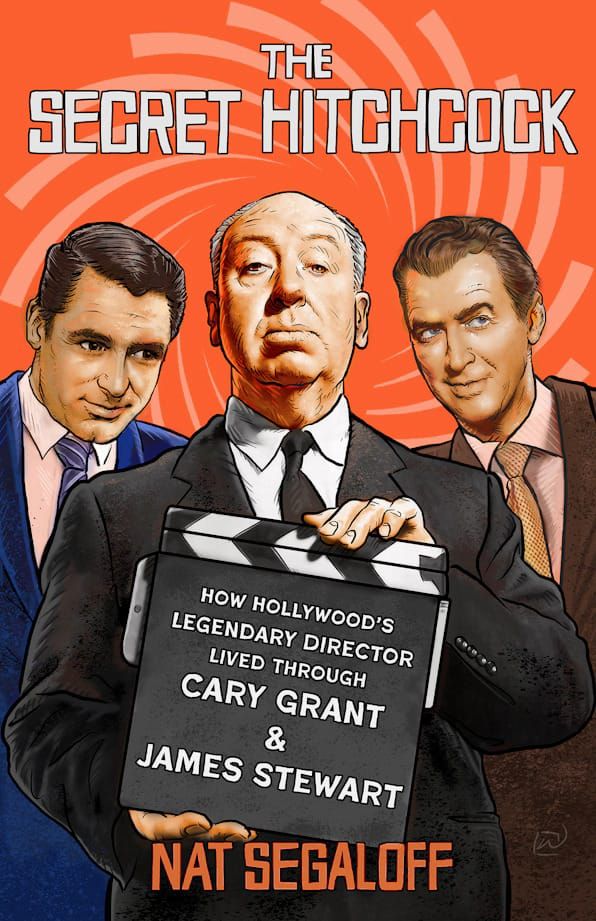
The Secret Hitchcock

Let’s talk about cinema. Not the soft, sanitized bullshit that gets passed off as entertainment, but the real, blood-and-guts, sweat-on-the-brow, psychological warfare of filmmaking. Cinema is an act of pure, unadulterated projection. You take a guy with a borderline-psychotic vision, put him behind a camera, and let him construct a world where he plays god. And nobody—absolutely nobody—played god with more meticulous, cold-blooded precision than the Master of Suspense himself.
But here’s the real kicker, the beautiful, twisted joke at the center of the frame: the man orchestrating all this tension was a bundle of raw nerves. A private, deeply insecure guy living under a microscope of his own making, utterly ruled by his anxieties and phobias. So what does a genius do when he’s too terrified to live out his own darkest, most dangerous desires? He finds avatars. He finds a couple of cool, charismatic bastards who can strut across a celluloid landscape and do all the dirty, beautiful things he never had the stones to do in real life.
Enter the dynamic duo of the Hitchcockian universe. You had Cary Grant, a guy who weaponized charm. The man was a walking, talking masterclass in high-society sophistication, moving through frames like a razor sharp switchblade wrapped in a tuxedo. Then you had James Stewart. Now, Stewart started out as that aw-shucks, boy-next-door type, but under the lens, he transformed into something far more interesting—a war-hardened, vulnerable, deeply complex everyman who could carry the weight of a narrative right on his shoulders. These two guys were everything Hitchcock wasn’t, and that’s exactly why he needed them.
Between 1941 and 1959, an eighteen-year stretch of pure cinematic lightning, this trio forged an alliance that yielded eight unforgettable films. Four with Stewart, four with Grant. This wasn't just a director hiring actors; it was a psychological hijacking. Through these men, Hitchcock found the ultimate freedom. He reached the absolute pinnacle of his craft by living his most daring, mysterious, and utterly unhinged self through their performances.
Look at what happened to the actors during this run. Cary Grant completely shed his lightweight comedic persona, stripping away the slapstick to reveal the steely, dangerous core of a true dramatic hero. Just look at the paranoia dripping off the screen in Suspicion (1941) or the suffocating, tragic romance of Notorious (1946). By the time you get to To Catch a Thief (1955) and the relentless, kinetic masterpiece that is North by Northwest (1959), Grant isn't just an actor anymore. He’s a living monument to cinematic cool, dodging crop dusters and scaling Mount Rushmore because his director was too busy sweating through his shirt in a canvas chair.
And Jimmy Stewart? Man, Stewart went to some dark, dark places. He stopped playing the innocent idealist and became an empty vessel for obsession. Think about the claustrophobic tension of Rope (1948) or the voyeuristic, sweaty anxiety of Rear Window(1954). He took the audience on a frantic, globe-trotting nightmare in The Man Who Knew Too Much (1956). And then, of course, there’s Vertigo (1958). That movie is a full-on, hallucinatory descent into madness. Stewart becomes a proxy for a man completely consumed by a ghost, chasing a fantasy until it destroys him.
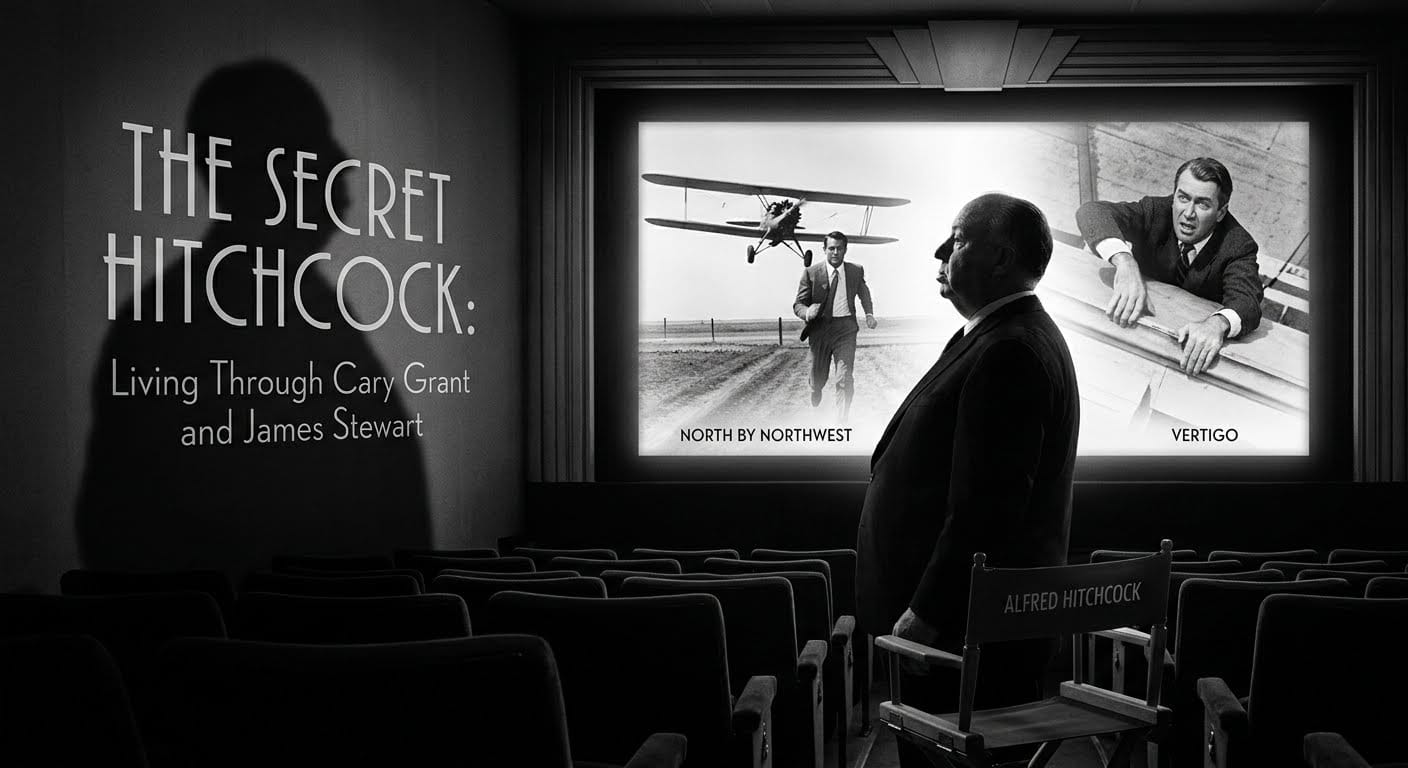
This brings us to the core thesis of Nat Segaloff’s explosive book. These eight films are not mere popcorn entertainment designed to kill two hours on a Saturday night. No, man. These flicks are veiled confessions. They are celluloid crime scenes littered with the fingerprints of Hitchcock’s deepest, most intoxicating obsessions, fears, and desires. Through Grant and Stewart, the director got to experiment. He got to vicariously love the untouchable ice-queen blondes. He got to kill, he got to conquer, and he invited the audience into a front-row seat to glimpse the magnificent, chaotic geography of his inner world.
The text pulls back the curtain with the relentless force of a hammer blow, revealing the profound, symbiotic connection between the man and his art. Hitchcock’s characters were granted a license that society denied the director himself. They could do what he never dared: expose a sadistic killer, rescue a terrified child, or crack a seemingly impossible crime. Behind the glitz and glamour of these creative partnerships lay a labyrinthine web of secrecy, control, and psychological manipulation.
What is delivered here is a fresh, compelling, and unapologetically bold portrait of a filmmaking titan. It unravels the mystery with absolute, razor-sharp precision, turning the spotlight onto the stars who volunteered to step into the dark. They didn't just speak the lines; they embodied the imagination. They walked into the shadows, looked the devil in the eye, and brought a genius's darkest dreams to life.