
Welcome to the Afterlife


To contemplate the afterlife is to engage in an exercise of profound, if occasionally anxious, imagination. For millennia, humanity has agonized over the precise nature of the Great Beyond, constructing vast, often intimidating tapestries of pearly gates, fiery pits, harp-strumming choirs, and cloud-bound architecture. It has historically been viewed as a place of immense bureaucracy, requiring a pristine moral resume and an apparent tolerance for endless, unchanging ambient music.
Yet, as it turns out, the administrative realities of eternity might actually require something far more practical: a thoroughly competent receptionist.
Enter Welcome to the Afterlife, a book that introduces a remarkably luminous and comforting vision of the "Upstairs," courtesy of Taryn Delanie Smith. Rather than relying on stern archangels or cryptic stone tablets, this particular cosmic waiting room is managed by a beloved character named Denise. Denise is Heaven’s sharp-witted, bighearted receptionist, a woman who possesses the rare and enviable gift of offering profound reassurance with humor, grace, and a knowing wink. For millions of onlookers who first encountered her in the digital ether of social media, Denise has become an indispensable guide to the infinite, transforming the terrifying void into something akin to a well-run boutique hotel where the concierge actually cares about your stay.
When one considers the sheer volume of human anxiety directed toward the end of existence, Denise is a distinct relief. New arrivals at Heaven’s front desk are rarely composed; they are, understandably, a bit disoriented. They arrive with a laundry list of pressing, occasionally eccentric, queries. What, precisely, is there to do for the rest of time? Can our left-behind loved ones still sense our presence? What about our pets—are the golden retrievers safely accounted for? And perhaps most urgently for the visually inclined, do we get to choose our eternal outfit?
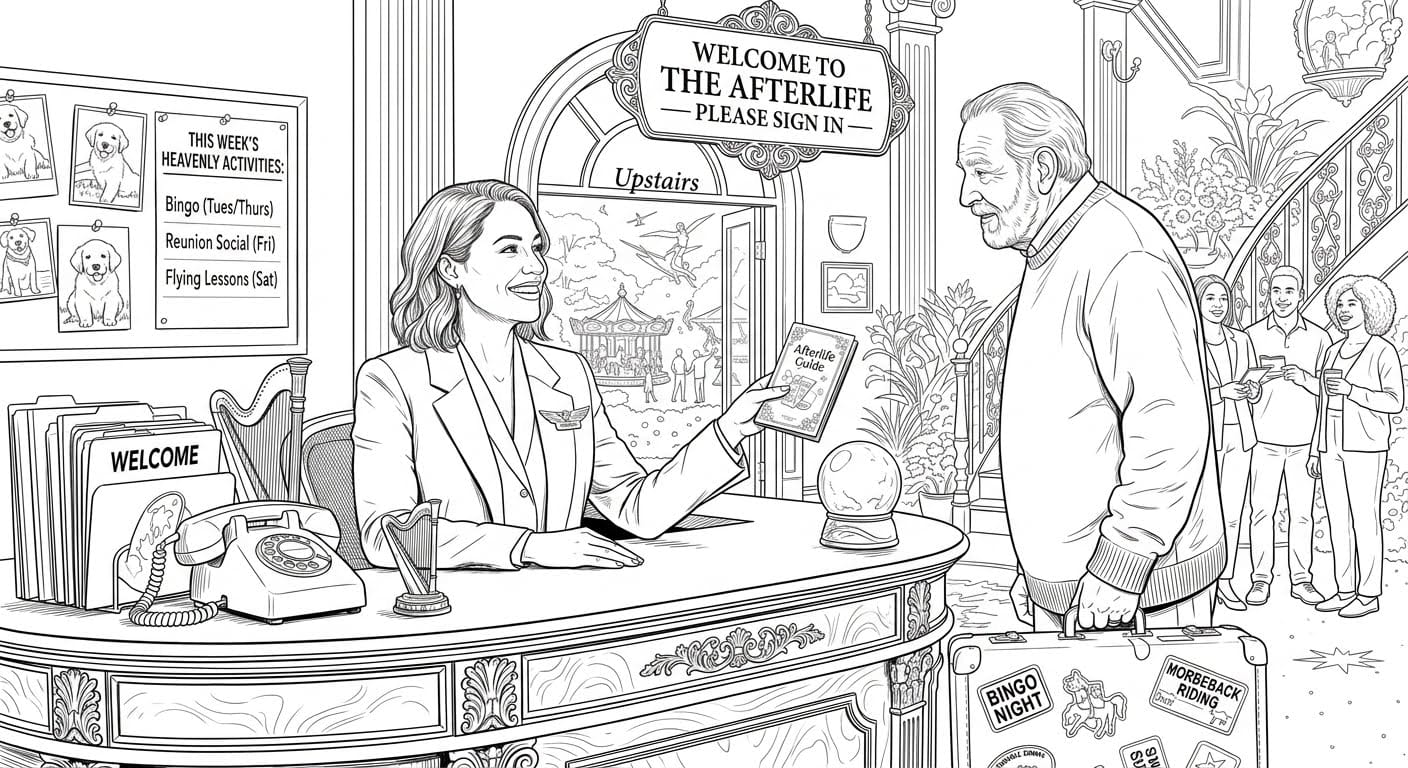
Denise has heard it all. With the patience of a seasoned public servant and the warmth of an old friend, she stands ready with answers that are as thoughtful as they are disarming. In Smith’s expanded narrative, Heaven is revealed to be a place not of rigid, chilly perfection, but of vibrant, restorative joy. It is an estate where the itinerary includes everything from horseback riding and bingo nights to flying lessons and long-awaited reunions. It suggests that eternity might not be a solemn, static monument, but rather an ongoing celebration of the things that made life worth living in the first place.
Yet, to treat this vision as mere cosmic fluff would be to miss its true brilliance. Behind the humor and sparkle lies a sturdy grounding in philosophy and religion, which lends a surprising depth and nuance to Denise’s voice. The book does not shy away from the knottier, more painful mechanics of mortality. It tackles the questions that keep the living awake at 3:00 a.m.: What happens to our unfinished business? How are the souls of babies cared for? Most formidably of all, how do we manage to forgive ourselves—and each other—once we have finally crossed the threshold?
Through a series of encounters with unforgettable souls, the narrative gently unpacks these heavy burdens. It operates on the comforting premise that the invisible threads binding us to one another do not simply snap when a heart stops beating. Instead, Denise serves as a steady reminder that love endures, and that those we have lost are never truly as far away as the quiet geometry of a graveyard might suggest. It turns a grand, terrifying theological concept into an intimate, human-scale meditation on grief and grace.
Ultimately, Welcome to the Afterlife achieves something quite rare in the literature of mortality: it offers solace without sentimentality, and wisdom without pomposity. It reminds the reader that what awaits us at the end of our earthly wanderings may be far less frightening, and far more beautifully ordinary, than the fire and brimstone of antiquity ever led us to believe. It is a hopeful, witty reminder that while life is short, the afterlife might just be wonderfully hospitable—provided, of course, that Denise is there to buzz us through.