
Brought To You By

We know how the trick works. We have seen the documentary footage, read the serialized investigative journalism, and absorbed the paperbacks with earnest, professorial subtitles. The tobacco industry lied about lungs turning black for decades. Big Pharma hid the data when the side effects got messy. Big Oil treated the planet like a rented convertible with a failing transmission while funding think tanks designed to make basic thermodynamics sound like an avant-garde opinion. Everyone knows this. It is cultural common knowledge, right up there with the fact that the 1986 Mets bullpen was perpetually hungover and that The Godfather Part II is better than the original.
So why do we keep letting them do it?
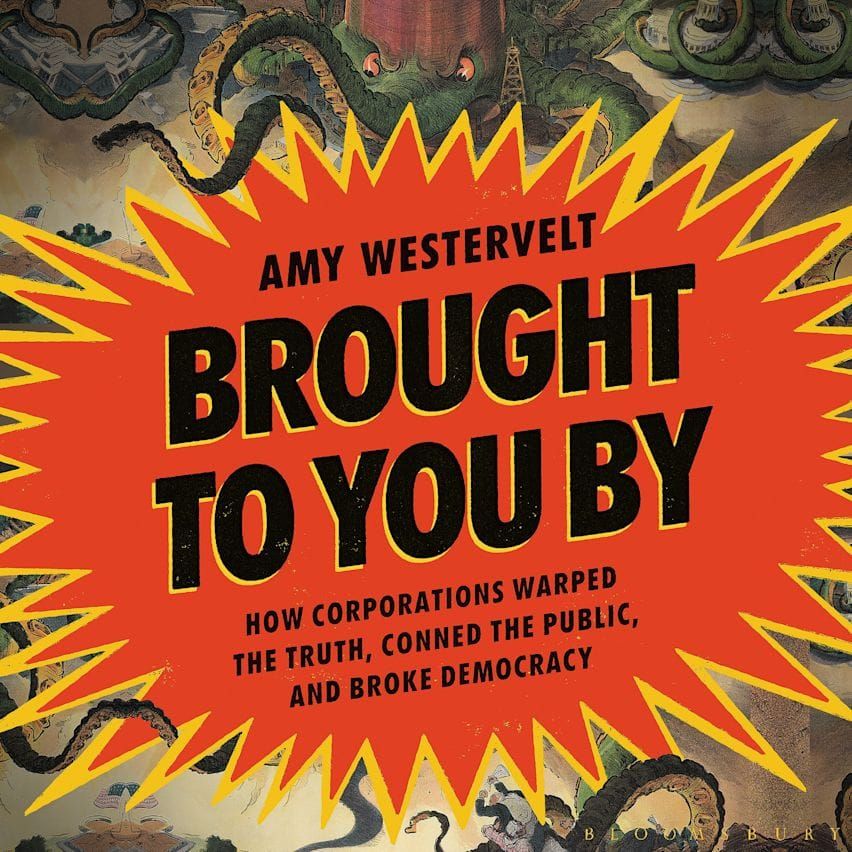
That is the implicit, lingering question at the center of Amy Westervelt’s Brought to You By, a book that does not merely restate the well-documented theorem that corporations lie for profit, but maps out the terrifyingly sophisticated plumbing behind the deception.
We tend to look at corporate misinformation as a series of isolated blunders—a few bad actors in bespoke suits getting caught with their hands in the ethical cookie jar. But Westervelt argues that what we are dealing with is not a glitch; it is the infrastructure. Over the past century, Big Industry didn’t just lobby Congress or run glossy magazine spreads about how much they love clean water and small-town America. They built a parallel reality. They constructed a sprawling, industrial-grade apparatus of sponsored university labs, malleable think tanks, compliant news networks, and high-priced spin doctors whose entire professional mandate is to poison the informational ecosystem until truth just sort of looks like a matter of personal taste.
It is brilliant, in a deeply nihilistic sort of way.
Consider the characters populating this ecosystem. Westervelt zeroes in on the architects of this modern epistemic crisis—people like Herb Schmertz, the Mobil Oil PR wizard who essentially invented the corporate op-ed, turning a multinational petroleum giant into a folksy, intellectual companion for the Sunday paper reading demographic. Or Richard Edelman, the PR titan who helped the dairy industry wage a quiet, existential war against oat milk because heaven forbid someone put a splash of pulverized oats into a latte without an ideological firefight. And then there is the modern evolution: figures like David Petraeus, the disgraced former spy chief casually deploying counter-insurgency tactics—actual military strategies designed to break insurgencies in foreign deserts—to discredit climate science and protect corporate bottom lines here at home.
It is enough to make you long for the simpler times when corporations just paid a guy to stand outside with a sandwich board shouting something demonstrably false.
Instead, we have arrived at an era of unprecedented corporate control where the lines between a lie and an opinion have been sanded down until they are practically invisible. When a corporation spends millions of dollars funding a study that suggests their product is totally fine, they aren't trying to win a scientific debate. They are trying to manufacture a controversy. They understand something fundamental about human psychology: if you can convince the average person that experts disagree, you don't actually have to prove you're right. You just have to make the truth look complicated enough that people throw up their hands, change the channel, and decide to worry about what they're having for dinner instead.
We let them get away with it because the alternative is exhausting.
Accepting the full scale of what Westervelt is describing means admitting that our entire daily information diet—the news we consume, the products we buy, the subtle cultural assumptions we make about what is safe and what is dangerous—has been carefully curated by a roomful of guys in half-windsor knots whose primary metric of success is quarterly growth. It’s much easier to just pretend that everything is a matter of two sides having a lively debate. It is more comforting to believe that oat milk is just a beverage choice rather than an ideological proxy war, or that climate change denialism is just folksy rural skepticism rather than a multi-billion-dollar psychological operation.
We treat corporate speech as if it were identical to individual speech, as if a billion-dollar conglomerate buying a narrative is the same thing as a guy in a coffee shop having a weird theory about zoning laws. We have conflated dollars with words, and opinions with verifiable reality, all because the machinery of modern PR is so seamless that we hardly notice the seams anymore.
Westervelt’s book isn't an optimistic beach read. It’s an autopsy of the social contract. It suggests that if we want to reclaim democracy—or even just reclaim the basic ability to agree on what color the sky is—we have to stop treating corporate propaganda as an annoyance and start treating it as the systemic threat that it is.
Until we do that, we’re just extras in a commercial we never signed up to watch, nodding along while someone tells us that the smoke on the horizon is just a very interesting point of view.