
Careless People

The meeting rooms at Facebook weren’t filled with cartoon villains. Instead, they were packed with young guys in gray hoodies, drinking trendy kombucha, convinced they were changing human consciousness. They genuinely believed that connecting the world was a secular miracle. What they missed—or chose to ignore—was that their new digital pipes were leaking toxic sludge into society.
When Sarah Wynn-Williams climbed into Facebook's upper management, she entered a world that felt more like a cult than a corporation. Mark Zuckerberg was the high priest, using his public awkwardness to hide massive, imperial ambition. Sheryl Sandberg was the high priestess of corporate feminism, using her "Lean In" slogan as both an inspiration and a managerial club. They created a pressure cooker disguised by luxury perks like private jets, gourmet meals, and meetings with world leaders. But underneath the shiny, utopian surface, the culture was rotten with double standards, blatant misogyny, and deep institutional carelessness.
The big problem was the massive gap between Facebook's public myth and its actual reality. Inside the company, growth metrics were the only truth that mattered. Engagement, active users, and data optimization were the gods they worshipped in Menlo Park. Engineers tweaked algorithms to feed users exactly what kept them scrolling: outrage, conspiracy theories, and division. To the tech guys, it was just good data; to the rest of the world, it was the destruction of democracy.
Wynn-Williams saw firsthand what happened when these data points collided with real-world politics. She watched tech executives stumble through awkward meetings with foreign military juntas, who had realized that a platform built to rate college girls' looks was a perfect tool for inciting ethnic violence. Facebook's response wasn't panic or self-reflection—it was just public relations. The machine couldn't be stopped; it could only be spun.
The absurdity peaked after the 2016 U.S. presidential election. For months, Russian disinformation and fake news networks used Facebook’s ad system to tilt American democracy. When Zuckerberg was finally forced to face the fact that his creation helped put Donald Trump in the White House, he didn't look inward. Instead, he looked at the wrecked political landscape and blamed the public. In Facebook's eyes, the platform wasn't broken; the voters just didn't use it right.
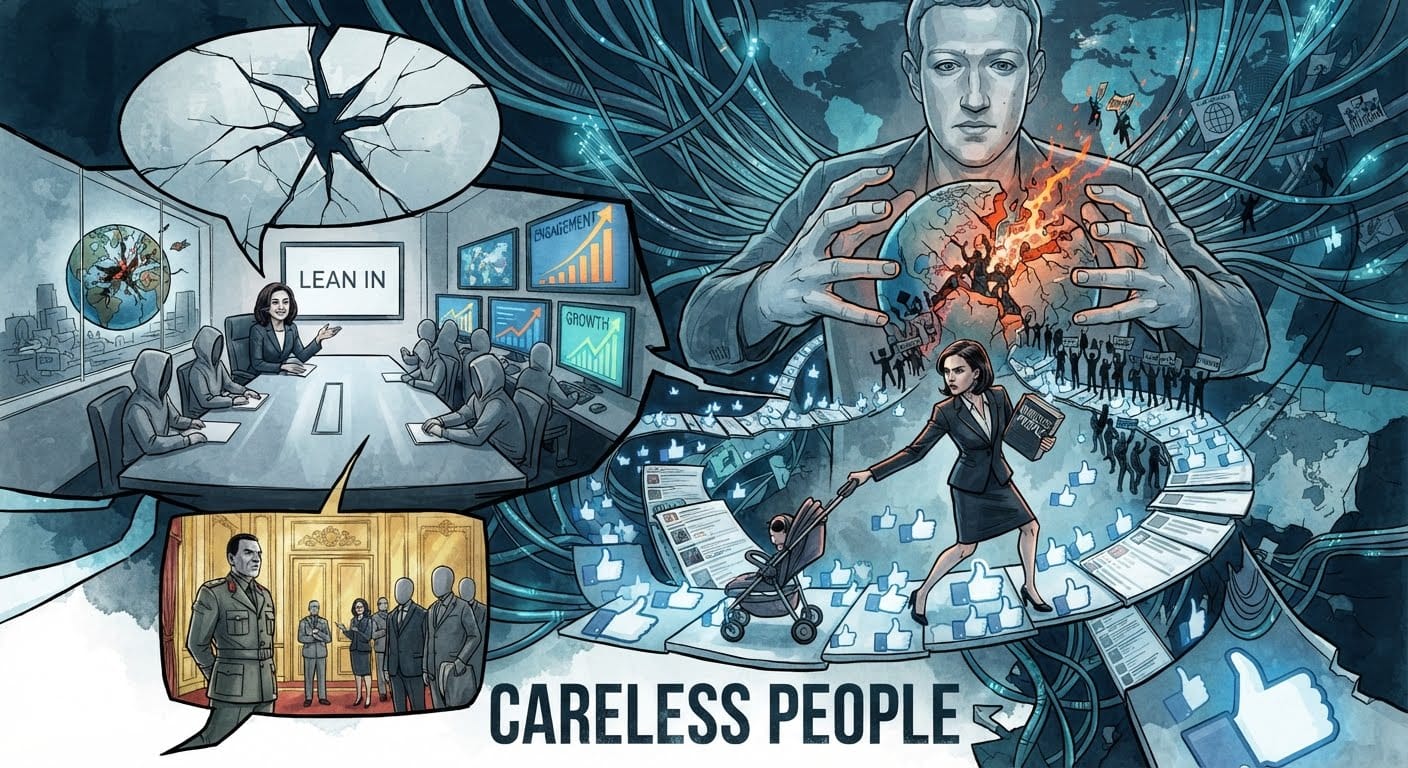
Meanwhile, everyday life for employees was its own nightmare. For Wynn-Williams, being a working mother in that aggressive culture required massive mental gymnastics. The company preached inclusivity but demanded that employees sacrifice their personal lives for corporate growth. Under Sandberg’s "Lean In" doctrine, leaning in didn't mean changing the system to help people—it meant turning yourself into a mindless cog in the machine. Moms who needed flexible hours were treated like computer glitches in a system built for 80-hour workweeks.
The most terrifying part was how much power was concentrated in the hands of a few totally unqualified people. A tiny circle of global elites, protected by extreme wealth and yes-men, controlled global conversation. The ultimate irony was that the more power they got, the less responsibly they acted. They built a machine too big to control, but too profitable to shut down.
When Wynn-Williams exposed this reality in her memoir, Careless People, Facebook predictably panicked. The media giant moved quickly to squash her story before the public could catch on. It was a classic display of corporate arrogance: using massive power to silence a critic, which outsiders slammed as a direct attack on free speech.
But the attempt to silence her backfired and made the story even bigger. The book became a massive hit, earning a spot as a New York Times Notable Book and making "best book of the year" lists at Time, The New Yorker, NPR, The Economist, and Scientific American. Critics loved its sharp, funny, and shocking look inside the tech elite.
Ultimately, the Facebook story is a modern warning about the dangers of unchecked arrogance. It shows what happens when a few careless people hold the world in their hands, believing that because they understand computer code, they understand human beings. They weren't comic book villains, but they were deeply reckless—and the rest of the world is still paying the price.
-30-