
Court and Spark, and the Sound of a Country Catching Its Breath

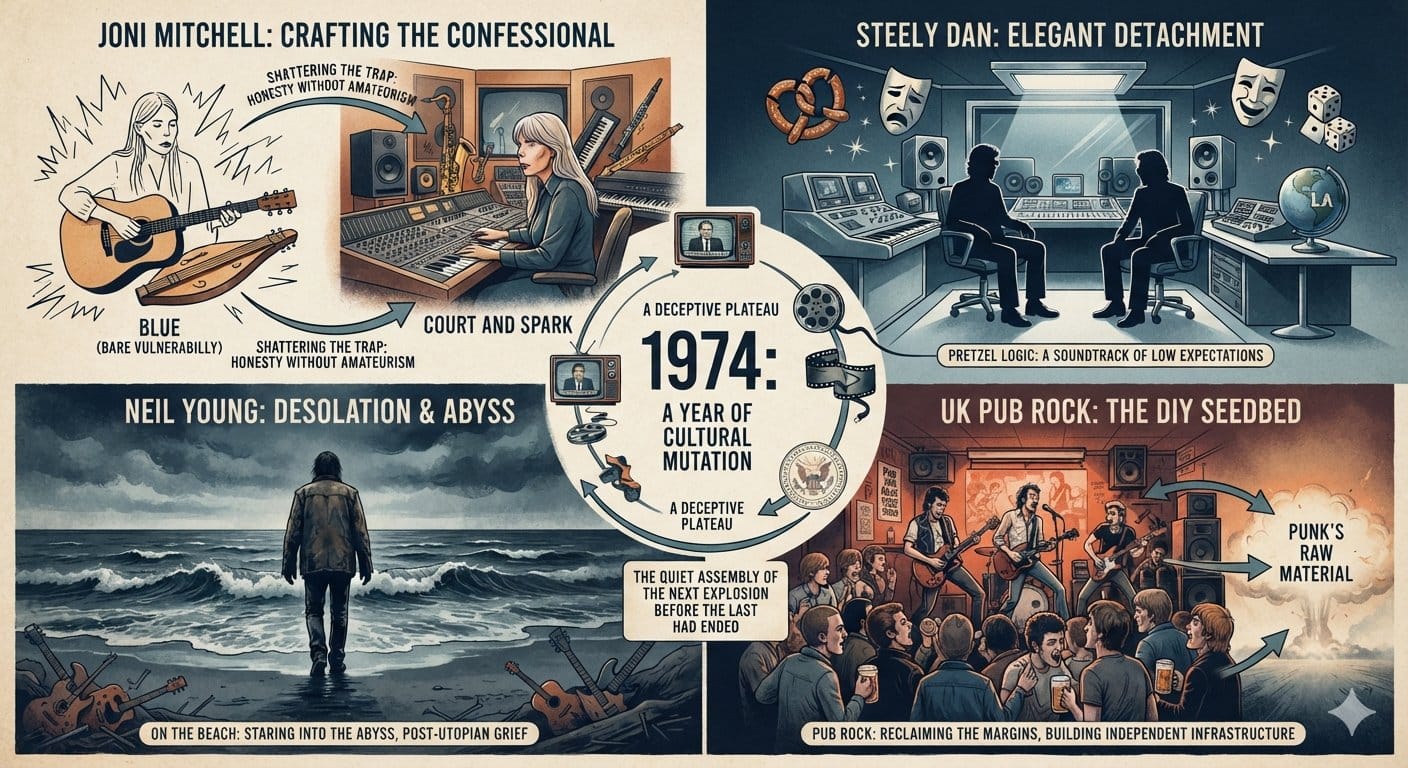
Joni Mitchell released Court and Spark in January 1974, and it’s worth concentrating on the album specifically because of what it represented in her own arc as an artist. For years, the prevailing consensus around the California singer-songwriter movement was that authenticity was directly transactional with exposure. The more naked the vulnerability, the truer the art. Blue, three years earlier, had been almost unbearably raw—a woman documenting heartbreak with no protective layer between the listener and the wound. It was an album that felt like an open acoustic nerve, establishing a standard of confessional intimacy that threatened to trap Mitchell within the very trauma she so beautifully articulated.
Court and Spark shattered that trap. It is no less honest than its predecessors, but it is honest with considerably more polish, more jazz sophistication, and the confident, settled craft of an artist who had fully arrived. No longer just a woman working out how much of herself she was willing to expose to a voyeuristic public, Mitchell took command of the studio. She integrated the smooth, complex modal shifts of Tom Scott’s L.A. Express, trading the sparse, weeping dulcimers of her early career for a lush, layered canvas of woodwinds, electric pianos, and intricate rhythm sections.
The record became her biggest commercial success. It served as definitive proof that the massive audience the confessional movement had built over the previous few years was now large enough, and sophisticated enough, to follow an artist as she grew more musically ambitious. Instead of punishing Mitchell for moving past her own most famous wounds, listeners embraced the transition. Tracks like "Help Me" and "Free Man in Paris" proved that intellectual rigor and commercial accessibility could coexist. Mitchell had successfully decoupled honesty from amateurism, signaling to the entire industry that the introspective 1970s had achieved a sleek, mature musical vocabulary.
While Mitchell was elevating the confessional into the stratosphere of high jazz art, other corners of the American landscape were curdling into something far more cynical, detached, and brilliant. Steely Dan released Pretzel Logic that February, tightening the jazz-inflected, lyrically cryptic sound Walter Becker and Donald Fagen had been refining since their debut. In an era dominated by the earnestness of stadium rock and the glitter of glam, Steely Dan stood almost entirely apart. They functioned like a pair of misanthropic studio directors hiring the finest session musicians in Los Angeles to execute their hyper-precise, ironical visions.
Pretzel Logic rewarded close listening with a wit and a musical sophistication that felt entirely out of step with the standard tropes of rock counterculture. In songs like "Rikki Don't Lose That Number" and the title track, Becker and Fagen blended Duke Ellington-style phrasing and bebop complexities with pristine pop hooks. Yet beneath the flawless, sterile perfection of the production lay a deep, pervasive American malaise. Their lyrics drifted through worlds of fading actors, historical time-travel, drug deals gone sideways, and an overarching sense that the idealistic promises of the previous decade had been nothing more than a sucker’s bet. They provided the definitive soundtrack for an era of low expectations, where the only survival mechanism left was an armor of intellectual irony.
If Steely Dan’s response to the rot of the mid-1970s was an elegant, mocking withdrawal into the studio, Neil Young’s response was to walk directly into the surf and let the tide pull him under. 1974 gave the world Neil Young's On the Beach, a record so bleak, so thoroughly saturated with post-Manson, post-Altamont, post-everything California disillusionment that Young himself kept it out of print for decades. He was deeply uncomfortable with just how raw and unresolved its portrait of a burned-out counterculture actually was.
On the Beach is the sound of the morning after the utopian dream died. Recorded in a haze of grief, substances, and profound alienation from his own massive stadium-level stardom, Young stripped away all the pastoral comfort of Harvest. On the epic, slow-burning title track and the devastating "Ambulance Blues," his guitar lines don't soar; they scratch and scrape against the arrangement like rusty nails. Young sings about the revolution turning into a lifestyle brand, about the terrifying emptiness of the Hollywood hills, and about the realization that the politicians and the radicals were ultimately cut from the same cloth. It was an album that stared directly into the abyss of a broken society, refusing to offer the listener any comforting choruses or easy escapes. It remains a monolith of beautifully preserved desolation.
Across the Atlantic, far away from the sun-bleached paranoia of Los Angeles and the brooding ranches of Northern California, a different kind of decay was generating an entirely separate musical mutation. In the pubs and small clubs of London, a scene was quietly forming that almost nobody paying attention to arena rock in 1974 would have predicted mattered at all.
By 1974, mainstream British rock had become an ecosystem of staggering excess. Progressive rock acts filled stadiums with multi-truck stage sets, laser shows, and side-long keyboard solos based on classical mythology. The barrier between the performer on the stage and the kid in the audience had never been wider or more financially insurmountable. In direct, visceral reaction to this increasingly bloated, orchestral ambition, a loose collective of musicians began reclaiming the margins.
This was pub rock. It was stripped-down, unpretentious, and aggressively retro. Bands like Dr. Feelgood, Ducks Deluxe, and Kilburn and the High Roads didn’t want to play stadiums; they wanted to play the back rooms of public houses to crowds of sweaty, beer-drinking working-class kids. Dr. Feelgood’s guitarist, Wilko Johnson, pioneered a rigid, percussive, machine-gun style of playing that abandoned the self-indulgent blues solos of the era in favor of pure, rhythmic violence.
Nobody called it a movement yet. To the mainstream music press, it was just a minor, nostalgic anomaly—a bunch of retro-leaning bands playing loud, short songs in small rooms because they’d gotten sick of eleven-minute synthesizer movements. But this dismissive view completely missed the architectural revolution taking place. Pub rock was quietly building the exact infrastructure of small independent venues, a fierce DIY attitude, and a simple, aggressive songcraft that punk would explode out of within just another two years. The pub circuits bypassed the major record label gatekeepers, proving that a band could sustain itself entirely on the energy of a local, localized community. The raw material for everything the Sex Pistols and the Clash would detonate in 1976 and 1977 was already quietly assembling itself in 1974, in rooms far too small for anyone in the mainstream to notice.
Truly, 1974 represents a strange, deceptive plateau in Western culture. To the casual observer look at the evening news or the box office charts, it appeared as though a grand cycle of American history had reached its logical, therapeutic conclusion. The constitutional crisis of Watergate had been resolved by the system working exactly as it was designed to do. The dark, paranoid masterpieces of cinema—Chinatown, The Conversation, and The Godfather Part II—had successfully diagnosed and exorcised the institutional demons of the age, transforming the nation's collective trauma into high art. The accountability the country had spent four long, exhausting years fighting for had finally arrived, and the art that decade of honesty had produced was already sitting, permanently, among the greatest work America would ever make.
But history does not pause for a curtain call. Even as the mainstream celebrated its survival and parsed its clean reflections in the mirror of popular culture, the ground was already shifting. The stability achieved in August 1974 was an illusion. The economic anxieties of inflation, the lingering psychic wounds of an unresolved war, and a deep, systemic distrust of authority could not be cured by a resignation speech or a cinematic masterpiece.
Underneath all of it, in small rooms, independent studios, and sticky-floored pubs that nobody was watching closely yet, the next explosion was already loading. The artists of 1974 had mapped the wreckage of the old world with stunning, unforgettable precision. But out in the dark, a new generation was already gathering the fragments, preparing to build something far faster, louder, and more dangerous out of the debris.
Tim
Tim Lowe is a writer, book expert, retired sailor, retail worker, and renaissance man.
He is currently traveling the country and working on his forthcoming book.