
Dead Batteries (fiction)


In the late autumn of 1989, a small team of engineers at Nintendo’s Research & Development 1 division in Kyoto, Japan, did something counterintuitive. At a time when the entire consumer electronics industry was racing toward high-definition color screens, backlit displays, and raw processing power, this group—led by a legendary, self-taught engineer named Gunpei Yokoi—decided to release a handheld gaming console that was deliberately underpowered.
It was called the Game Boy. It had a tiny, unlit screen that displayed four shades of greenish-gray. It looked like a brick. It was, by all contemporary metrics of tech innovation, a relic before it even launched. Yet, it went on to sell over 118 million units worldwide, becoming one of the most successful pieces of technology in human history.
Why? Because Yokoi understood a fundamental principle of human behavior that his competitors missed—a concept he termed Karei naru Kareki, or "Lateral Thinking with Withered Technology." Yokoi realized that consumers don’t actually want cutting-edge complexity; they want reliability, affordability, and above all, familiarity. They want a machine that doesn't break, and one where the batteries last for thirty hours instead of three.
This idea—that survival and success are not products of hyper-sophistication, but of radical simplicity and extreme adaptation to constraints—is the invisible engine driving one of the most remarkable and gripping debut novels of recent years.
Consider the premise. The world has been obliterated. A catastrophic pandemic has wiped out 99.9% of the global population in a matter of weeks. In the lexicon of sociology, this is what we call a "clean break" event—a moment where the existing infrastructure, social contracts, and norms of civilization vanish overnight. For most people, this is an unmitigated disaster. The sudden shift from a highly connected, hyper-vocal world to an absolute, terrifying silence causes immediate psychological collapse.
But what happens when the end of the world is intercepted by someone who has already been living in the end of the world?
Enter May. In the "Before," May’s life was defined by a very specific kind of structural isolation. Her husband left the moment parenthood became difficult, leaving her alone to raise their autistic son, Davis, who has high support needs. In a modern, pre-pandemic society—a society that prides itself on efficiency, speed, and rigid behavioral expectations—May and Davis were effectively discarded. The world had no patience for Davis's meltdowns, no flexibility for his need for absolute routine, and no grace for May’s exhaustion.
To survive in that world, May had to become an expert in what psychologists call "social cocooning." She mastered the art of self-imposed isolation. She mapped out the exact margins of her environment. She figured out how to exist entirely outside the mainstream grid of human interaction.
And this is where the book introduces its first great Gladwellian twist: When the pandemic hits, May and Davis do not collapse because their existing life was already a masterclass in pandemic survival.
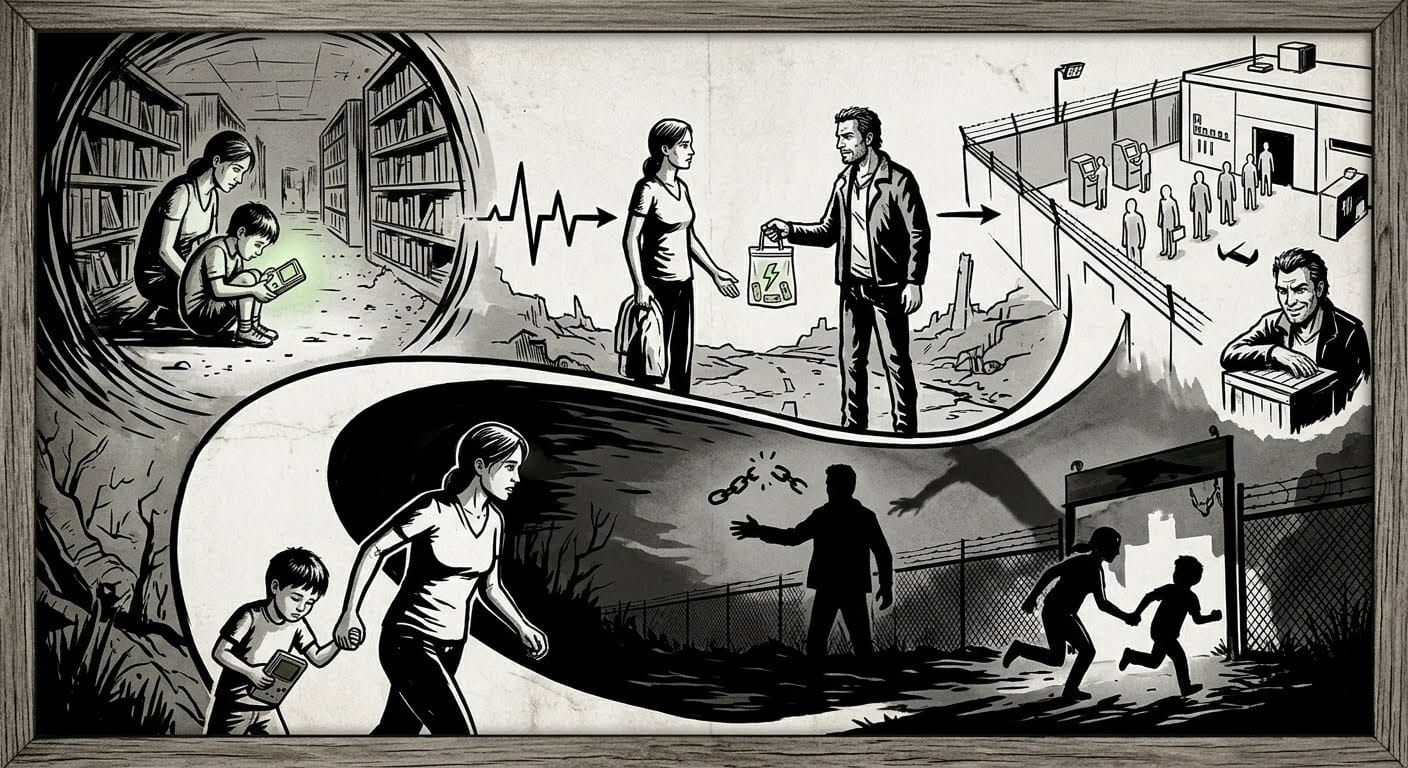
The very traits that made them outliers and misfits in a bustling, neurotypical society suddenly become their greatest competitive advantages. While the rest of modern civilization is panicking over the loss of grocery stores and social media, May and Davis simply pivot. They move into an abandoned library. They establish a precise, unyielding routine. And most importantly, they rely on a single, archaic piece of "withered technology" left over from the 1980s: a battery-powered Game Boy.
For Davis, the Game Boy is not a toy. It is a psychological tether. In the field of developmental psychology, we talk about "anchoring mechanisms"—objects or routines that allow a neurodivergent mind to regulate stimulus and find predictability in a chaotic environment. The predictable, 8-bit chiptunes and the repetitive movements of the pixels provide Davis with a safe harbor. As long as the Game Boy has power, Davis is regulated. As long as Davis is regulated, they can survive.
But this brings us to the core problem of the narrative, a problem that is fundamentally logistical: the battery paradox.
May can scavenge for food. She can fortify a library. But she cannot manufacture double-A batteries. Every hour Davis plays, the clock ticks closer to zero. And when the batteries run out, the anchor vanishes, and the fragile ecosystem May has built will shatter.
This structural vulnerability is what forces May into a dangerous transaction. She encounters a stranger named Bird. Bird is a classic example of what sociologists call a "social operator"—a man who survives not through isolation, but through leverage and manipulation. Bird has discovered a hidden community of survivors. But the community has a strict, gatekeeping rule: they only admit families. They want the illusion of the old world. They want order. Bird needs a wife and a child to get through the gates; May needs the one thing this community possesses in abundance—crates of batteries.
What follows is a fascinating psychological experiment in forced cooperation. May agrees to play the part. She leaves the safety of her library, uproots Davis from the routine that keeps him sane, and enters a community that promises stability but demands conformity.
When we look closely at how communities form after a disaster, we often find a hidden tension between security and control. The tragedy of May’s new reality is that this haven of survivors is not a utopia; it is a manifestation of the very same biases, hierarchies, and rigid expectations that marginalized her and Davis before the world ended. The new world, it turns out, looks depressingly like the old one. It is just as intolerant of deviation, just as transactional, and just as dangerous for a boy who cannot speak or look a gatekeeper in the eye.
When Bird’s true, dark motivations are finally illuminated, May is forced to confront a radical question. In a world stripped down to its bare elements, what is the true cost of protection? And how far will a mother go to defend an outlier?
Ultimately, this debut novel is not just a gripping thriller about the post-apocalypse. It is a profound exploration of human adaptation. It reminds us that sometimes, the tools we need to survive the future are not the loudest, newest, or most sophisticated technologies. Sometimes, survival belongs to the quietest among us, armed with nothing more than a mother's fierce resolve, a pocketful of double-A batteries, and a little gray plastic brick that refuses to die.
-30-