
Death of an Ordinary Man

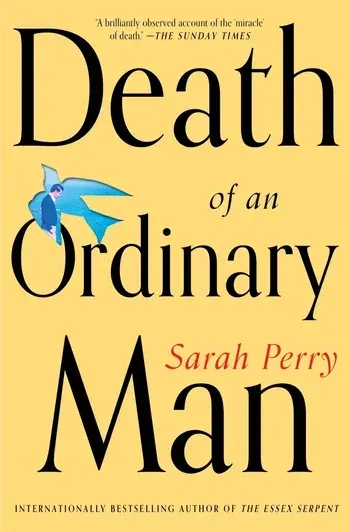
The literary landscape is currently crowded with what I tend to think of as "grief architecture"—books constructed so precisely to house the author’s pain that the reader often feels like an intruder in a highly curated mausoleum. We live in an era that demands vulnerability but frequently settles for a performance of it. So when a novelist of immense, almost intimidating talent turns their gaze toward the finality of the flesh, one braces for impact.
The book opens on a scene so aggressively pleasant it feels retroactively haunted: a charming, merry seaside carnival in Yarmouth. It is late August, that specific pocket of the year where the light begins to turn golden and thin, carrying the first faint scent of decay. Perry, her husband, and her father-in-law, David, are participating in a decades-old ritual. The day was fine, Perry notes with a novelist's restraint, and the shining tide was going out. It is a image of perfect, unremarkable stability.
And then, the drop.
Three weeks later, Perry watches David approach across a market square. In that single, unbidden glance, she is struck by a certainty she has never possessed before: David is dying. There is no dramatic symptom, no sudden collapse, just a shift in the way he occupies space. He would be dead in less than three months from a rare, swiftly moving cancer. Anyone who has ever loved a person through a terminal illness knows this specific, sickening flash of clairvoyance and the moment the loved one ceases to belong entirely to the world of the living and begins their slow orientation toward the dark.
What follows is an intimate account of sitting at David’s bedside across those final days. Where a lesser writer might retreat into fuzzy sentimentality or high-flown metaphor to soften the blow, Perry leans into a style that is both devastatingly plain and clinically scientific. She understands the truth that our death-denying culture tries desperately to ignore: the end of a human life is a physical event. It has a cadence, a biochemistry, a brutal and fascinating mechanics. By laying out these details, Perry doesn't strip the process of its dignity; rather, she restores a profound, grounding reality to it. She invites the reader into the quiet, claustrophobic reality of the hospice room—a space where time stretches and collapses, where the clink of a teacup or the turning of a newspaper page carries the weight of an epoch.

Yet, Perry’s mind is too capacious to remain trapped within the four walls of a sickroom. Throughout the narrative, she brilliantly interweaves her immediate, raw experience with a broader historical perspective. She traces how humans have accounted for death throughout the ages, examining the shifting rituals, the poetry, and the philosophies we have desperately constructed to anchor ourselves in the face of the void. She looks to the stars, to ancient texts, and to modern medicine, creating a trademark blend of the factual and the spiritual. It is a narrative strategy that prevents the book from collapsing under the weight of its own sadness. Instead of a insular cry of pain, the memoir becomes a grand, collective human inventory. It reminds us that while grief feels entirely isolating, dying is, ultimately, the most democratizing and human thing any of us will ever do.
But the true triumph of Death of an Ordinary Man lies in its resistance to abstraction. Perry never allows David to become simply a symbol of mortality or a canvas for her own philosophical musings. She ensures we know exactly who he was in all his specific, unrepeatable glory. We learn the exact, stubborn way he drank his tea. We learn which sections of the Sunday newspaper he reached for first, the specific sound of his laughter, and the constellation of people and animals that held his affection.
This is where the book achieves its deepest emotional resonance. Perry forces us to confront the terrifying asymmetry of loss: the way an entire universe of specific habits, memories, and preferences can be permanently erased from the earth in a matter of weeks. She mourns all that will be lost forever with his passing, yet—in a move that feels marvelously transcendent—she uses the very act of writing to celebrate that he was here in the first place. The prose functions as a defiance of time, a stubborn insistence that David's specific life mattered.
Written in Perry’s inimitable, luminous style, Death of an Ordinary Man manages to be both fiercely intellectual and fiercely tender. It is a book that refuses to offer cheap comfort or easy answers about what comes next. Instead, it offers something far more valuable: a clear-eyed, courageous look at the beauty and terror of being a biological entity capable of love. It is a riveting, abundant work that reminds us, line by brilliant line, that when it comes to the human condition, there are no ordinary men.