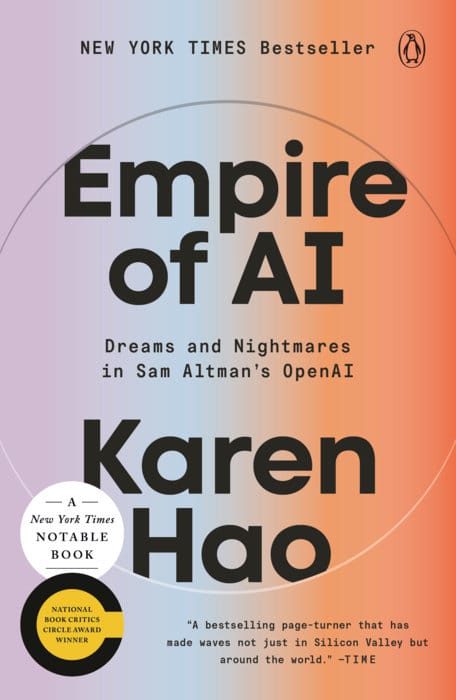
Empire of AI

Dreams and Nightmares in Sam Altman's OpenAI
The talk surrounding artificial intelligence has long been dominated by two extremes: promises of a frictionless future and alarmist warnings about impending doom. Both approaches prove distracting, and both are fundamentally shallow. The true story of AI is not found in the speculative fiction of the future, but in the brutal, material reality of the present.
Empire of AI is the definitive account of the most fateful tech arms race in history. It moves past the headlines to document exactly how the industry defining our era is reshaping the planet as we speak.
When the artificial intelligence sector first burst into the public consciousness, the prevailing sentiment was one of optimism. OpenAI, under the leadership of Sam Altman, positioned itself as a counterbalance to the profit-driven, often reckless impulses of legacy Big Tech. Founded as a nonprofit, its mission statement explicitly prioritized safety and human benefit above all else. For many, it was a compelling vision, a necessary check on the system.
However, Empire of AI peels back the layers of that vision to reveal a different reality. The book demonstrates that success in the current AI landscape requires an unprecedented level of resource extraction. Building models capable of mimicking human cognition demands far more than just sophisticated code. It necessitates a voracious appetite for high-end compute power, astronomical volumes of data scraped from across the internet, and a hidden, global army of laborers—often working for minimal wages in the Global South—tasked with cleaning and categorizing the raw information that feeds the system.
Underneath the software lies an environmental cost that is rarely acknowledged - a staggering spike in energy and water usage already taxing local infrastructures from the American Southwest to Chile. We have entered a new age of empire, where the barriers to entry are so high that only a handful of trillion-dollar corporations can compete. The critical question presented here is no longer whether this technology will be dangerous, but who holds the authority to decide which risks are acceptable.
Empire of AI chronicles the transformation of OpenAI from a principled nonprofit to a corporate behemoth fueled by billions in Microsoft capital. It provides an unprecedented, intimate view of the internal fractures that led to the world-shaking events of late 2023—the sudden firing and triumphant return of Sam Altman—told in full for the first time.
This work moves past the sanitized public relations distributed from corporate headquarters. Instead, it is constructed upon years of rigorous, on-the-ground reporting. The book synthesizes the perspectives of the engineers in Silicon Valley building the architecture, the data laborers in Kenya scrubbing it, and the water activists in Chile fighting to protect local resources from the demands of massive data centers.
What emerges is a portrait of a system that is warping the judgment of everyone involved. While it is tempting to label corporate leaders as villains, the reality is more complex. Power is rarely naked; it is almost always draped in the language of progress and the ideology of benevolence. The individuals driving this frenzy believe they are saving the world, even as the enormous wheels of extraction they have set in motion continue to grind.
Empire of AI is not a book about the "gods" of the industry. It is a book about the people—those in the corner offices making the decisions and those on the ground bearing the costs. By bridging the gap between technical, political, and human analysis, this book pierces the veil of the industry that is currently reshaping the planet.
For readers seeking to move beyond the hype and the panic, Empire of AI provides a clear-eyed account of the mechanisms of this new frontier. The public is often told that this transition is inevitable and that the trajectory is fixed. This book demonstrates that it is neither. The path of this technology is a series of choices, made by specific people, in specific rooms, for specific reasons.
To understand how the current state was reached, who is actually pulling the levers, and why the "good guys" narrative finally collapsed, this book provides the necessary evidence. We are in the middle of a massive global displacement, and it is time to view it for what it truly is.