
ER: The Oral History

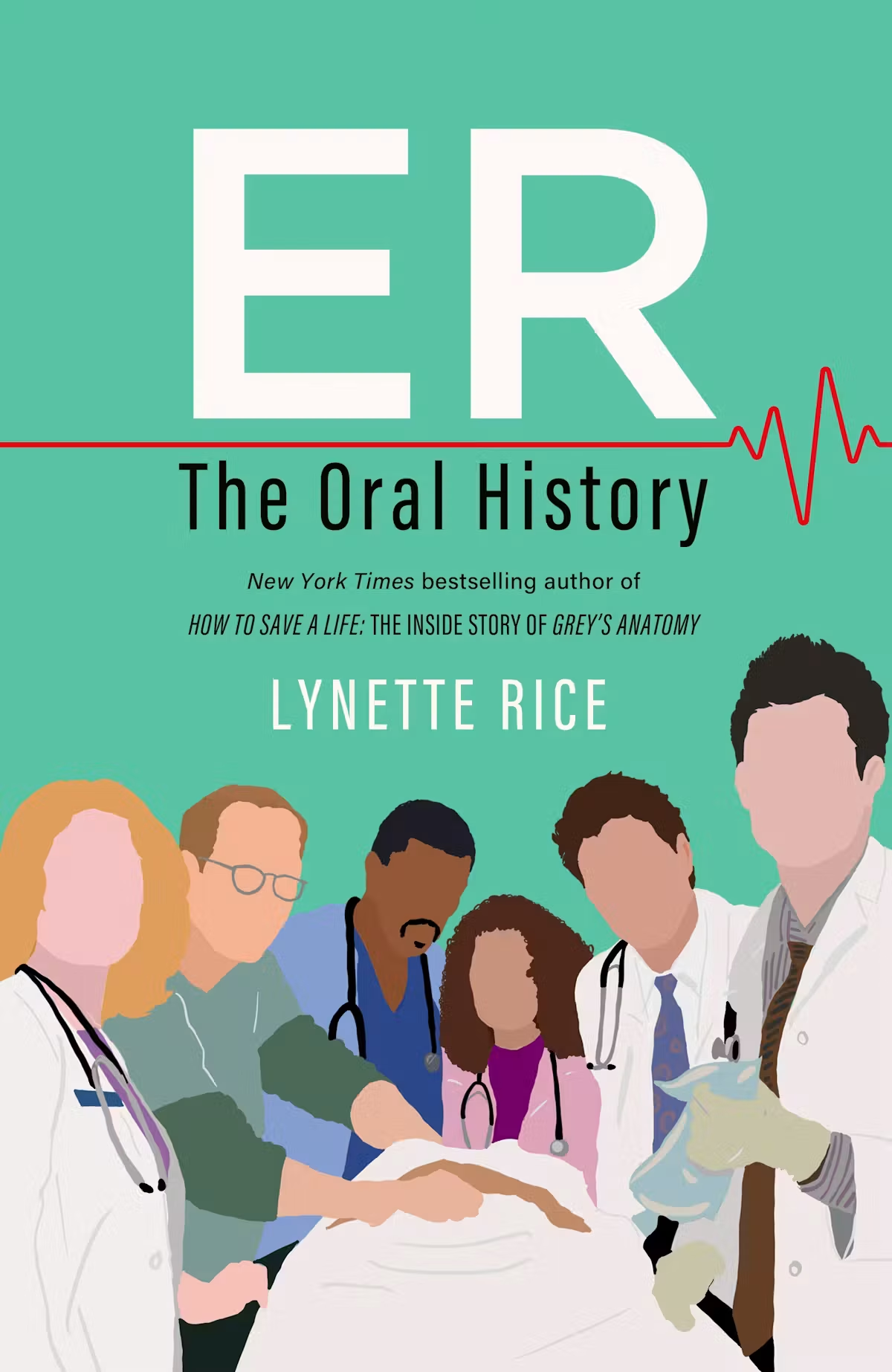
The movies have always been terrified of the truth of a hospital. For decades, Hollywood treated the emergency room as a sterile stage for melodrama, a place where doctors with perfectly parted hair delivered grave diagnoses in hushed, theatrical tones, and patients died gracefully with their makeup intact. It was clean. It was orderly. It was a lie.
Then came Michael Crichton. Long before he cloned a single dinosaur or built a theme park full of prehistoric nightmares, Crichton was a young medical student at Harvard, pacing the linoleum floors of a high-octane emergency department. He didn't see melodrama; he saw a war zone. He saw a relentless, grinding machine fueled by adrenaline, cheap coffee, and the terrifying realization that human lives hang on split-second decisions made by people who haven't slept in thirty-six hours. He wrote a screenplay about it. Hollywood, predictably, looked at the chaos, the overlapping dialogue, and the sheer velocity of the narrative and said, No thank you. It was too fast, too dirty, too real.
It takes a monster to make a miracle in show business. Only after Crichton’s Jurassic Park became a cinematic juggernaut did Steven Spielberg look at the towering author and ask the eternal Hollywood question: What else do you have in the drawer? The rest is television history. The suits didn't want a movie, but they desperately needed a hit for the small screen. What they got was ER, a cultural earthquake that shook the foundations of broadcasting.
When ER burst onto NBC, it was pitched against CBS’s Chicago Hope, a traditional, slick, handsomely mounted medical drama. It wasn’t a fair fight. Chicago Hope was a movie from 1956; ER was a bullet train. It cannibalized its competition because it understood something fundamental about the modern audience: we didn't want to be comforted by authority figures anymore; we wanted to be strapped into the passenger seat of a runaway vehicle.
Watching those early seasons of ER was an visceral experience. The camera, handled with a frantic, Steadicam urgency, chased doctors down infinite corridors. The dialogue was a dense, impenetrable thicket of medical jargon—“CBC,” “chem-7,” “bag him!”—delivered at a auctioneer's pace. You didn't always know what the words meant, but you knew exactly what was at stake. It was pure cinema deployed on a wooden television set. In an era before streaming, before digital video recorders allowed us to pause and breathe, ER commanded the American Thursday night. Thirty-five million people sat down at the exact same hour, week after week, to watch County General Hospital bleed.
But a gimmick like velocity only carries a show for a season or two. What kept ER at the pinnacle of the medium for fifteen years was its extraordinary eye for human behavior, anchored by a cast of actors who looked and felt like real, flawed citizens of Chicago.
Consider the young, callow Dr. John Carter, played by Noah Wyle with a beautiful, fumbling vulnerability. We watched him grow from a terrified student into the battle-hardened conscience of the ER. There was Anthony Edwards as Dr. Mark Greene, the quintessential ordinary man under extraordinary pressure—the kind of doctor you actually pray will walk into your room when the world is ending.
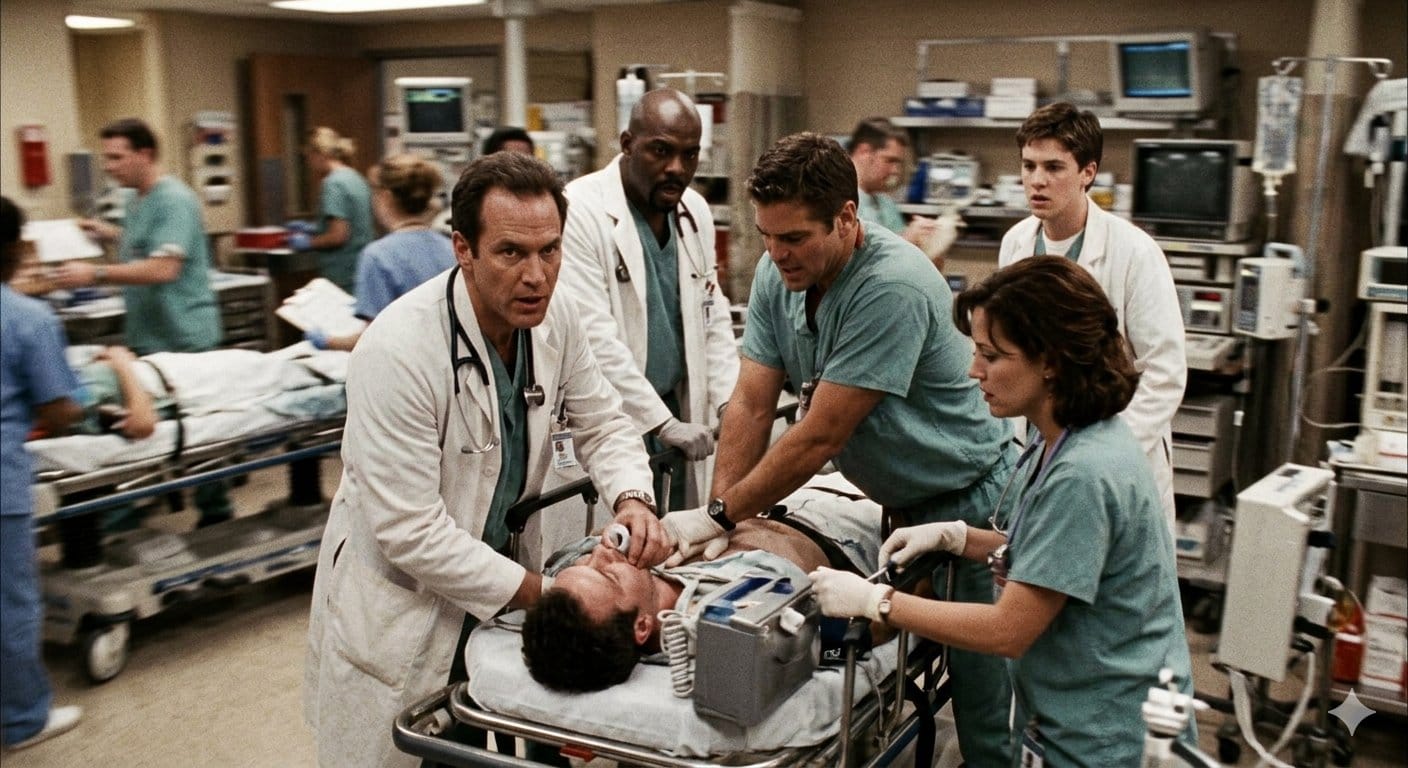
And then, of course, there was the handsome fellow with the Caesar haircut. George Clooney had bounced around Hollywood for years, a journeyman actor in search of a frame that could hold his specific, old-school movie star charisma. As Dr. Doug Ross, a pediatrician with a self-destructive streak and a fierce devotion to vulnerable kids, Clooney found his lightning bolt. He played Ross not as a hero, but as a man constantly running from his own shadow. His chemistry with Julianna Margulies' Nurse Carol Hathaway became the romantic spine of the series, an operatic, high-stakes love story born amid the ruin of the trauma bays.
Stars left, as stars always do when the movies come calling. Clooney departed for the big screen, Margulies followed, and lesser shows would have collapsed into the dust. But ER possessed a rare, institutional strength. It was built like a real hospital; the staff turns over, but the emergencies keep coming. The show seamlessly re-invented itself, bringing in a murderer’s row of vibrant talent: Maura Tierney, bringing a bruised, cynical intelligence as Abby Lockhart; Mekhi Phifer's brash intensity; Linda Cardelinni's grounded warmth.
Over 124 Emmy nominations and fifteen seasons, the show mapped the entire terrain of the human condition. It gave us births in elevators, tragic deaths in the snow, weddings in the rain, and the slow, agonizing decline of beloved characters. It dared to be bleak when reality demanded it, and it found small, transcendent moments of grace in the quiet hours of the morning shift.
Today, television is flooded with medical procedurals. The networks are lousy with copycats, most notably Grey's Anatomy, which has spent decades trading on the romantic entanglements of attractive surgeons. But let us be clear: there would be no Grey Sloan Memorial without the cracked pavement outside County General. ER invented the vocabulary of modern television drama. It proved that an audience could think fast, feel deeply, and tolerate a messy, unresolved world. It remains a towering achievement, born from the frustrated dreams of a medical student who looked at a room full of suffering and saw a masterpiece.