
Fear, Faith, and the Old Neighborhood

The Exorcist opened in December of 1973 and did something almost no horror film before it had managed — it convinced serious critics, serious audiences, and even the Catholic Church itself to take it seriously as a genuine work of art rather than dismiss it as disreputable genre entertainment. William Friedkin, fresh off The French Connection, shot the film with the same documentary-grade realism he'd brought to Popeye Doyle's car chase two years earlier, refusing every cheap shortcut horror films typically relied on, and the result was a movie so viscerally overwhelming that theaters reportedly kept smelling salts on hand for fainting patrons and ambulances parked outside for the genuinely traumatized. But underneath the pea soup and the spinning head, and this is the part that gets lost in the film's pop-culture reputation as pure shock value, The Exorcist is a profoundly serious meditation on faith in an age that had spent the better part of a decade systematically demolishing every other form of institutional authority. Father Karras, the young priest at the film's emotional center, is a man whose own faith has quietly collapsed under the weight of doubt and his mother's death, and the film's real drama isn't really the demon at all — it's whether a man who has stopped believing can find his way back to belief in time to save someone else. That's not shock cinema. That's a genuinely rigorous theological argument, dressed in the year's most commercially explosive horror premise, and audiences, exhausted by a decade of watching every other authority in their lives revealed as compromised or corrupt, responded to a film that took the question of whether anything transcendent still existed with total, unblinking seriousness.
Mean Streets, released that October, gave American film Martin Scorsese in essentially his fully formed voice for the first time, a scrappy, low-budget portrait of small-time hoods in New York's Little Italy that had none of The Godfather's operatic grandeur and all of its moral complexity compressed down to street level. Harvey Keitel's Charlie, caught between loyalty to his reckless, self-destructive friend Johnny Boy — played by a young Robert De Niro in the performance that first announced him as a genuine force — and his own ambitions within the neighborhood's criminal hierarchy, embodies the same tragic mechanism of institutional loyalty corrupting a fundamentally decent man that Michael Corleone had embodied on a grander scale the year before, except here it plays out in cramped apartments and dive bars rather than marble-floored compounds, low to the ground and all the more devastating for it. Scorsese shot the film with a kinetic, almost documentary urgency, using pop and rock songs on the soundtrack in a way that felt genuinely new, needle drops that commented on the action rather than simply scoring it, a technique he would refine across the rest of his career but that arrives here, in 1973, already remarkably assured for a director working with almost no money and total creative desperation.
And then there was American Graffiti, George Lucas's warm, wistful comedy about a group of teenagers cruising the strip on their last night before adulthood, set explicitly in 1962, the year right before Kennedy's assassination, the year right before everything this entire series has been tracing actually started happening. Released that August, the film became a massive, unexpected hit, and its success tells you something genuinely important about where the culture's head was at by 1973 — barely a decade removed from the world the film depicts, and audiences were already nostalgic for it, already treating 1962 as a kind of lost innocence worth mourning, a simpler world of drive-ins and AM radio and teenage romance before Vietnam and assassinations and Watergate had turned the whole country inside out. That's a striking thing to witness happening in real time, a culture beginning to mythologize its own very recent past as a golden age almost the moment it had actually ended, and it tells you something about just how much genuine trauma the preceding decade had inflicted that audiences were already hungry, this early, for a two-hour vacation back to before any of it had started.
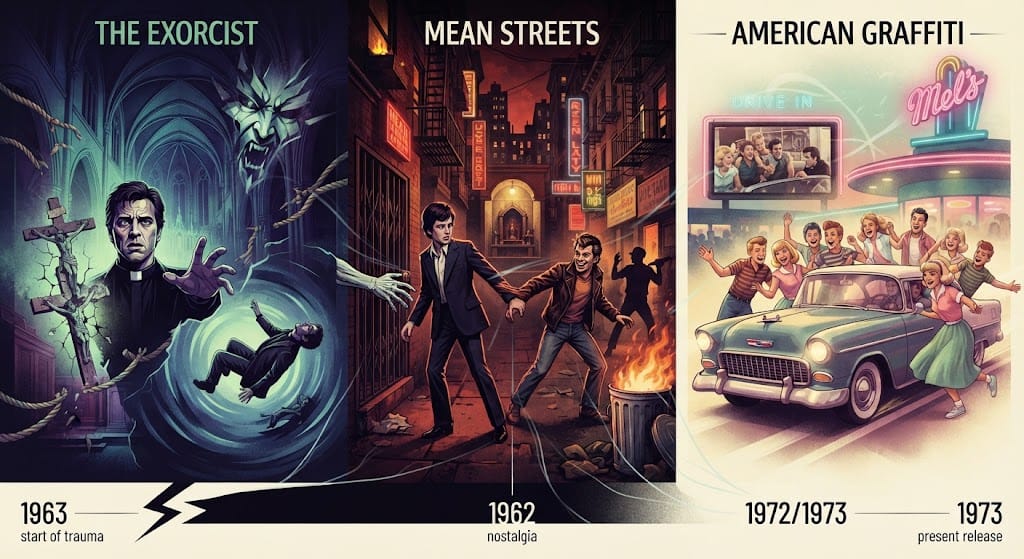
Three films, three completely different registers — pure theological horror, street-level crime tragedy, and warm generational nostalgia — and all three, in their own way, wrestling with the exact same question the whole decade kept asking over and over. What do you hold onto once the old certainties are gone? Karras reaches, desperately, for faith. Charlie reaches, fatally, for loyalty to people who will destroy him. And an entire generation of moviegoers, only a decade removed from 1962, reached for the memory of a summer night before any of the wreckage had started falling.
I'll close out 1973 in the next segment with the year's music, which includes a concept album about mental illness and mortality that would go on to spend more consecutive weeks on the album charts than any record in American history, and a debut from a Jersey kid nobody outside a small circle of critics had heard of yet.
Tim
Tim Lowe is a writer, book expert, retired sailor, retail worker, and renaissance man.
He is currently traveling the country and working on his forthcoming book.