
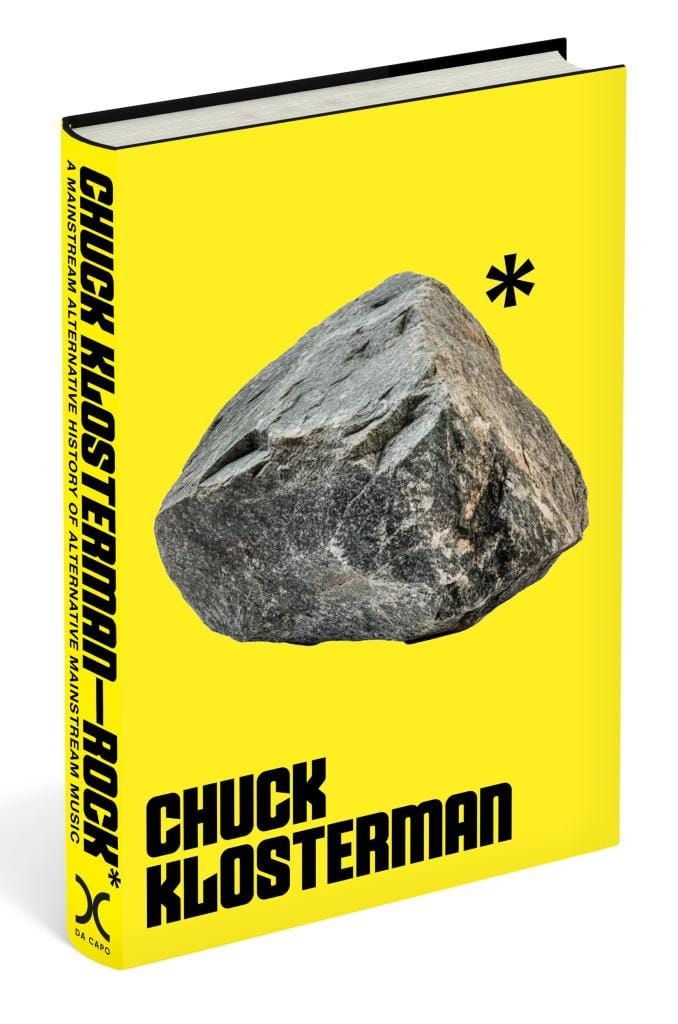
Rock*

There is a mostly unexamined consensus that historical reality is a fixed object. We tend to view history as a series of heavy blocks that could only have dropped into place exactly the way they did. You have the Beatles on The Ed Sullivan Show, which leads to the collapse of the traditional post-war social contract, which leads to the summer of 1967, which leads to an institutionalized counterculture that somehow manages to simultaneously commercialize rebellion and solidify the modern corporate media industrial complex.
But anyone who has ever spent more than forty-five minutes thinking about the ways of pop culture knows that this is a total illusion. History is actually incredibly flimsy. It is held together by scotch tape, fluke distribution deals, and the psychological stability of about six people in London and New York in any given calendar year.
The easiest way to understand this fragility is to look at The Velvet Underground & Nico.
You already know the boilerplate rock-critic cliché, because Brian Eno stated it so cleanly that it became a secular commandment: the record only sold ten thousand copies in the spring of 1967, but every single person who bought one started a band. It is the gold standard for low-yield, high-influence cultural transactions. It’s the ultimate intellectual security blanket for people who want to believe that artistic merit exists entirely independent of capitalism.
But what if that transaction had been scaled up to an absurd, mathematically terrifying degree? What if, instead of selling ten thousand copies, it sold ten million? What if it sold a hundred million copies? What happens to the trajectory of human consciousness if Lou Reed—a man whose primary creative mode was a combination of flat-affect heroin reportage and abrasive tonal hostility—becomes the undisputed, singular architect of global monoculture? What if everything that happened in the remaining thirty-three years of the twentieth century was merely a footnote to the fact that "Heroin" was more commercially dominant than "Hey Jude"?
The answer to that question is the core engine of Rock*, a staggering work of counterfactual madness that operates like The Rolling Stone History of Rock & Roll if it had been ghostwritten by Philip K. Dick, Jorge Luis Borges, and a slightly more lucid version of Patrick Bateman.
The conceit here is brilliant because it refuses to change the art itself. The songs remain the same. "Venus in Furs" still has the same scraping, monolithic viola drone. But because the context of how those songs are consumed shifts by a factor of ten thousand, the entire universe warps around them.
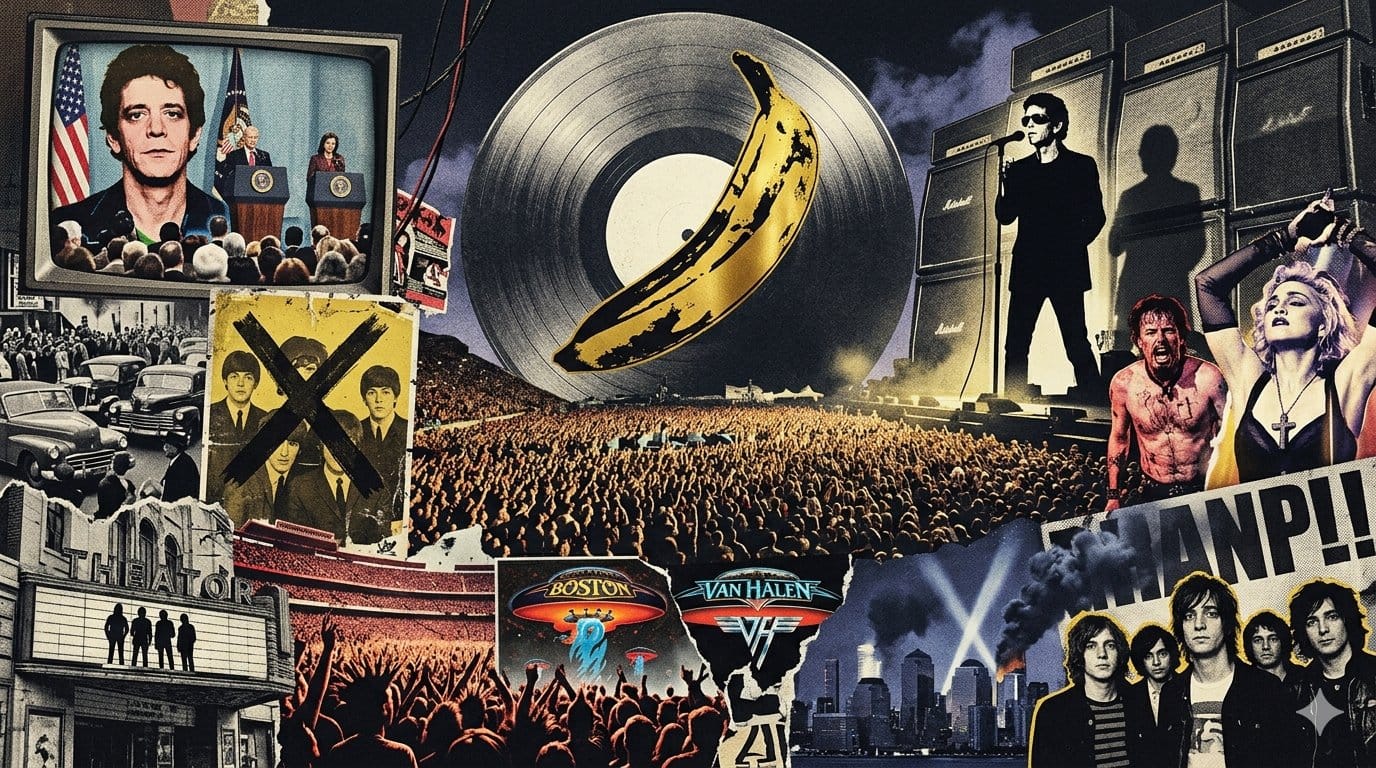
In the reality constructed by Rock*, Lou Reed isn’t a curmudgeonly downtown footnote; he is a literal messiah. He is a cultural force so massive that his personal whims reverse the monoculture and directly dictate the outcomes of American presidential elections. Because the Velvet Underground consumes all the available oxygen in the late sixties, the Beatles don't break up—they just sort of evaporate into irrelevance, a weird skiffle anomaly that never quite found its footing. The Rolling Stones collapse under their own blues-derivative weight, and Led Zeppelin goes bankrupt trying to sell high-volume fantasy-blues to a public that only wants avant-garde drone.
What makes this book so readable is how it tracks the domino effect of this aesthetic inversion. Because the default setting of popular music is now dark, feedback-drenched nihilism, the entire spectrum of genre flips on its axis.
Punk rock doesn't happen in dingy clubs; it fills 80,000-seat sports stadiums. And because punk is the mainstream corporate standard, the underground radicals who try to subvert the system aren't mohawked teenagers—they are clean-cut, hyper-virtuoso corporate rock acts like Boston and Van Halen, playing insouciant, highly complex pop hooks as a form of avant-garde protest. Disco is entirely eradicated before it can even formulate a bassline. Hip-hop somehow morphs into the cultural equivalent of country music, trading urban grit for rural, traditionalist storytelling.
By the time the book hits the 1980s, the landscape is beautifully unrecognizable. The era of disposable, hyper-commercialized pop icons is dominated not by Michael Jackson, but by G.G. Allin, while the vanguard of conservative Christian revivalism is led by a young singer named Madonna. Lenny Kravitz is still letting love rule, Oasis is still colliding with a wonderwall, and then, in a terrifyingly logical culmination of twentieth-century paranoia, the geopolitical trauma of the 9/11 terrorist attacks is somehow pinned entirely on the Strokes.
Now, a conventional novelist writing an alternate history would focus on the plot. They would treat this like a sci-fi puzzle to be solved. But Rock* isn't interested in a narrative resolution, because history doesn't have a narrative resolution. It's interested in something much weirder: the agonizingly subjective nature of historical consensus. It’s a book about how success alters the very chemistry of perception. When an piece of art becomes that massive, it ceases to be "art" and becomes "weather." You can't critique the rain; you can only live inside it.
It uses satiric contrarianism and Spinal Tap-ish absurdity not as a gimmick, but as a scalpel to dissect the dark, unspoken theories of what actually makes things popular. It forces you to confront the uncomfortable reality that our collective musical taste isn't a reflection of innate human truth, but the result of random, chaotic path-dependence. We like the Beatles because they were big, and they were big because we liked them. It's a closed loop. Rock* shatters that loop, and in doing so, reveals how arbitrary our cultural gods really are.
This is not the greatest book ever written about rock and roll. It doesn't want to be, and it explicitly rejects the sentimental hagiography required to claim that title. But it is, without question, the last book about rock and roll that ever needs to be written. Once you have seen the entire history of modern music dissolved in a vat of Lou Reed’s feedback and reassembled into a funhouse mirror, there is simply nowhere else for rock criticism to go. It’s over. We can all go home now.