
Roundabout Now

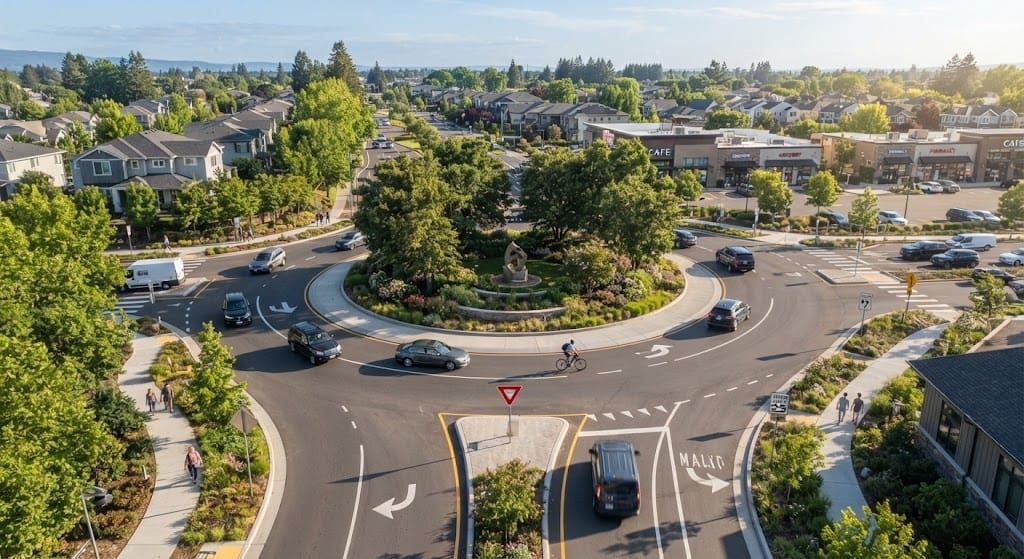
The history of American transportation is largely a chronicle of straight lines and stubborn boxes, a grid-iron obsession born from the minds of surveyors who looked at a continent of rolling hills, ancient forests, and sprawling plains and decided that everything should intersect at right angles. For generations, the four-way stop and the flashing electronic sentinel of the traffic light ruled the American asphalt. They were fixtures of civic life, humming away in the dark, turning millions of motorists into involuntary supplicants who sat in idling rows staring at red bulbs, listening to AM radio, and contemplating the fleeting nature of human existence while waiting for a green light that never seemed to arrive. It was a system built on abrupt halts, a mechanical dance of steel and gasoline that resulted in crumpled fenders, T-bone collisions at deadly ninety-degree angles, and a staggering waste of fuel. Yet, for the longest time, any suggestion that Americans should abandon their beloved traffic lights in favor of an unblinking, circular island of concrete was met with a mixture of profound skepticism and outright hostility.
The roots of this American resistance actually stretched back to the early twentieth century, when urban planners first attempted to tame the nascent automobile age with traffic circles. Designed by visionaries like William Phelps Eno in New York City, these early monstrosities such as Columbus Circle were sprawling, high-speed affairs where entering vehicles held the right-of-way. The results were predictably disastrous. Cars barreled into the circles at reckless speeds, merging was treated as a blood sport, and traffic frequently locked up into permanent, gridlocked knots that made motorists want to chew through their steering wheels. By the mid-1950s, cities across North America were violently ripping out these failed rotaries and replacing them with trusty traffic lights. The American motoring public learned a lasting lesson: circular intersections were chaos incarnate.
While America nursed its collective grudge against traffic circles, engineers across the Atlantic were quietly engineering a revolution. In Great Britain during the 1960s, transportation authorities solved the fatal flaw of the old rotary by instituting a simple yet brilliant rule change: vehicles already circulating within the ring held absolute priority, and anyone wanting to enter was forced to yield. Combined with a tighter, more physically constraining geometry that forced drivers to drastically reduce their speed, the modern roundabout was born. It was safer, it moved traffic in a continuous, flowing sweep, and it eliminated the dreaded T-bone intersection crash entirely. Europe embraced the concept with evangelical zeal, eventually paving tens of thousands of them across France and the United Kingdom.
America, meanwhile, remained safely cocooned behind its red-and-green lights until 1990, when the modern roundabout finally made a modest, sun-baked debut in a residential development near Las Vegas, Nevada. For a few years, it remained an isolated novelty, a strange western curiosity that drivers treated like an obstacle course. The real tipping point arrived later that decade in an affluent suburb north of Indianapolis, where a visionary local mayor named Jim Brainard returned from a trip to Europe utterly transfixed by walkable communities and flowing traffic. Determined to slash accident rates and curb vehicle emissions, he spearheaded an ambitious campaign to systematically eradicate standard intersections from his city.
What followed was a quiet infrastructure crusade. Carmel, Indiana, transformed from a sleepy grid into the undisputed roundabout capital of the nation, eventually constructing well over a hundred of the circular wonders. Skeptics howled, local politicians worried about driver confusion, and fender-benders abounded in the early learning curve. But as the months ticked by, the math proved impossible to ignore. Fatal accidents plummeted, traffic flowed like water down a drain, and millions of gallons of gasoline were saved because cars no longer sat idling in endless rows. Federal highway officials took notice, turning what began as a municipal eccentric experiment into a nationwide engineering movement.
Today, the transformation is nearly complete. From rural crossroads in Virginia to bustling suburban corridors across the Sunbelt, thousands of roundabouts have quietly colonized the American landscape. Drivers who once cursed the mere mention of a yield sign have largely converted, realizing that the gentle, sweeping curve of a roundabout gets them home a little faster and a lot safer. The red light has not vanished entirely, but its monopoly on American transit is broken. In its place stands a humble circle of concrete, quietly spinning the nation forward one revolution at a time.
Roundabouts in the United States: Selected Statistics
| Category | Statistic / Data Point | Notes |
| Adoption & Growth | Estimated 8,000 - 10,000+ | The number of operational modern roundabouts in the U.S. continues to grow annually as infrastructure projects are completed. Precise, real-time totals are difficult to track due to decentralized state and local data. |
| Primary Benefits | Reduced Fatalities: Up to 90% | Studies consistently show that replacing signals or stop signs with roundabouts drastically reduces fatal and injury crashes because they eliminate left turns across oncoming traffic (the cause of most T-bone collisions) and lower overall speeds. |
| Primary Benefits | Reduced Injury Crashes: 76% - 80% | Roundabouts significantly decrease the severity of crashes. |
| Primary Benefits | Traffic Flow: Increased Capacity 30% - 50% | Roundabouts can handle higher traffic volumes than stop signs or signals during peak hours because vehicles generally move continuously, rather than waiting for a signal change. |
| Safety Data | Decrease in Conflict Points: 8 vs. 32 | A standard four-way intersection has 32 potential points where vehicles can collide. A single-lane roundabout reduces this to 8 conflict points. |
| Vehicle Speeds | Design Speed: 15 - 25 mph | Roundabouts are physically designed to slow traffic, making collisions less likely to be fatal for pedestrians and other vehicles. |
| Public Perception | Public Support Growth: 30% to 70%+ | Studies show that while the public often opposes roundabouts before construction due to unfamiliarity, approval ratings soar once they are operational and drivers experience the safety and efficiency benefits. |
| Cost Comparison | Generally Similar or Less Than Signal | While initial construction costs can sometimes vary, roundabouts often have lower long-term costs because they require no electricity for signals, no hardware maintenance, and prevent costly injury crashes. |
| Fuel & Emissions | Reduced Idling: 30% - 50% | Less stopping and waiting leads to reduced fuel consumption and vehicle emissions (CO2, NOx, hydrocarbons). |
| Pedestrian/Bicycle | Safety: 40% fewer collisions | Proper roundabout design includes raised splitter islands that act as pedestrian refuges, allowing crossings in two stages. Bicyclists can choose to merge with traffic or use provided ramps to exit to the sidewalk. |
Tim
Tim Lowe is a writer, book expert, retired sailor, retail worker, and renaissance man.
He is currently traveling the country and working on his forthcoming book.