
The Dark Side and the Kid from Asbury Park

Pink Floyd released The Dark Side of the Moon that March, and the scale of its eventual commercial life is almost impossible to overstate — it would go on to spend over seven hundred weeks on the Billboard album chart, a run so long it stretched across nearly the entire remaining decade and well beyond it, a genuinely strange fact for a record built around such unflinchingly bleak subject matter. This is an album explicitly about time running out, about the specific terror of watching a bandmate, Syd Barrett, disintegrate into mental illness before your eyes, about money and death and the particular madness of ordinary modern life, all of it assembled with a production clarity and conceptual rigor that turned genuinely difficult subject matter into something audiences wanted to live inside for years at a stretch. That paradox — the bleakest possible content becoming some of the most enduringly popular music ever recorded — is the same paradox this series keeps returning to. The most honest art of this decade was rarely comfortable art, and audiences, again and again, proved considerably more willing to sit with real darkness than the industry executives making the release decisions ever gave them credit for.
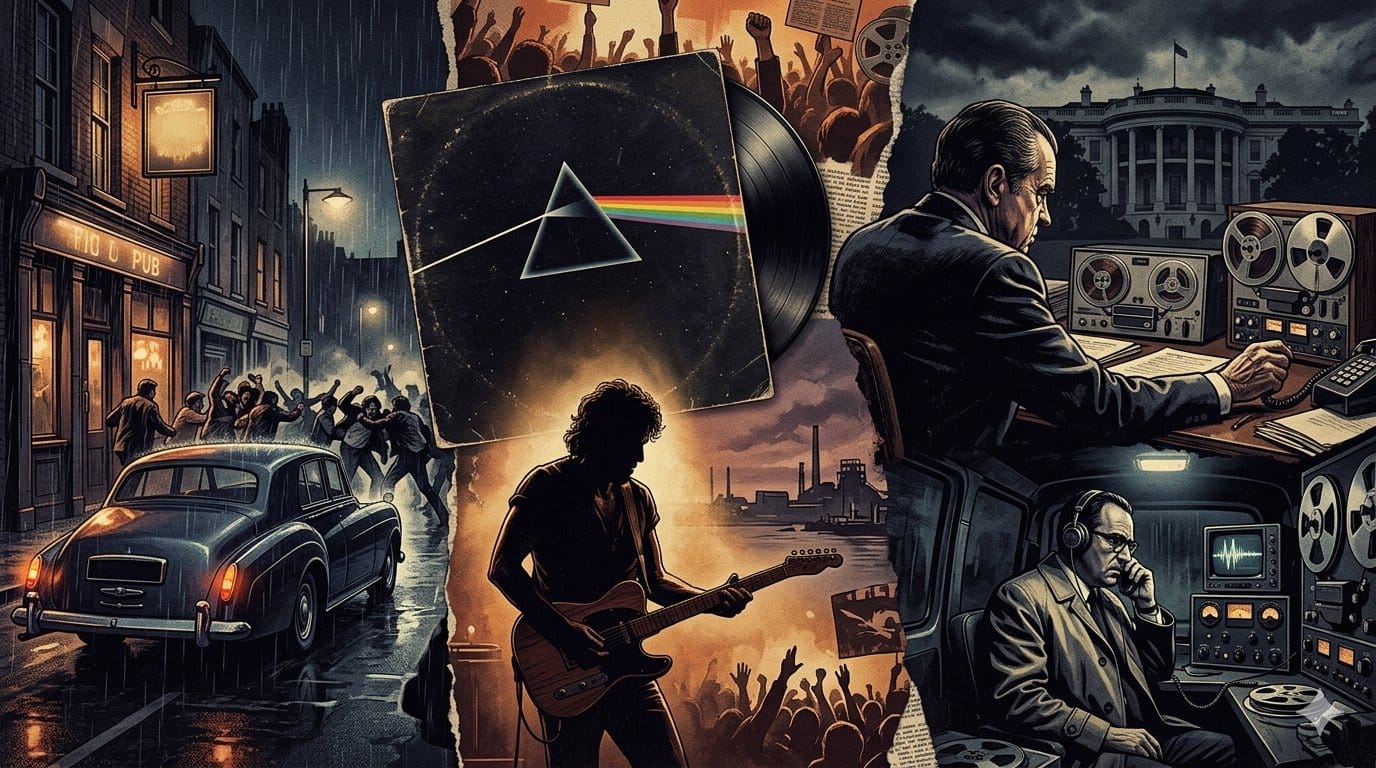
That same year, Bruce Springsteen released his first two albums, Greetings from Asbury Park, N.J. in January and The Wild, the Innocent & the E Street Shuffle that September, both of them commercial disappointments at the time, both of them now recognized as the foundation of one of the most significant American songwriting careers of the century. Springsteen arrived already writing about exactly the terrain this book has spent its entire Watergate-and-Vietnam-soaked narrative circling — small-town disappointment, the gap between the American promise and the American reality, characters trying to figure out what was left to believe in once the old certainties had burned off. He wasn't a star yet in 1973. That was still two years away. But the songs were already there, fully formed, a young guy from the Jersey Shore already writing with the same hard-won clarity that Marvin Gaye and Joni Mitchell had brought to their own records a couple years earlier, proof that whatever this decade's animating honesty actually was, it hadn't run its course yet. It was just getting started in some corners, even as it was reaching its most crushing commercial apex in others.
By the end of 1973, the war in Vietnam had formally ended for American troops, Roe v. Wade had reshaped the constitutional landscape, the Watergate tapes existed and Nixon was fighting with everything he had to keep them sealed, and the country's popular culture — its films, its music — had fully absorbed and were now fluently speaking the language of institutional distrust and hard-won honesty that this whole decade had been building since January of 1970. Next year, accountability reaches its final, inevitable conclusion, when a sitting American president resigns from office rather than face the impeachment his own recorded words had made unavoidable — and American film, in the same twelve months, delivers what may be the single greatest movie ever made about paranoia, surveillance, and the corrosive cost of complicity, a film so precisely tuned to its exact moment that its director claims, to this day, he had no idea Watergate was even happening while he made it.
Tim
Tim Lowe is a writer, book expert, retired sailor, retail worker, and renaissance man.
He is currently traveling the country and working on his forthcoming book.