
The Fall, and the Shark

On April 30, 1975, North Vietnamese tanks rolled through the heavy steel gates of the presidential palace in Saigon, and the images that came out of that final, frantic day — American helicopters lifting desperately off the roof of the U.S. embassy, chaotic crowds trying frantically to scale the perimeter walls to reach the last evacuation flights out of the city, a war that had utterly consumed a decade of American political life and killed nearly sixty thousand American service members alongside a catastrophic, uncountable number of Vietnamese dead — finally, completely ended. There was no grand victory parade awaiting the troops at home. There was no clean, satisfying resolution to be found. The war that had originally opened this entire decade's long argument about institutional trust, that had put a defensive Richard Nixon on national television announcing a controversial military expansion into Cambodia five years earlier, and that had gotten four young students shot dead at Kent State, simply concluded in unmitigated defeat and absolute chaos. It was broadcast directly into American living rooms with the exact same unflinching, unglamorous honesty that had characterized the whole decade's painful, ongoing reckoning with its own government.
This was not the triumphant cinematic ending Hollywood would have scripted, but it was the real one. The evening news broadcasts did not frame the exit with comforting triumphalism or diplomatic grace; instead, they captured a frantic, undignified scramble for the exits. It was an ignominious final chapter that punctured the long-held myth of American invincibility. For a nation already deeply exhausted by domestic corruption scandal and crippling economic stagflation, the television footage from Saigon was a devastatingly clear mirror showing exactly where a decade of political arrogance, official deception, and systemic overreach had inevitably led.
I don't think it's an exaggeration to say the fall of Saigon completely closes the specific chapter of American history this series has spent its time tracing. Vietnam had been the original, deepest wound, the foundational trauma that taught an entire generation of journalists, filmmakers, and musicians never to trust official pronouncements issued from Washington. By the time it finally, fully ended, that cynical lesson had already been thoroughly, irreversibly absorbed into the broader culture through the publication of the Pentagon Papers, through the slow-motion, televised collapse of Watergate, through the pitch-black, systematic corruption of movies like Chinatown and The Conversation, and through every furious, acoustic Neil Young lyric written in between.
The war's actual conclusion arrived almost as a hollow, anti-climactic formality by 1975 — the country's faith in unquestioned executive authority, military dominance, and institutional integrity had already been systematically dismantled years earlier. Saigon's fall was simply the final, brutal period placed at the end of a long, painful sentence everyone in the country already fully understood. The collective consciousness had shifted permanently; national innocence was gone, replaced by a weary, protective armor of deep skepticism that defined the mid-1970s.
And then, that June, in what has to be one of the strangest, most fascinating tonal pivots in the entire history of American popular culture, a twenty-seven-year-old director named Steven Spielberg released Jaws. In doing so, he invented, more or less single-handedly, the modern concept of the summer blockbuster. Universal Pictures had originally planned a fairly modest, conventional release for the movie, fully expecting the film's notoriously troubled production — during which the mechanical shark barely functioned, the ocean shoot ran wildly over budget, and daily schedules collapsed — to produce, at best, a decent, mid-tier box office hit.
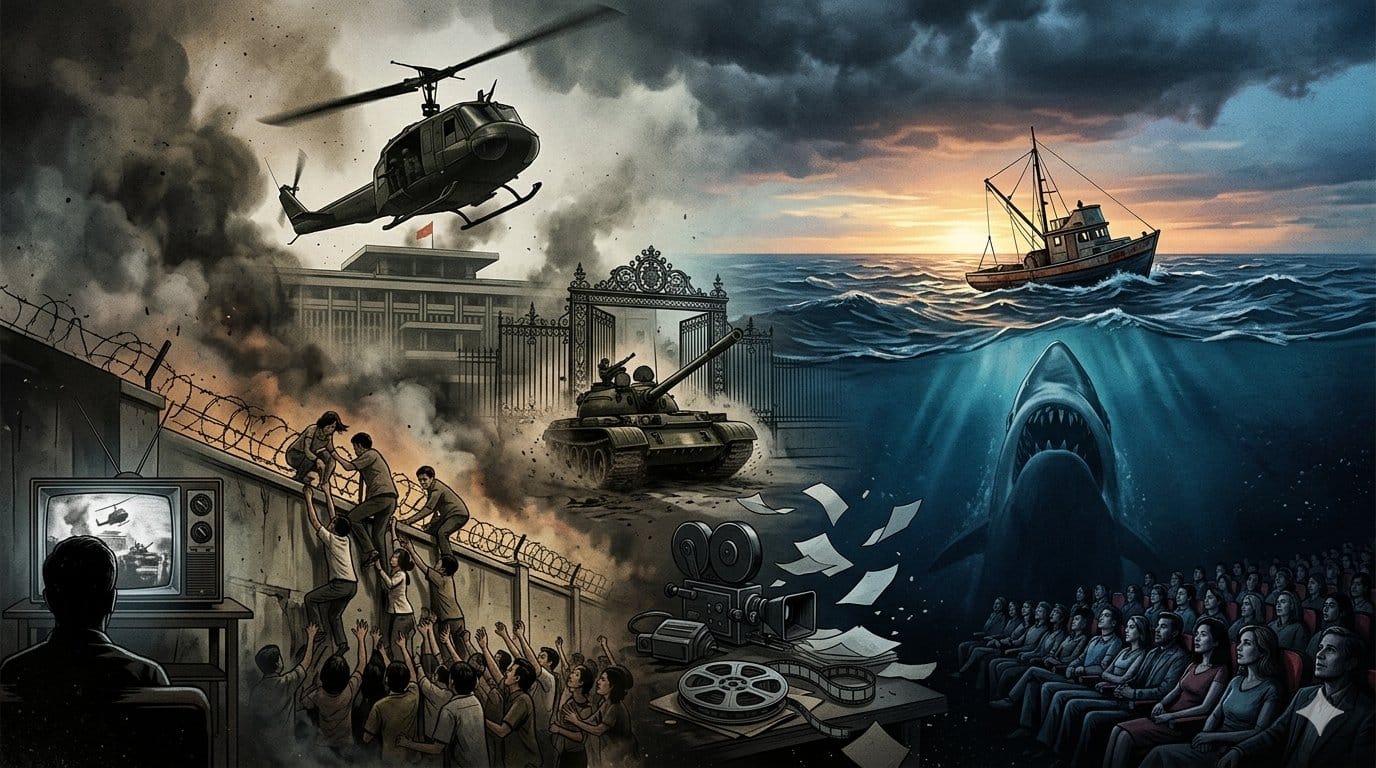
Instead, Jaws exploded into the national culture to quickly become the highest-grossing film in history to that point. This unprecedented success was driven by a wide, saturation-level release pattern combined with an aggressive national television advertising campaign that the traditional studio system had never really attempted on this scale before. It created a highly lucrative marketing template that would completely reshape how every major studio packaged, hyped, and released its biggest films for the rest of the century. Spielberg, forced by the malfunctioning mechanical shark to suggest its terrifying presence through music and camera angles rather than show it outright for much of the running time, built something closer to a classic Hitchcockian thriller than a straightforward monster movie. The visceral result terrified an entire generation of beachgoers so completely that swimming attendance at major American beaches reportedly plummeted that summer, proving that the collective imagination could be captured just as thoroughly by primal fear of the unknown as it had been by the political anxieties of the previous years.
There's a real, profound tension worth naming here, because Jaws arrives at almost the exact moment this series has been arguing that American film's greatest artistic achievement was its willingness to sit inside genuine moral complexity. Throughout the early 1970s, mass audiences regularly flocked to serious cinema that actively confronted uncomfortable truths — Chinatown's total, systemic corruption; The Conversation's inescapable, tech-fueled paranoia; Michael Corleone's absolute moral isolation in the final frames of The Godfather Part II. New Hollywood had been brave enough to refuse easy answers, mirroring a deeply fractured society back to itself.
Jaws is emphatically not that kind of film. It is pure, expertly crafted, unapologetic popcorn entertainment. It simplifies the chaotic world into a monstrous threat hiding under the water, three flawed but ultimately heroic men trapped on a boat, and a genuinely satisfying, explosive catharsis in which the shark gets (spoiler alert!) blown up and the good guys actually win the day. It swapped existential moral ambiguity for binary survival, and audiences hungry for a reprieve from real-world political darkness devoured it.
And its runaway, earth-shaking success marks, whether anyone fully recognized it in the heat of that summer moment or not, the beginning of the end of the very era this book has spent five parts celebrating. This was the moment the film industry discovered that a single, brilliantly executed, emotionally satisfying spectacle could out-earn every morally ambiguous, character-driven study Hollywood had spent the first half of the decade perfecting. That discovery would eventually reshape the entire business model of American filmmaking, permanently pivoting toward exactly that kind of bankable spectacle, for better and for considerably worse, for the rest of the century. The art house mentality that had briefly taken over the mainstream multiplex was forced to retreat, pushed out by the rising tide of high-concept cinema that favored visceral thrills over deep, psychological introspection.
We will pick up the rest of 1975 in the next segment of this journey — exploring Bob Dylan's masterful, heartbroken album Blood on the Tracks, Bruce Springsteen's actual, mythic commercial arrival with Born to Run, and the small, scrappy, sweat-soaked scene in a rundown New York bar called CBGB that was about to change everything all over again. We will see how, even as Hollywood began to pivot toward comfort and spectacle, other artistic frontiers were still digging deep into the marrow of American life, refusing to let the fire of the early seventies die out just yet.