
The Reckoning

By the summer of 1974, the vast, slow-moving story this series has spent five straight chapters meticulously describing—the leaked Pentagon papers, the bungled burglary at the Watergate complex, the hyper-focused metro reporters who simply wouldn't quit, the riveting Senate hearings broadcast into virtually every American living room, and the shocking revelation of the secret White House taping system itself—finally closed its jaws completely. The momentum of the scandal had shifted from a series of disparate political fires into an all-encompassing, inescapable constitutional crisis.
On July 24, the legal battle reached its apex when the Supreme Court ruled unanimously in United States v. Nixon. The highest court in the land declared that the president could not withhold the crucial Oval Office tapes from federal investigators by invoking a blanket, unilateral claim of executive privilege. It was a staggering blow to the administration, made all the more devastating because even Nixon's own hand-picked appointees to the Court joined the decision without dissent, prioritizing the rule of law over political loyalty. ( Imagine this happening today.) Within days of this landmark ruling, the House Judiciary Committee capitalized on the legal momentum and voted out formal articles of impeachment, setting the stage for a historic trial on the House floor.
Then came the final, fatal blow. On August 5, under direct order of the Court, the administration released what quickly became known to history as the "smoking gun" tape. This audio recording, captured just six days after the initial Watergate break-in in June 1972, laid bare the raw complicity at the top. On the tape, Nixon himself could be heard clearly directing his chief of staff, H.R. Haldeman, to have the CIA intervene and obstruct the FBI's ongoing investigation into the burglary. The revelation was catastrophic. It completely eliminated whatever fragment of political support the president had left in Washington, completely alienating even the staunchest congressional Republicans who had spent two solid years defending his character on the national stage.
On August 8, a visibly defeated Richard Nixon sat before a bank of television cameras and announced his resignation to a stunned nation. Effective the following day, he became the first and only president in American history to leave office before completing his term, choosing a quiet departure over the public humiliation of near-certain impeachment by the House and a definitive conviction in the Senate.
From our vantage point half a century later, it is incredibly important to sit with the radical improbability of that outcome for a moment. It is dangerously easy, from this chronological distance, to treat Nixon's downfall as an inevitable historical narrative—a foregone conclusion that was set in stone the exact moment those five men were caught with wiretapping equipment inside the DNC offices back in June of 1972. It was absolutely not inevitable.
To truly understand the scale of what happened, we must remember that Nixon had just won reelection in one of the largest, most staggering landslides in American political history a mere twenty months earlier, carrying 49 of 50 states. He possessed immense political capital. He had, at multiple points along his arduous defense, genuine, rational reason to believe he could ride the whole storm out. He assumed the public's short attention span would eventually wander to other news, and he fully expected his own political party to close ranks behind him to protect their shared executive power, just as political parties almost always do when pushed into a corner.
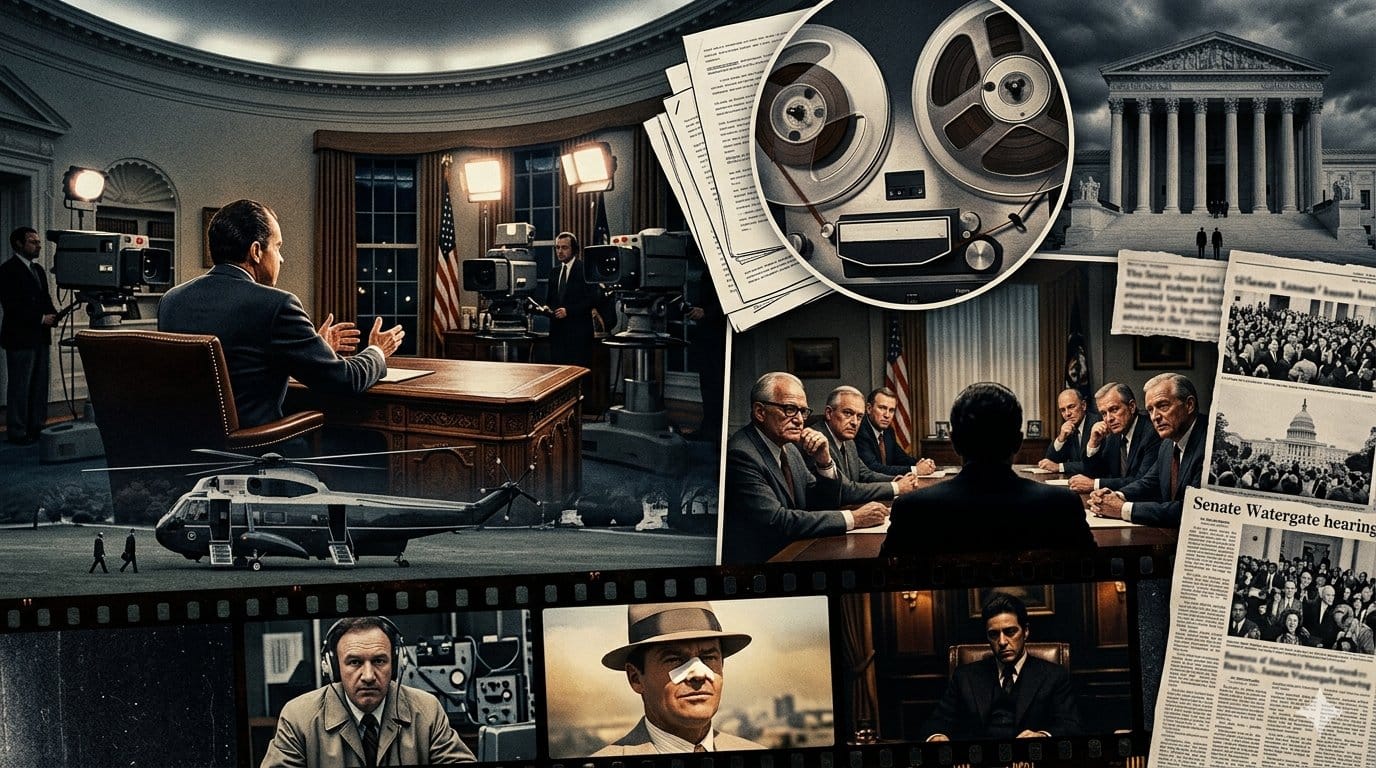
What actually transpired instead was a beautiful, chaotic convergence of institutional integrity that defied all partisan gravity. ( Once again, imagine this happening today. ) It required a free and fiercely independent press that absolutely refused to let a complex story die under the weight of White House denials. It required a Senate willing to hold transparent, public hearings that deeply damaged a president of its own chamber's majority party in some cases. It required a Supreme Court, including justices Nixon himself had fought to appoint, willing to rule unanimously against the very man who put them on the bench. And eventually, it required his own party's senior leadership, led by Senator Barry Goldwater, to walk directly into the Oval Office and tell the president personally that the defensive line had broken and the votes for his conviction were officially there.
This sequence of events represents about as complete and pure a demonstration of functioning constitutional accountability as American history has ever produced. It didn't happen overnight; it took four agonizing years of political warfare, and it required nearly every major branch and institution in American governance to do its job honestly, courageously, and simultaneously. But against the odds, it happened. A sitting American president lied to the public, obstructed justice to cover up a political crime, got caught by the system, and that system—however messily, slowly, and imperfectly—actually held him accountable for it. That is the singular, triumphant sentence this entire book has been building toward since its opening chapter, and 1974 is where that promise finally, fully comes true.
We will turn to the groundbreaking films of that exact same year in the very next segment of this series, because 1974, almost unbelievably, gave American cinema three distinct masterpieces that would each, independently, go on to be regarded among the greatest movies ever made. What makes this cinematic trifecta so brilliant is how flawlessly it mirrored the real-world drama unfolding in Washington. Every single one of these films is, in its own visceral way, explicitly about the hidden mechanics of surveillance, systemic institutional corruption, and the crushing, paranoid impossibility of ever trusting the very people who claim to be protecting you. The line between the evening news and the silver screen had never been thinner.
Tim
Tim Lowe is a writer, book expert, retired sailor, retail worker, and renaissance man.
He is currently traveling the country and working on his forthcoming book.