
The Year America Watched Itself on TV

Nothing can convince you for how strange it was to live through the spring and summer of 1973, when the Senate Watergate Committee hearings, chaired by the courtly, Bible-quoting North Carolina Democrat Sam Ervin, were broadcast live on national television and an enormous share of the American public stopped what they were doing to watch. Restaurants installed televisions. Offices piped the hearings through on radio. This wasn't a niche political drama followed by a handful of committed junkies — it was appointment viewing on a scale usually reserved for moon landings and World Series games, and week after week the country watched, in real time, as witness after witness peeled back another layer of what the Nixon administration had actually done.
The single most explosive revelation arrived that July, almost by accident, when a relatively obscure White House aide named Alexander Butterfield, testifying before the committee, was asked an offhand question about whether the president's conversations were ever recorded, and answered, matter-of-factly, that yes, Nixon had installed a voice-activated taping system throughout the West Wing that had captured essentially every conversation held in the Oval Office for years. The room reportedly went silent. Every question the committee had been chasing for over a year — what did the president know, and when did he know it — suddenly had a literal, mechanical answer sitting on tape reels inside the White House itself, if the committee could get Nixon to hand them over. He would spend the next year fighting that exact demand all the way to the Supreme Court, and losing, and the tapes, once released, would prove to contain precisely the evidence of obstruction and cover-up that would end his presidency the following August.
But 1973 wasn't only the year of Watergate. It was also the year the war in Vietnam, at long last, formally ended for American combat troops, with the Paris Peace Accords signed that January and the last U.S. forces withdrawing by March, closing out a conflict that had dominated and disfigured American political life for the entire preceding decade, even as the war would continue, brutally, for the Vietnamese themselves for two more years until Saigon's fall in 1975. And it was the year the Supreme Court decided Roe v. Wade that January, a ruling that would go on to reshape American political alignment more completely than almost any other single legal decision of the century, establishing a constitutional right to abortion that would remain the law of the land for nearly fifty years before being overturned in 2022.
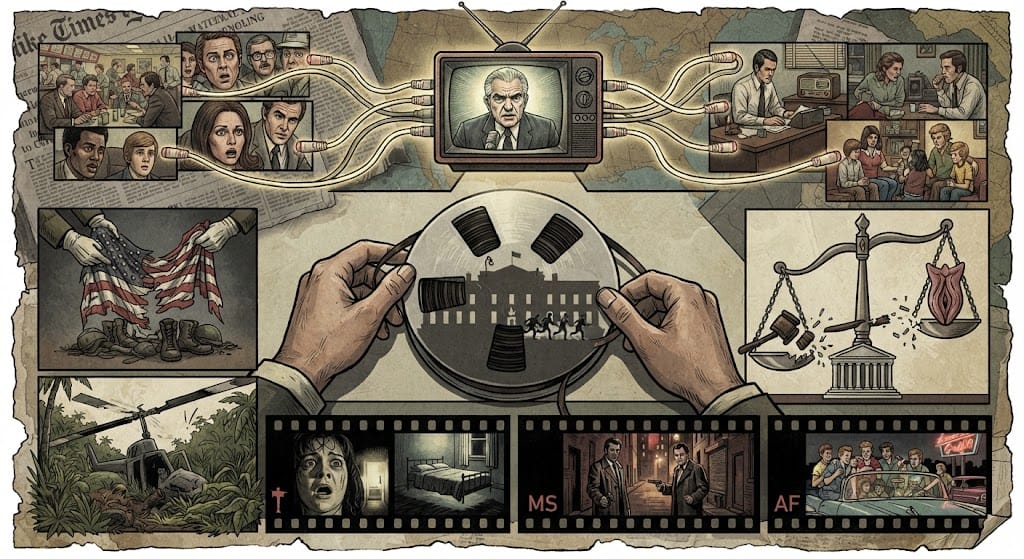
I bring up Roe here specifically because it belongs in the same accountability story this whole series keeps circling back to, even though it's not a scandal or a war — it's the Court, in the same general era that had just watched a free press take down a president's credibility over Vietnam, asserting itself as a genuinely activist check on state legislatures that had, up to that point, held nearly unlimited power over women's bodies with no meaningful federal constraint at all. Whatever your view of the decision's legal reasoning or its ultimate fate decades later, it belongs to the exact same 1970s pattern we have been tracing — old, largely unquestioned authority, in this case state governments' near-total control over reproductive decisions, getting hauled in front of a body willing to actually scrutinize it rather than simply defer to precedent and custom.
Next segment: the films of 1973, which include what might be the single most purely terrifying movie ever made by a major studio, alongside a scrappy little debut from a young director who'd grown up in Little Italy, and a nostalgic teenage comedy that, in its own quiet way, was already starting to mourn the sixties as a lost golden age even though they'd only just ended.