
The Year of Living Suspiciously

Three films. One calendar year. Chinatown, The Conversation, and The Godfather Part II, all released in 1974, and all three now sitting comfortably on essentially every serious list of the greatest American films ever made. I don't think any other single year in Hollywood history has produced three films of that magnitude simultaneously, and I don't think it's a coincidence that it happened in the exact year a president resigned in disgrace after two years of proven, documented lying.
Chinatown, directed by Roman Polanski from Robert Towne's screenplay, gave Jack Nicholson's private investigator Jake Gittes a case that starts as a straightforward matter of marital infidelity and unspools into a conspiracy involving municipal water rights, incest, and a level of institutional corruption so total that Gittes, by the film's final scene, cannot save the one person he's actually trying to protect. The film's closing line — "Forget it, Jake, it's Chinatown" — has become one of the most quoted endings in American cinema precisely because of what it actually argues, stated as plainly as a film noir ever states anything: that some corruption runs so deep, is so thoroughly embedded in the machinery of power, that individual virtue simply cannot beat it. That is an almost unbearably bleak thesis for a major studio picture to advance, and audiences in 1974, having just watched their own government prove exactly that thesis true in real life, over four straight years of hearings and leaks and a resignation speech, understood the film immediately and completely.
The Conversation, written and directed by Francis Ford Coppola in the same year he also delivered The Godfather Part II, follows Gene Hackman as Harry Caul, a surveillance expert hired to record a private conversation who becomes increasingly, paranoically convinced that the recording he's made will be used to justify a murder. Coppola has said repeatedly, in interviews over the decades, that he wrote the screenplay years before Watergate broke and had no idea, while making the film, that it would end up premiering in the exact same cultural moment that a surveillance-based political scandal was actively destroying a presidency. That coincidence, rather than undermining the film's relevance, actually proves the larger point of this entire book more completely than almost anything else could. Coppola didn't need to know about Nixon's tapes to make a film about the moral horror of surveillance and the impossibility of ever really knowing what your own careful, professional detachment has actually enabled. The anxiety was already fully present in the culture, gestating independently in a screenwriter's imagination at the exact same time it was gestating, entirely separately, inside the actual White House. Both Coppola and Nixon's men were responding to the same air everyone in America was breathing by the early seventies — an air thick with the conviction that recorded information, however it was gathered, had become the era's most dangerous and most decisive form of power.
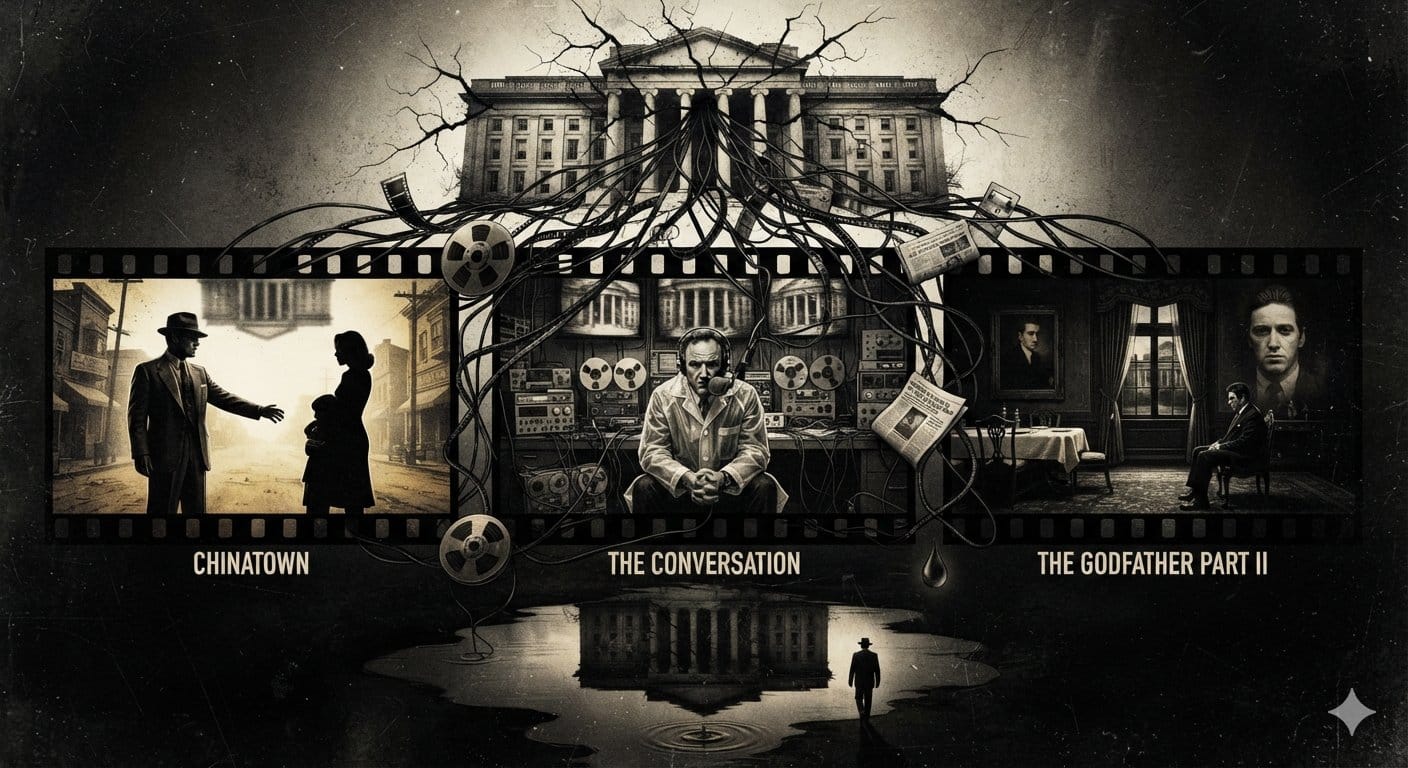
And then there's The Godfather Part II, which somehow managed to both deepen and darken everything the original film had established, cutting between young Vito Corleone's rise in early-twentieth-century New York and Michael's complete, irreversible moral collapse in the years following his father's death, ending with Michael sitting alone, having ordered the murder of his own brother, surrounded by every material trapping of success and utterly, permanently isolated by what he has become to secure it. If the first film's tragedy was Michael's slow transformation into his father, the sequel's tragedy is the discovery that he has actually become something considerably worse — his father, whatever his crimes, had never turned on his own family, and Michael, by the film's final frame, has severed himself completely from the very people the entire enterprise was ostensibly meant to protect.
Take these three films together, released in the same twelve months a president was forced from office by his own recorded words, and you get the most complete artistic statement American film would ever produce about what institutional power actually costs the people who hold it and the people who trust them. Corruption that outruns individual virtue. Surveillance that destroys the very trust it claims to protect. Power that isolates even as it accumulates. None of these films are commenting directly on Nixon. They didn't need to. Nixon's downfall and these three films were both, simultaneously, independently, the same culture finally, completely reckoning with a question it had been circling since January of 1970 — what happens to people and institutions once the illusion of good faith finally, irreversibly breaks.
I'll close out 1974, and this stretch of the article, in the next segment with the year's music — a record about the fall of an American icon, the arrival of a scrappy pub-rock scene in London that nobody yet realized was punk's true starting gun, and Joni Mitchell, once again, doing something nobody else in popular music could do.
Tim
Tim Lowe is a writer, book expert, retired sailor, retail worker, and renaissance man.
He is currently traveling the country and working on his forthcoming book.