
Thunder Road and the Bowery

Bob Dylan released Blood on the Tracks that January, and it stands, even now, as arguably one of the greatest breakup albums ever recorded, a set of songs written in the aftermath of the collapse of his marriage to Sara Dylan, delivered with a lyrical precision and emotional devastation that Dylan himself would later claim, somewhat implausibly, was inspired by short stories rather than his own life. Nobody who actually listens to "Idiot Wind" or "You're a Big Girl Now" buys that deflection for a second, and that's precisely the point. This is the same confessional honesty Joni Mitchell had pioneered on Blue four years earlier, arriving now from the songwriter most responsible for teaching an entire generation that popular music could carry real literary weight, applied with brutal precision to the actual ruin of his own family. The record's initial version was even rawer than what got released — Dylan re-recorded several tracks at the last minute in Minneapolis, with local musicians pulled together almost overnight, tightening the songs into the versions the world actually knows. It remains the album songwriters most frequently cite when asked what an artist can do with genuine, unguarded pain once they've stopped worrying about how flattering that pain makes them look.
Then, that August, Bruce Springsteen released Born to Run, an album he had reportedly worked and reworked with such obsessive, nearly career-ending perfectionism that Columbia Records was seriously considering dropping him before it was finished. The title track alone took six months to record. And what emerged from all that obsessive labor was an album that did something genuinely rare — it took the small, disappointed, blue-collar American landscape Springsteen had already been writing about on his first two commercially unsuccessful records and blew it up into something operatic, cinematic, and enormous, without losing a single ounce of the specific, grounded reality that made the earlier songs feel true. "Thunder Road" opens the record with a screen door slamming and Mary's dress waving, and by the time the song builds to its climax it has become nothing less than a full-throated argument that escape, however delusional, however doomed, is still worth chasing with everything you've got. The album made Springsteen a star practically overnight, landing him simultaneously on the covers of both Time and Newsweek in the same week that October, a level of mainstream cultural saturation that no rock artist had achieved quite that fast before.
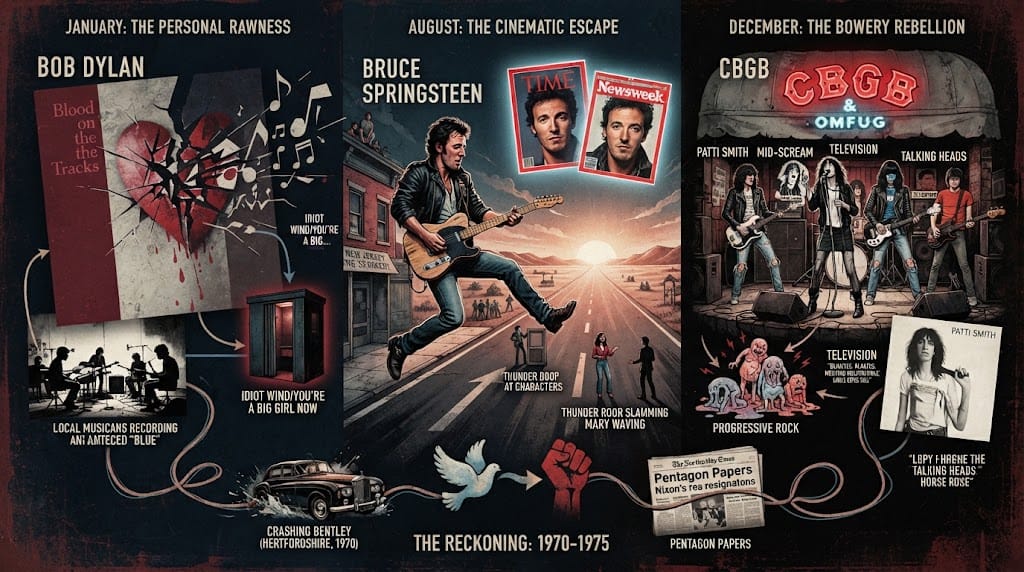
And in a rundown bar on the Bowery in downtown New York, a scene was already fully assembling itself around a small stage that owner Hilly Kristal had originally intended for country, bluegrass, and blues acts, hence the club's name — CBGB. By 1975, that stage belonged instead to Television, Patti Smith, the Ramones, and Talking Heads, bands that had almost nothing in common musically with each other except a shared, furious rejection of everything arena rock and progressive rock had become by the middle of the decade — the bloated concept albums, the extended solos, the sheer scale and remove of stadium spectacle. Patti Smith released Horses that December, opening with her radical reworking of Van Morrison's "Gloria" — "Jesus died for somebody's sins, but not mine" — a statement of pure artistic and spiritual insurrection delivered by a poet who had wandered into rock and roll almost sideways and immediately reshaped what the form could hold. The Ramones hadn't released their debut yet — that's early 1976 — but they were already playing CBGB regularly by 1975, hammering out two-minute songs at a speed and with a stripped-down simplicity that constituted its own complete rejection of everything Yes and Emerson, Lake & Palmer had spent the first half of the decade building toward.
This is the final turn this series needs to make before it closes out, because it completes the whole arc. The decade had opened with Woodstock's optimistic scale curdling into Altamont's violence, with a war that revealed the government's capacity for sustained institutional lying, with a press and a Supreme Court and eventually an entire constitutional system rising to hold that lying accountable, and with an explosion of morally serious, unflinchingly honest art across music and film that mirrored and amplified that same hard-won reckoning. By 1975, with Vietnam over and Nixon gone and Blood on the Tracks and Born to Run both proving the confessional, literary strain of that art could still reach its absolute peak, a new and different kind of honesty was already brewing in a bar most of the country had never heard of, a scene that would spend the next two years stripping rock and roll back down to its rawest, angriest essentials, in direct rebellion against the very sprawling ambition the first half of the decade had celebrated. The seventies, it turns out, never stopped eating their own most comfortable assumptions and turning the wreckage into something new. That instinct — burn it down, mean every word of what you build next — is the actual through-line of this entire decade, from a Bentley crashing outside a Hertfordshire pub in January 1970 to a poet screaming about Jesus and sin on a Bowery stage five years later. Nothing about it was comfortable. Almost none of it was safe. And that is exactly, unmistakably, why so much of what it produced still refuses to let go of us, all these decades later.
Tim
Tim Lowe is a writer, book expert, retired sailor, retail worker, and renaissance man.
He is currently traveling the country and working on his forthcoming book.