
Two Hundred Years and a Trial by Fire

America turned two hundred years old on July 4, 1976, and the country threw itself a party of genuinely staggering scale — tall ships crowding New York Harbor, fireworks over every city with a budget to afford them, a nationwide outpouring of flag-waving celebration that arrived, strangely enough, less than two years after a president had resigned in disgrace and barely a year after the country had watched its longest war end in outright defeat. That timing tells you something important, something this series has been building toward across its entire account of the decade so far. The Bicentennial wasn't blind, uncomplicated patriotism of the kind the country might have indulged in a decade earlier. It arrived instead as something closer to a genuine, hard-won reaffirmation — a country that had just spent six straight years proving its own institutions could actually hold power accountable, choosing to celebrate not despite that reckoning but because of it. The system had been tested about as severely as a modern democracy can be tested short of actual civil war, and it had held. That's worth celebrating honestly, and for the most part, the country did.
Jimmy Carter, a peanut farmer and former one-term Georgia governor virtually unknown on the national stage eighteen months earlier, won the presidency that November, running explicitly and relentlessly on a promise that he would never lie to the American people, a campaign platform that would have sounded almost absurdly modest in any other decade and that landed, in the specific aftermath of Nixon's resignation, as exactly the message an exhausted electorate needed to hear. Carter beat Gerald Ford, the unelected president who had pardoned Nixon just a month into his own accidental presidency, a pardon that Ford's team had hoped would let the country move past Watergate and that instead, for a great many voters, simply extended the stain another two years. Carter's win is, in its own quiet way, one more data point in my ongoing argument — a country that had learned, through genuine institutional struggle, to demand honesty from its leaders, actually rewarding the candidate who promised it most explicitly, however imperfectly he'd eventually deliver on it once in office.
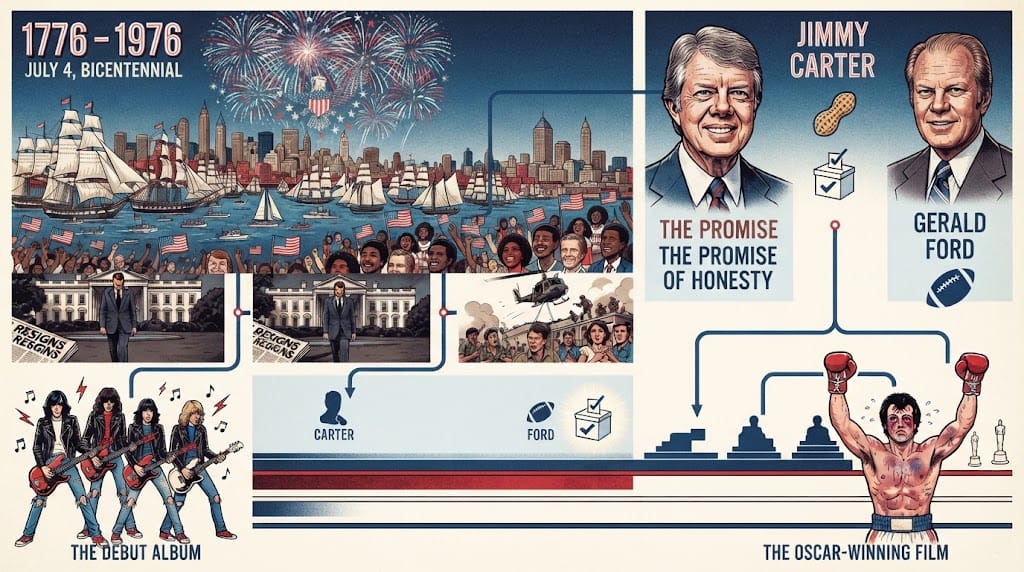
I'll turn to the year's music and film in the next segments — a debut record from four leather-clad guys from Queens that clocked in at under thirty minutes and changed rock and roll forever, and a boxing picture nobody in Hollywood believed in that ended up sweeping the Oscars anyway.
Tim
Tim Lowe is a writer, book expert, retired sailor, retail worker, and renaissance man.
He is currently traveling the country and working on his forthcoming book.