
Why Donald Trump is the Living Ghost of Charles Foster Kane

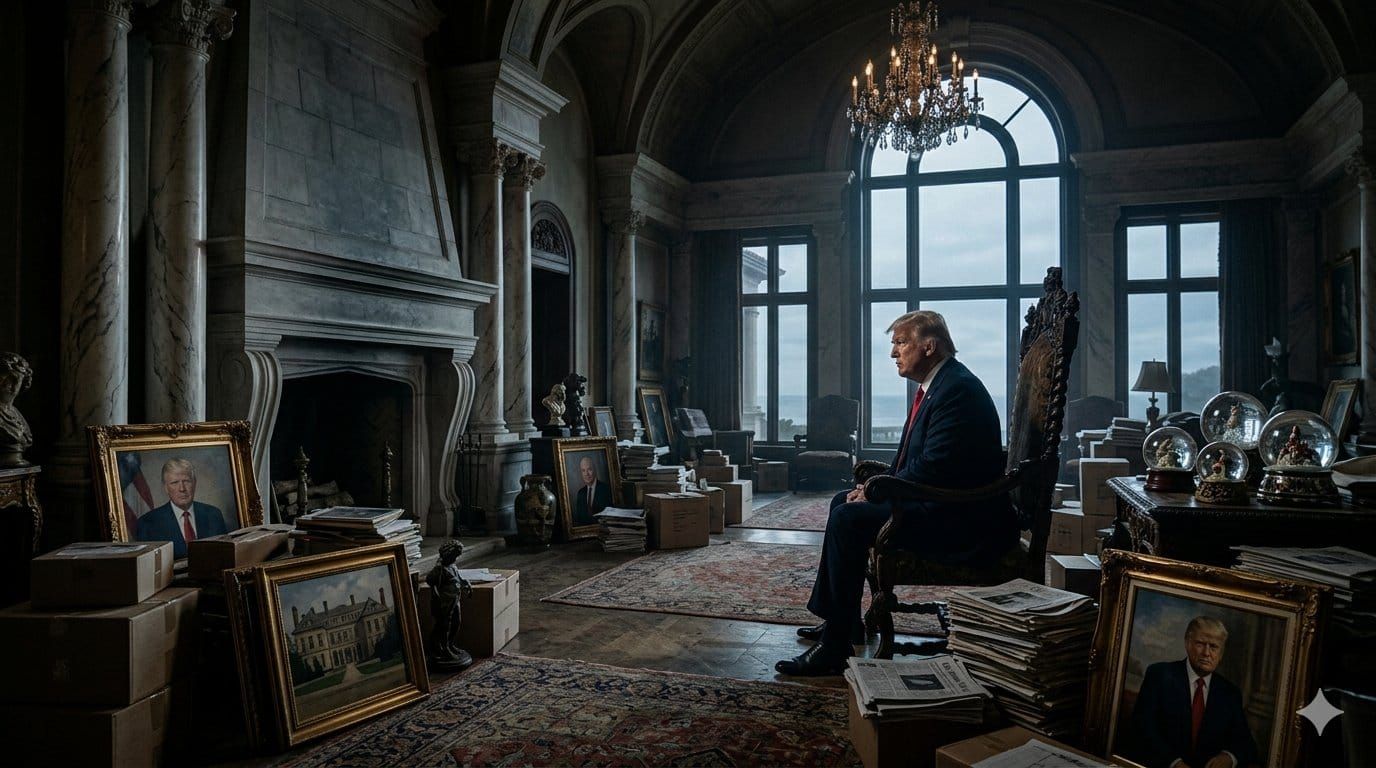
The rain never stopped in New York, but inside the penthouse of Trump Tower, the world was cast in twenty-four-karat gold. It was a fortress of glass and steel, suspended above the concrete canyons of Manhattan. From this vantage point, the people below didn’t look like voters, consumers, or citizens. They looked like ants.
Decades later, the scene would shift south to the Atlantic coast, to an opulent, Spanish-style redoubt called Mar-a-Lago. Guarded by Secret Service, ringed by concrete barriers, and populated by a rotating gallery of sycophants and power brokers, it became the ultimate manifestation of a singular American psychological phenomenon.
It was Xanadu. And the man pacing its gilded halls wasn't just a political disruptor. He was the living, breathing reincarnation of Charles Foster Kane.
To understand the trajectory of Donald J. Trump, you have to bypass the daily cable news warfare, the poll numbers, and the screaming headlines. You have to look at the architectural blueprint of the American soul. In 1941, Orson Welles and Herman J. Mankiewicz gave the world Citizen Kane, a cinematic autopsy of a fictional media tycoon whose insatiable hunger for love, power, and adulation ultimately consumed him. They thought they were making a movie about William Randolph Hearst. What they were actually doing was writing a prophetic dossier for the twenty-first century.
The parallels between Trump and Kane aren't merely superficial. They are structural. They are the gears of a specific, high-stakes machinery that drives men of immense ambition to scale the highest peaks, only to find the air at the top entirely unbreathable.
Look at the genesis. Charles Foster Kane did not build his empire out of a love for journalism; he built it because the New York Inquirer was a weapon. It was a printing press that could shape reality, punish enemies, and force a reluctant public to look at him. Kane understood a fundamental truth about the American public long before the advent of social media: people do not want objective truth. They want a show. Kane weaponized sensationalism, yellow journalism, and manufactured controversy to turn himself into a populist hero. "I think it would be fun to run a newspaper," a young Kane famously declares.
For Trump, that weapon was television, real estate branding, and eventually, a Twitter feed that operated like a personal, digitized printing press. Long before he stepped onto the political stage, Trump understood that in a media-saturated culture, attention is the ultimate currency. It didn’t matter if the headlines were positive or negative, as long as his name was in the biggest font available. Like Kane, Trump recognized that the press wasn't an independent arbiter of facts; it was a theater. If you control the stage, you control the audience.
Both men transitioned from building empires to chasing the ultimate prize: political power. And they did it by positioning themselves as the champions of the forgotten man.
When Kane runs for Governor of New York, he stands before a massive, towering banner of his own face. He speaks to a working-class crowd, promising to protect them from the corrupt political machines and the predatory interests of Wall Street. He positions himself as a billionaire savior, a man of immense wealth who is uniquely qualified to fight for the poor because he cannot be bought. It is a brilliant, high-wire act of political populist theater.
The imagery is almost identical to the stadium rallies that defined Trump’s political rise. The towering banners, the roaring crowds, the billionaire outsider promising to dismantle a corrupt establishment on behalf of the working class. The irony is thick enough to choke on: two men born into incredible privilege, surrounded by unimaginable luxury, claiming to be the exclusive voice of the common laborer.
But the tragedy of the populist billionaire—whether fictional or historical—is that the love of the crowd is a drug with a rapidly diminishing return. You can never get enough of it.
The turning point for Kane comes when his political ambitions collapse under the weight of personal scandal. Confronted by his rival, Boss Gettys, Kane refuses to back down, locked in a state of absolute defiance. He cannot conceive of a world where his willpower cannot bend the rules of society to his whim. When the public turns on him at the ballot box, the rejection is systemic. It fractures his psyche. He retreats from public life, turning his back on the democracy he claimed to love, and continues the construction of Xanadu—a colossal, private monument to his own ego, filled with statues, exotic animals, and the relics of a hundred different cultures.
This is where the Trump-Kane parallel shifts from a political thriller into something far darker, something psychological. Mar-a-Lago is not just a resort; it is Trump’s Xanadu. It is a self-contained ecosystem where the realities of the outside world can be systematically barred at the gate. Inside those walls, the applause never stops. The portraits on the wall reflect a specific, curated version of history. The guests are vetted to ensure maximum loyalty. It is a fortress designed to protect a fragile ego from the ultimate horror: the perception of losing.
"You don't care about anything except you," Kane’s second wife, Susan Alexander, screams at him before she packs her bags and leaves the hollow halls of Xanadu. "You don’t love me! You just want me to love you! 'Sure, I’m Charles Foster Kane. Whatever you want, just name it and it’s yours! But you’ve got to love me!'"
That line is the skeleton key to both men. The tragedy of Charles Foster Kane—and by extension, the tragedy that critics see in the public persona of Donald Trump—is the absolute inability to distinguish between love and adulation. Adulation is loud, expensive, and transactional. It can be bought with a headline, a real estate project, or a campaign speech. But it leaves the soul entirely hollow.
In the final, haunting frames of Welles’s masterpiece, Kane lies on his deathbed, surrounded by a mountain of priceless, unused jigsaw puzzles and crates of artwork he never looked at. He holds a glass snow globe, whispers a single, cryptic word—"Rosebud"—and dies alone. The wealth didn't save him. The political power didn't protect him. The crowd had long since gone home. "Rosebud" was the sled from his childhood, the last memory of a time before the money, before the empire, when he was just a boy who was loved for who he was, not what he owned.
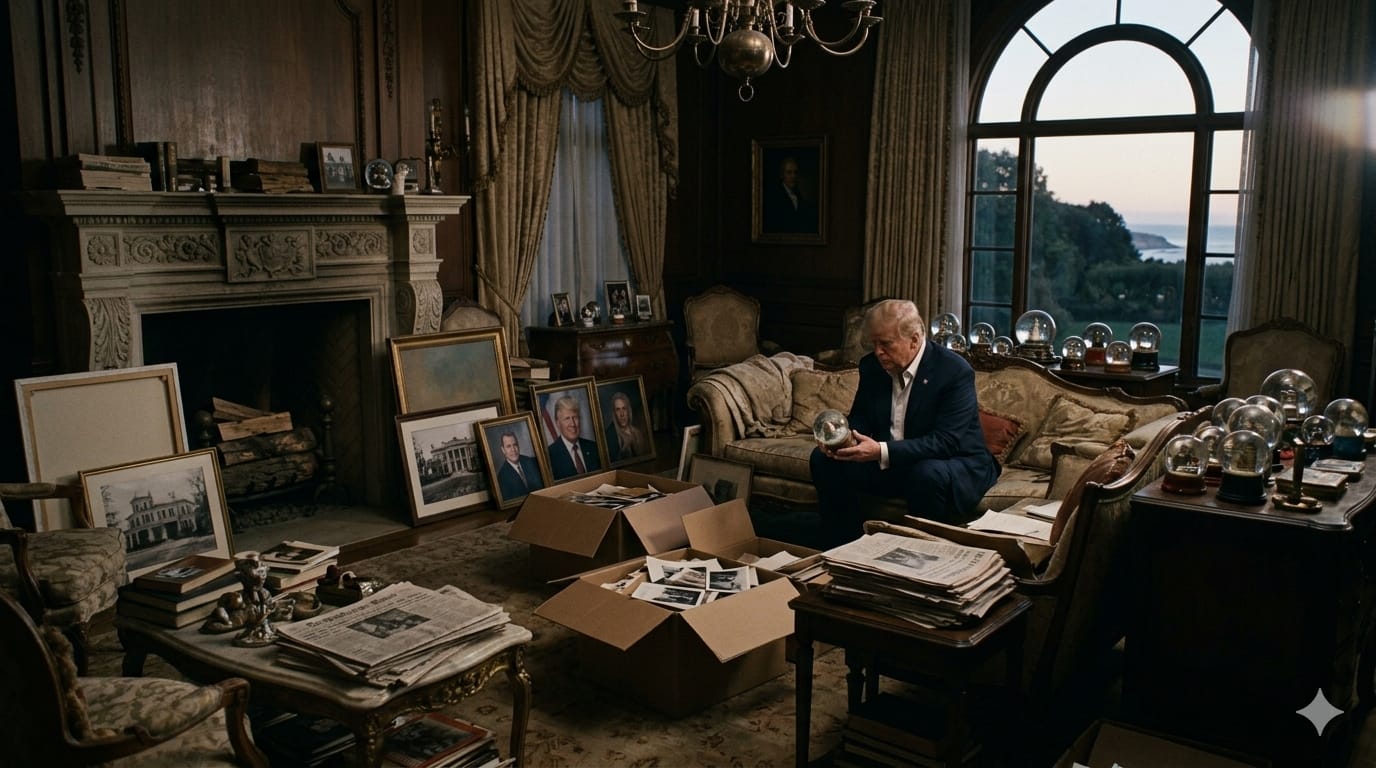
Donald Trump has famously commented on Citizen Kane, calling it one of his favorite films. But Trump missed the central warning of his favorite movie.
The warning is that you cannot fill a spiritual void with real estate. You cannot build a wall high enough to keep out the passage of time, and you cannot buy a headline big enough to make the world love you the way you want to be loved.
As the sun sets over Mar-a-Lago, the ghost of Charles Foster Kane still walks the corridors. The stage is still lit. The crowd is still waiting. But the snow globe is slipping.
Tim
Tim Lowe is a writer, book expert, retired sailor, retail worker, and renaissance man.
He is currently traveling the country and working on his forthcoming book.