
Are They Dead Yet?

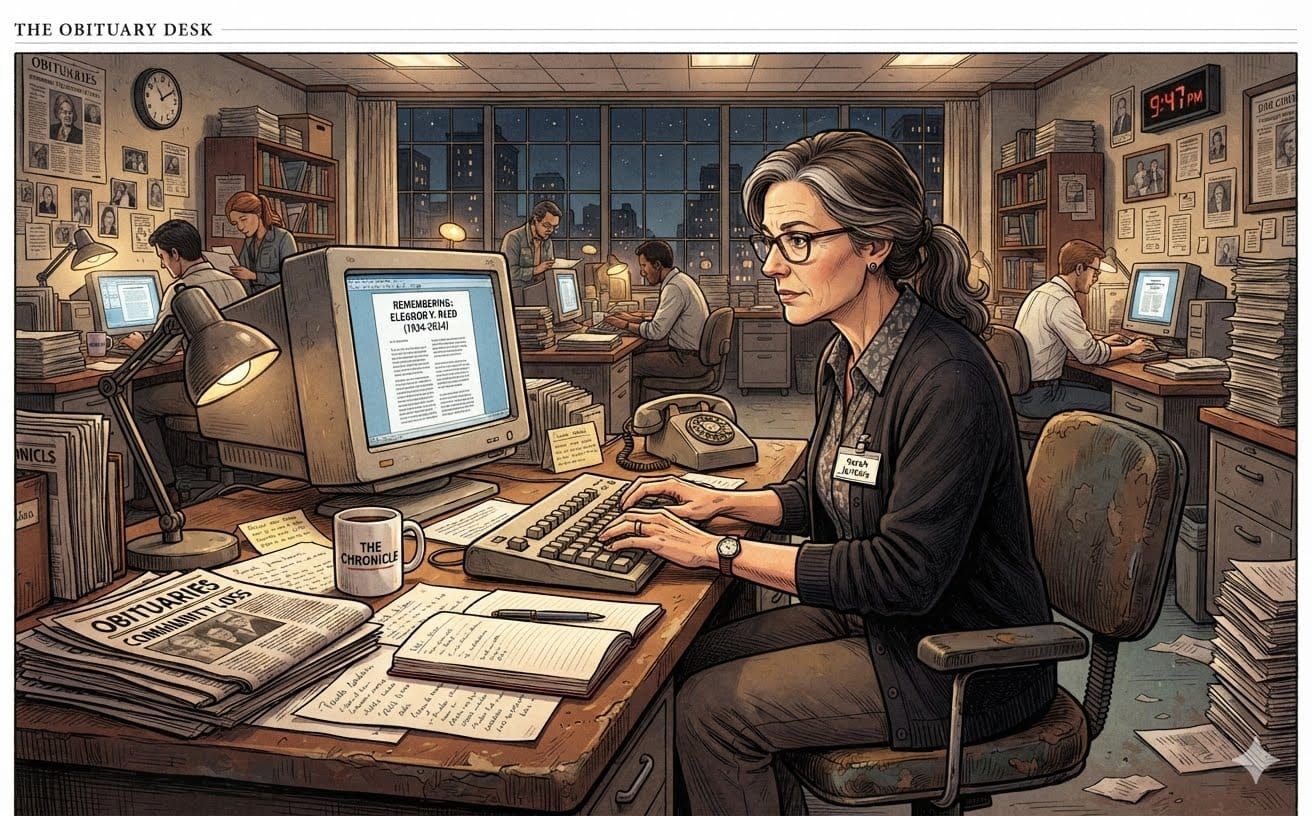
If you ever find yourself with a spare afternoon and a sudden, slightly morbid urge to examine the human condition, you could do a great deal worse than to wander into the back corner of a major newsroom and seek out the obituaries editor. For it is here, amidst the hum of computers and the smell of cooling coffee, that you will find a small band of people engaged in a most extraordinary sort of magic.
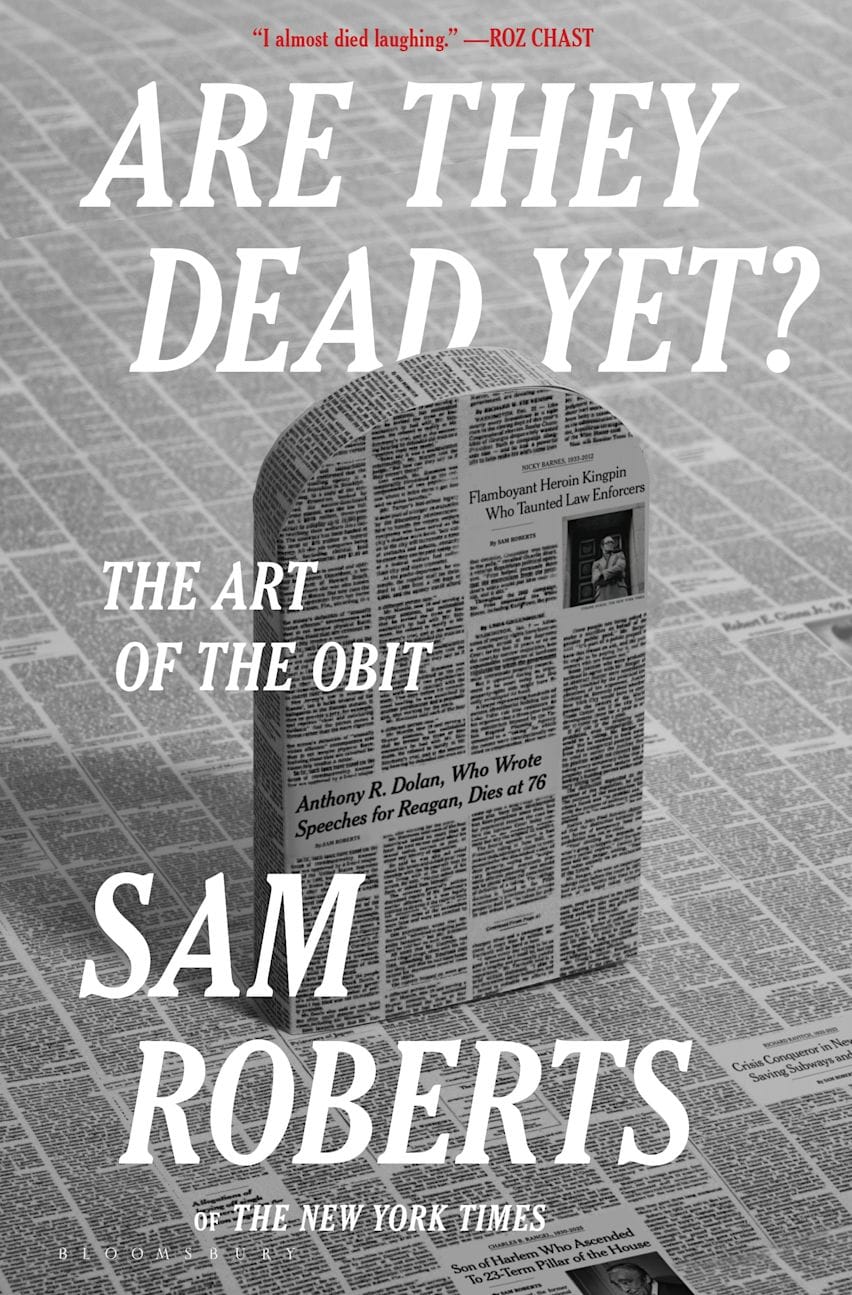
Consider the career of a man named Roberts. For nearly a decade, Roberts has clocked into work at what is grandly referred to as the "paper of record"—the New York Times, an institution that takes itself very seriously indeed—and spent his days pondering the deceased. He has, by his own reckoning, composed some 1,500 obituaries. Now, you might reasonably assume that spending ten years drowning in a sea of expired citizens would make a person rather gloomy, or at the very least, an expert on the mechanics of dying. But as Roberts explains in his wonderfully illuminating book, Are They Dead Yet?, you would be entirely wrong.
The great, ironic secret of the obituary desk is that obituaries have almost nothing to do with death. In fact, if you look closely at a properly constructed obituary, you will notice that the actual act of dying is usually dispensed with in a single, perfunctory sentence—often something along the lines of "died on Tuesday at his home in Poughkeepsie"—and then never mentioned again. The remaining nine hundred words are devoted exclusively to something much more interesting: life.
It is a staggering logistical exercise. Every morning, Roberts arrives at his desk, is handed a name he has quite possibly never encountered before, and is tasked with distilling that person’s entire earthly existence—their triumphs, their catastrophic missteps, their peculiar habits, and their very essence—into a few tight, definitive paragraphs before the evening deadline. It is a bit like being asked to summarize the history of Western civilization on the back of a postage stamp, and to do it by lunch.
In Are They Dead Yet?, Roberts pulls back the curtain on this strange and secretive trade, guiding us through the philosophical minefields that obituarists must navigate every day. The first, and perhaps most agonizing, question is simply: who gets in? In a world where roughly 150,000 people have the bad manners to die every single day, how do we decide whose passing warrants a formal public accounting? Is it enough to have invented the plastic cap on the end of a shoelace, or must you have successfully run a small European principality?
And once a subject is deemed worthy, how on earth does one choose what to leave out? Human lives are notoriously messy, disorganized things, rarely adhering to a neat narrative arc. Roberts introduces us to the sheer panic that ensues when an obituarist uncovers a piece of information that is, shall we say, inconvenient. What do you do when you discover that a celebrated, saintly philanthropist actually spent his weekends embezzling from orphanages, or that a pioneering nuclear physicist met her end in some deeply undignified, wonky manner involving a rogue lawnmower?
Then there is the vexing problem of legacy. We tend to think of our "claim to fame" as a fixed, immutable monument. But Roberts reveals that what makes someone famous in the cold light of a post-mortem headline is often entirely distinct from what actually mattered to them while they were still breathing. A man might spend forty years being a wonderfully attentive father, a brilliant amateur watercolorist, and a beloved neighbor, only to be remembered by history exclusively because he happened to be the guy who accidentally set fire to the Ohio River in 1969.
Perhaps the most fascinating revelation in the book is the existence of the "advance" obituary. At any given moment, the New York Times holds a vast, digital vault containing more than 2,000 pre-written obituaries. These are meticulously researched, beautifully polished biographies of people who are currently walking around, eating sandwiches, and entirely oblivious to the fact that their death notices are regularly updated by a quiet man in Manhattan. It is a chillingly efficient system. The moment a major figure collapses at a gala, a journalist somewhere simply hits 'publish,' and history is instantly codified.
Roberts also takes us on a tour of the linguistic gymnastics peculiar to the craft—the delightful, classic euphemisms used to smooth over life’s rougher edges. We learn that in the coded language of the obituary, a gentleman who was "devoted to his mother" or "never married" was often living a life that, in a less tolerant era, could not be explicitly named. A person described as having a "robust personality" was almost certainly an insufferable bully, while someone who "did not suffer fools gladly" was a tyrant who threw typewriters at the copy boys.
With tremendous wit and an abundance of behind-the-scenes intrigue, Roberts examines how America's relationship with the grim reaper has shifted in the shadow of major modern traumas like 9/11 and the global pandemic. Yet, despite the inherent gravity of the subject, the book never feels depressing. Instead, Roberts uses his decades of experience to deliver a profoundly comforting conclusion.
In the end, by looking at humanity through the rearview mirror of its passings, Roberts proves something utterly magnificent. He shows us that when you peel away the grand titles, the medals, and the puffed-up resumes, every single life is an astonishingly complex, wildly improbable adventure. In a universe that is mostly empty space and cold rock, the mere fact that we are here at all, making messes and leaving footprints, is a miracle. Roberts reminds us that if you look closely enough at anyone's story, you will find something extraordinary. The greatest lesson from a long career spent in the company of the dead is beautifully simple: there is quite genuinely no such thing as an ordinary life.
Please follow our instagram: @radicalgrammar