
Dave Marsh (1950-2026)

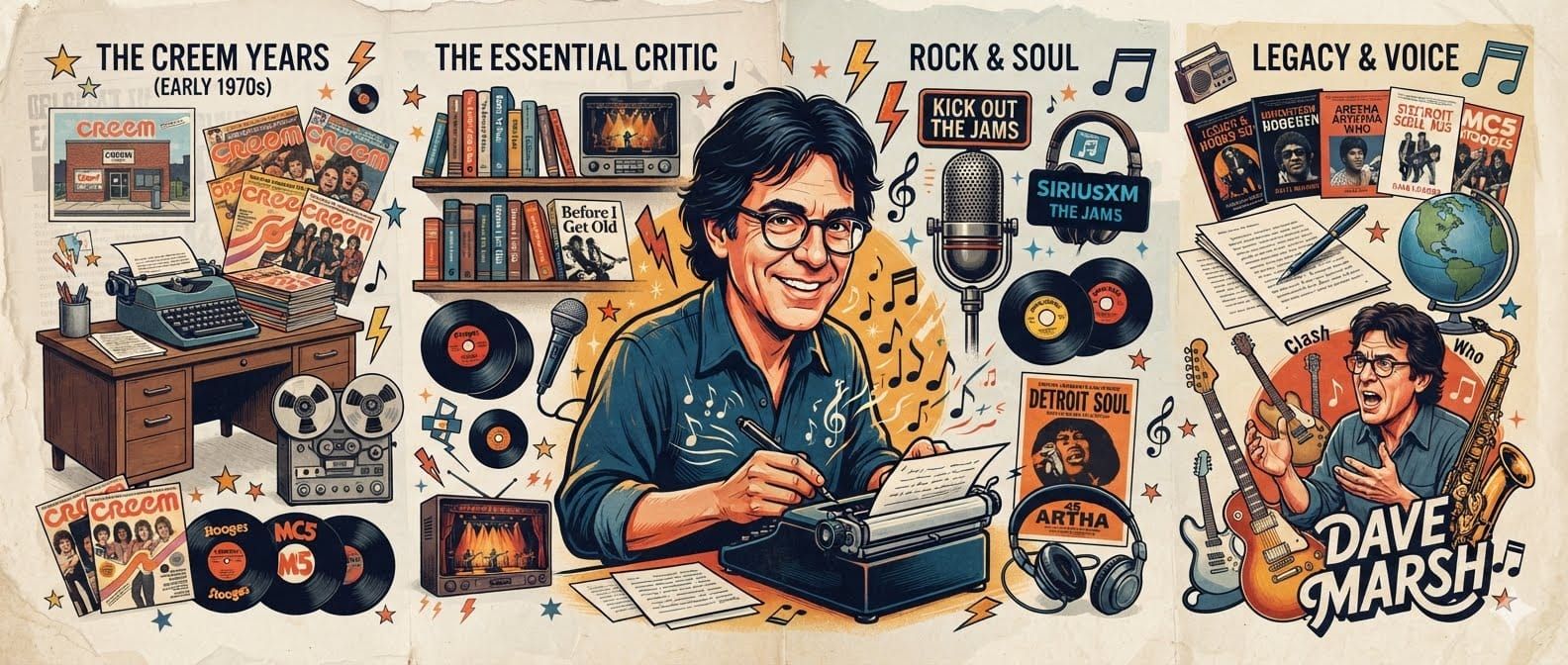
The foundational paradox of rock criticism has always been the requirement to intellectualize something that is fundamentally designed to be felt in your lower gut. To be a rock critic is to look at a three-minute explosion of adolescent lust and working-class frustration and decide that it needs a thesis statement. Nobody understood this tension—or weaponized it with more aggressive, single-minded conviction—than Dave Marsh.

Marsh, who passed away today at the age of 76, did not view rock and roll as a lifestyle choice or a soundtrack for suburban teenagers to format their identities around. He viewed it as a high-stakes, ongoing conflict for the soul of American democracy. If you grew up reading his work in Creem or Rolling Stone during the 1970s and ’80s, you quickly realized that to Marsh, a bad review wasn't just an aesthetic disagreement. It was an indictment of character. To praise the wrong record was to side with the forces of cultural apathy; to champion the right one was to partake in a small, righteous revolution.
This unyielding framework is precisely how we ended up with the mythology of Bruce Springsteen. There is a very real argument to be made that without Dave Marsh, the concept of the working-class rock prophet does not exist in the same way. Marsh didn’t just write the definitive 1979 biography Born to Run; he helped construct the entire intellectual architecture that allowed a kid from Asbury Park to be taken as seriously as John Steinbeck. When Marsh looked at Springsteen, he didn’t just hear great hooks and cinematic lyrics; he saw the ultimate synthesis of American possibility and American tragedy. He heard the truth, and he spent the next fifty years demanding that everyone else admit it, too.
In a contemporary media landscape where criticism has largely been flattened into consumer advocacy—where we grade albums out of ten to help algorithms optimize our streaming queues—Marsh’s intensity feels like a relic from an entirely different civilization. He belonged to a generation of writers who genuinely believed that a record review could alter the course of an election or fix a broken health care system. He was exhausting, tribal, and hyper-literate, operating with the kind of certainty that is completely impossible to sustain in the internet age. He was the kind of guy who would co-found Creem, establish the rock book list as a literary genre, host radio shows on SiriusXM for decades, and somehow still make you feel like he was whispering a radical secret across a dimly lit bar.
When a writer like Marsh dies, we don't just lose a person; we lose a specific way of thinking about the world. We lose the idea that pop culture matters enough to fight about. He spent his entire life kicking out the jams because he knew that if you stop making noise, the silence that takes its place isn't peace—it’s just defeat.
Rest in peace, Dave.