
Days of Miracle and Wonder

There is a panic that visits the exceptionally successful when they realize the world they mastered no longer exists. In the dead heat of 1984, Paul Simon was experiencing this precise existential vertigo. He was forty-two years old, a complicated age to be an American pop star, but a catastrophically difficult age to be one in the mid-1980s. The musical landscape had radically re-engineered itself while he was looking the other way. The intellectual, acoustic folk-rock poetry that had propelled Simon & Garfunkel into the cultural stratosphere was suddenly treated like an ancient, obsolete dialect. The world was now governed by the hyper-visual, neon-drenched dictates of MTV, a network that demanded its artists look like cartoon characters and sound like robots. The charts were dominated by the artificial percussive thud of the LinnDrum and the icy, synthesized sheen of the Yamaha DX7. For a man whose entire artistic identity was built around the warmth of a fingerpicked acoustic guitar and the precise, literary weight of a handwritten lyric, this new digital reality felt like a hostile eviction notice.
To make matters worse, Simon’s internal world was fracturing with the same aggressive velocity as his public career. His high-profile marriage to actress Carrie Fisher was disintegrating in real-time, collapsing under the weight of mutual brilliance and volatile temperaments. His latest solo effort, Hearts and Bones, had flopped hard, completely ignored by a public that was busy buying records by Duran Duran and Cyndi Lauper. Simon was trapped in that most terrifying of creative paradoxes: he was too famous to be ignored, too old to be hip, and too proud to simply fade into the nostalgia circuit. He was a legacy act before the concept of legacy acts had even been fully monetized by the recording industry.
Then, as is so often the case in the history of rock and roll breakthroughs, the trajectory of modern music was altered by a completely mundane, accidental interaction with a piece of plastic.
Driving around New York that summer, desperate for a distraction from his own thoughts, Simon slipped a bootleg cassette into his car stereo. The tape, lent to him by a friend, was an underground compilation of "township jive"—the raw, frenetic, aggressively joyful street music of South Africa, specifically a genre known as Mbaqanga. It was an aesthetic universe away from anything happening on American radio. Yet, to Simon’s ears, it felt instantly familiar. It didn't sound like the slick, over-processed future; it sounded like the past. It possessed the exact same kinetic energy, the same unbridled, rhythmic optimism that had defined the early days of 1950s American rock and roll before the genre became corporate and self-serious. While cruising the highway, Simon began to hum along, superimposing his own Western melodies and abstract lyrical fragments over the relentlessly looping basslines and stuttering guitar grooves.
The music became an obsession. But it also presented a massive, seemingly insurmountable moral and political dilemma. South Africa in 1984 was a global pariah, governed by a brutal, institutionalized system of white supremacist apartheid. The United Nations and the international artistic community had instituted a strict cultural and economic boycott designed to completely isolate the regime. To travel there, let alone to record music there, was to invite an avalanche of political condemnation. It was a high-stakes move that could permanently destroy whatever remained of his public reputation. Yet Simon, driven by a mixture of artistic desperation and a stubborn belief that music operates on a higher metaphysical plane than global politics, became determined to orchestrate a collaboration. He wasn't looking to make a grand political statement; he was looking for a heartbeat.
In 1985, Simon made the fateful, highly controversial decision to board a flight to Johannesburg. It was a cultural gamble of unprecedented proportions. He wasn't arriving as a musical tourist looking to sample exotic sounds for a pre-existing pop record; he was throwing himself into an entirely collaborative, highly experimental process with local musicians like the vocal group Ladysmith Black Mambazo and bass virtuoso Bakithi Kumalo. The sessions were loose, chaotic, and fundamentally cross-cultural, defined by a radical re-imagining of how a pop album could be constructed. Simon took these foundational African tracks and spent the next year traveling the world—layering elements in New York, Los Angeles, London, and even incorporating the Zydeco accordion sounds of Louisiana. He was stitching together a global sonic tapestry that defied geographical logic.
The result of this high-wire act was Graceland, released in 1986. Against every conceivable piece of conventional industry logic, the album became a towering, inescapable cultural phenomenon. It was a rare, monolithic triumph that satisfied both the snootiest highbrow critics and the most casual radio listeners. Graceland completely redefined Simon's career. The album won multiple Grammy Awards, including the coveted Album of the Year, sold 16 million copies globally, and launched a massive, triumphant worldwide tour that lasted for five years. Songs like "You Can Call Me Al" and "The Boy in the Bubble" became permanent fixtures of the global monoculture, marrying heavy, existential anxieties with infectious, danceable polyrhythms.
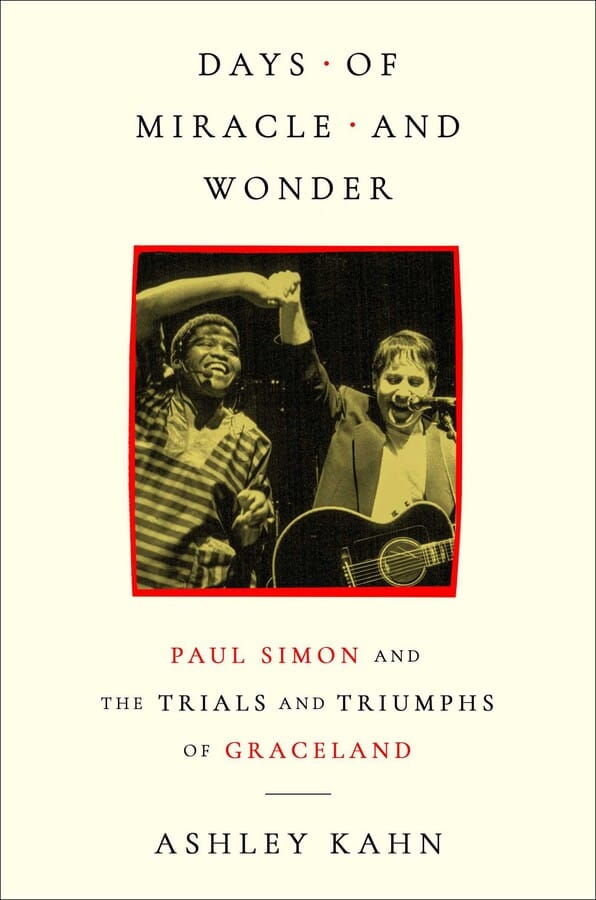
This entire chaotic, brilliant, and deeply complicated saga is finally given its definitive historical treatment in the book Days of Miracle and Wonder. This is the first exhaustive, multi-dimensional account of how Graceland was actually built from the ground up. It functions as a forensic examination of Simon’s obsessive creative psychology, pulling back the curtain on the technical, multi-track recording innovations that allowed engineers to splice together seemingly incompatible musical traditions into a seamless pop masterpiece. The book maps out the dizzying geography of the album's creation, charting the human stories of the musicians and engineers across multiple continents who lent their souls to the project. Furthermore, it analyzes the massive corporate and media machinery that allowed an album sung partly in Zulu to achieve total mainstream dominance in Reagan-era America.
Crucially, Days of Miracle and Wonder does not flinch from the heavy ideological baggage that has shadowed the record for forty years. It tackles the bitter controversies head-on—the fierce debates over cultural appropriation, the accusations of breaking the anti-apartheid strike, and the complicated ethics of a wealthy Western superstar entering an oppressed society to extract its art. These are the arguments that remain just as loud, uncomfortable, and relevant today as they were in 1986.
What the book ultimately delivers is an incredibly informed, deeply felt, and intellectually rigorous celebration of Paul Simon’s definitive magnum opus. It paints a vivid portrait of a masterpiece that was forged in the fires of an incredibly tense, deeply fractured cultural moment. Yet, despite the darkness of its geopolitical origins, the music itself remains permanently suffused with a sense of hope, radical reinvention, and a profound, universal belief in the power of global connection. It is the story of an artist who looked into the abyss of his own obsolescence and somehow found the rest of the world looking back at him.