
Love and Terror

The Helter-Skelter History of the Manson Murders
written by Claudia Verhoeven, published by Verso Books
August 1969. Hollywood. The "beautiful people" were living on borrowed time, and the Manson Family came to collect.
We’ve all heard the story—or at least the version of it that’s been drilled into the collective consciousness for decades. It’s the gruesome tableau that, as Joan Didion famously put it, served as the definitive funeral for the sixties. It was supposed to be a spark, a twisted tactical strike intended to frame Black radicals and ignite an apocalyptic race war. Instead, it just cast a long, suffocating shadow over the entire counterculture, cementing itself as the founding myth of the modern true-crime obsession.
But what if the version of the Manson story you know is just a cover track, polished and scrubbed until the jagged, uncomfortable edges were smoothed away?
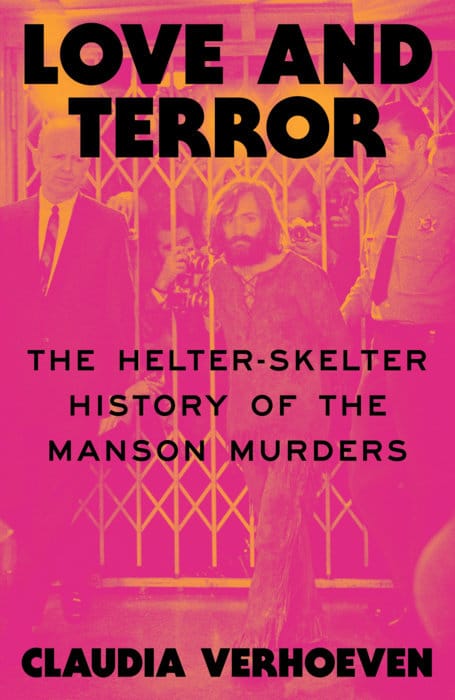
That’s where Claudia Verhoeven’s Love and Terror comes in. Forget the "mastermind" caricature you’ve seen in every documentary or sensationalized paperback. Verhoeven didn't just rehash the old transcripts; she dug into newly released archival material to pull the case out of the "shopworn narrative" trap and drop it back into the messy reality of the late twentieth century.
The result isn’t just a book; it’s a kaleidoscopic deep dive. She reframes the Manson saga not as a standalone act of horror, but as a prism reflecting the chaos of the time—global avant-garde movements, the rise of revolutionary violence, and the terrifying birth of our current age of spectacle. It turns out, Manson wasn't just some singular boogeyman; he was a symptom of a culture already spiraling.
Verhoeven’s writing doesn't try to sanitize the insanity of the event. She captures the "confused, tumultuous, and pell-mell" nature of it all. It’s carnival-esque and deeply unsettling, yet somehow, it’s impossible to look away. She taps into why we keep coming back to these murders with such morbid, repetitive compulsion. It’s that Helter Skelter effect—the sickening, addictive ride of going up and down, over and over again, fed by a relentless "Manson industrial complex" that refuses to let the story die.
Love and Terror is a corrective. It’s a move away from the myth and back toward the history, asking us to look past the gore and understand how this event became the engine for a culture industry that feeds on our fear. If you think you’ve heard everything there is to know about the Manson family, this is the book that reminds you how little we’ve actually understood.
Claudia Verhoeven is an associate professor of history at Cornell University. She received a BA in Philosophy from UC Berkeley and a Ph.D. in History from UCLA. She is the author of The Odd Man Karakozov: Imperial Russia, Modernity, and the Birth of Terrorism and the co-editor of The Oxford Handbook of the History of Terrorism. She has been a fellow at the Robert Schuman Center of Advanced Studies at the European University Institute, the Society for the Humanities at Cornell, and the Institute of Advanced Studies in Berlin.