
Notes of Deception


How a Quartet of American Musicians Outwitted the KGB
The thing about the 1980s is that we have collectively decided to remember it as a decade defined entirely by neon plastic, bad hair, and a kind of narrative simplicity. We look back at the Cold War through the lens of Rocky IV or Red Dawn, treating the geopolitical tension between the United States and the Soviet Union as a binary, hyper-stylized conflict where the stakes were explicitly binary: capitalism versus communism, freedom versus oppression, nuclear winter versus the continuation of the American shopping mall. It was an era where the concept of espionage was fundamentally tied to a specific aesthetic—trench coats, cyanide pills, and smooth-talking men with government clearance who knew how to assemble a sniper rifle in the dark.
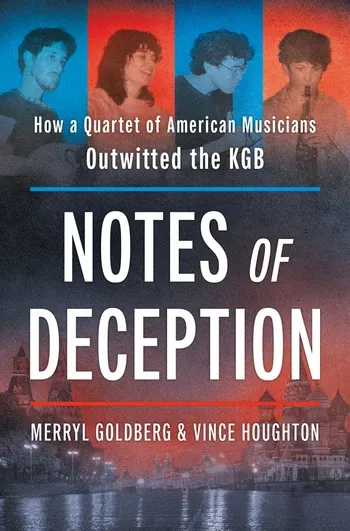
But reality, as it usually does, has a strange habit of being far more absurd and significantly more interesting than the pop-culture mythology we use to replace it. This is the underlying realization that hits you when you pick up Notes of Deception: How a Quartet of American Musicians Outwitted the KGB, a book that forces you to re-evaluate what we actually mean when we talk about the mechanics of historical importance. The premise sounds like something a Hollywood executive would pitch after eating a late-night edible, yet it is completely, undeniably true. In 1985, four American musicians associated with the New England-based, Yiddish-music focused Klezmer Conservatory Band landed at Sheremetyevo International Airport in Moscow. They were not trained operatives. They did not have diplomatic immunity. What they did have was a collection of instruments, a spiral-bound notebook of sheet music, and a secret mission to smuggle critical intelligence in and out of the Soviet Union to aid Jewish dissidents known as Refuseniks.
The book, written by the quartet's saxophonist, Merryl Goldberg, alongside Vince Houghton, the Director of the National Security Agency’s National Cryptologic Museum, operates on a fascinating sort of structural irony. When we read traditional spy thrillers, the tension comes from the hyper-competence of the protagonists. We assume James Bond or Jason Bourne will survive because they possess a specialized toolkit of lethal skills. In Notes of Deception, the tension is driven by the exact opposite dynamic: the terrifying realization that these people have absolutely no idea what they are doing in the traditional sense of international intrigue. They are artists who suddenly find themselves being trailed by actual KGB agents who talk into their sleeves and look at them with the cold, unblinking certainty of state-sanctioned paranoia.
What makes Goldberg’s account so brilliant—and what Houghton’s historical framework contextualizes so well—is the sheer elegance of the central conceit. To transport names, addresses, and vital logistical data past the Soviet border control, Goldberg didn't build a false-bottomed suitcase or hide microfiche in a hollow tooth. Instead, she recognized that the human brain categorizes information based on expectation. If a border guard looks at a piece of paper covered in numbers and letters, they see a code. But if they look at a piece of paper covered in staves, clefs, and sixteenth notes belonging to a traveling klezmer musician, they just see a melody.
Goldberg created an ingenious mathematical cipher that mapped intelligence onto musical notation. She encoded geopolitical secrets directly into the sheet music. It is a concept that feels deeply philosophical if you think about it long enough. Music is already a code; it is an abstract system of symbols used to communicate complex human emotions across time and space. Goldberg simply took that existing architecture and applied it to the high-stakes reality of global brinkmanship. To the KGB, it was just the idiosyncratic noise of traditional Yiddish folk music. To the dissidents in Moscow and the lawmakers back in Washington, it was a lifeline.
There is a temptation to view this story as a whimsical caper, a lighthearted footnote in the broader tapestry of 20th-century diplomacy. But the book refuses to let the reader off that easily. The authors capture the genuine, suffocating fear of the era—the electricity being abruptly cut during underground jam sessions, the psychological weight of knowing that while the Americans could eventually get on a plane and fly back to Boston, the Soviet citizens they interacted with faced the very real prospect of being beaten, imprisoned, or erased from society entirely. The book does an exceptional job of balancing the inherent absurdity of the situation with the profound moral seriousness of what these musicians were trying to accomplish.
Ultimately, Notes of Deception works because it subverts our understanding of how history is made. We like to think that global shifts are orchestrated exclusively by men in wood-paneled rooms signing treaties or generals moving tanks across a map. But more often than not, history is pushed forward by ordinary people who find themselves in extraordinary situations and decide to use whatever specific, seemingly irrelevant skills they possess to do something decent. In 1985, the most effective weapon against the terrifying apparatus of the Soviet state wasn't a nuclear missile or a CIA asset; it was a soprano saxophone and a notebook full of hand-notated klezmer tunes. It is a story about the ultimate power of human connection, the flexibility of language, and the strange things that happen when art refuses to stay in its lane.