
Paranoia as an Art Form

Watch enough films from 1971 in a row and a pattern emerges that no single director planned but that the entire industry seemed to arrive at simultaneously, almost as if the culture's growing suspicion of its own institutions had leaked directly into the water supply every studio in Los Angeles was drinking from. The movies of 1971 are not comfortable movies. They are stories about systems that fail, authorities that cannot be trusted, and individuals left to sort out the wreckage because the institutional safety nets have entirely evaporated.
The French Connection, directed by William Friedkin and released that October, gave America Gene Hackman as Popeye Doyle, a narcotics detective who is racist, violent, obsessive, and entirely removed from the neat moral framework of the era's earlier cop-movie heroes. The film's justly famous car chase, shot with a documentary-grade grit that made audiences physically flinch in their seats, wasn't just a technical achievement. It was a statement about a kind of policing that operated by its own brutal, desperate logic, completely outside the predictable boundaries that had governed classic Hollywood cops-and-robbers pictures for decades. Popeye gets his man in the end, more or less, but the film still refuses him any real triumph, choosing to fade out on a note of deep moral murk rather than neat resolution. Audiences, exhausted by a government caught lying about a war and increasingly suspicious of every authority figure in American life, didn't want the clean comfort of Dragnet anymore. They wanted a cop who was as morally compromised as the world he was supposedly cleaning up, because that felt like the truth.
Dirty Harry arrived that same December, and Clint Eastwood's Harry Callahan became an entirely different, considerably more controversial answer to the same cultural anxiety. Critics like Pauline Kael famously savaged the film as fascist propaganda, and there is a compelling argument to be made for that perspective, given that the narrative essentially endorses a cop taking the law into his own hands because due process has become an obstacle to justice rather than a safeguard of civil liberties. But whatever one thinks of its politics, Dirty Harry landed precisely because it tapped into a genuine, growing panic on both the political left and right that American institutions had stopped functioning the way they were supposed to.
A Clockwork Orange, Stanley Kubrick's adaptation of Anthony Burgess's novel, released that December as well, pushed this institutional distrust into even more disturbing territory. The film follows a violent young sociopath through a brutal aversion-therapy cure administered by a state that turns out to be exactly as sadistic and morally bankrupt as the violence it claims to be correcting. The film was so controversial upon release, so genuinely unnerving in its refusal to offer audiences a safe place to stand, that Kubrick himself would eventually withdraw it from release in Britain after reports of copycat violence, keeping it unavailable there for decades. That is not a film industry playing it safe for investors. That is an industry, emboldened by a few years of proof that audiences would actually show up for genuinely difficult material, pushing as far into moral discomfort as the culture could bear, and in Kubrick's specific case, slightly further than that.
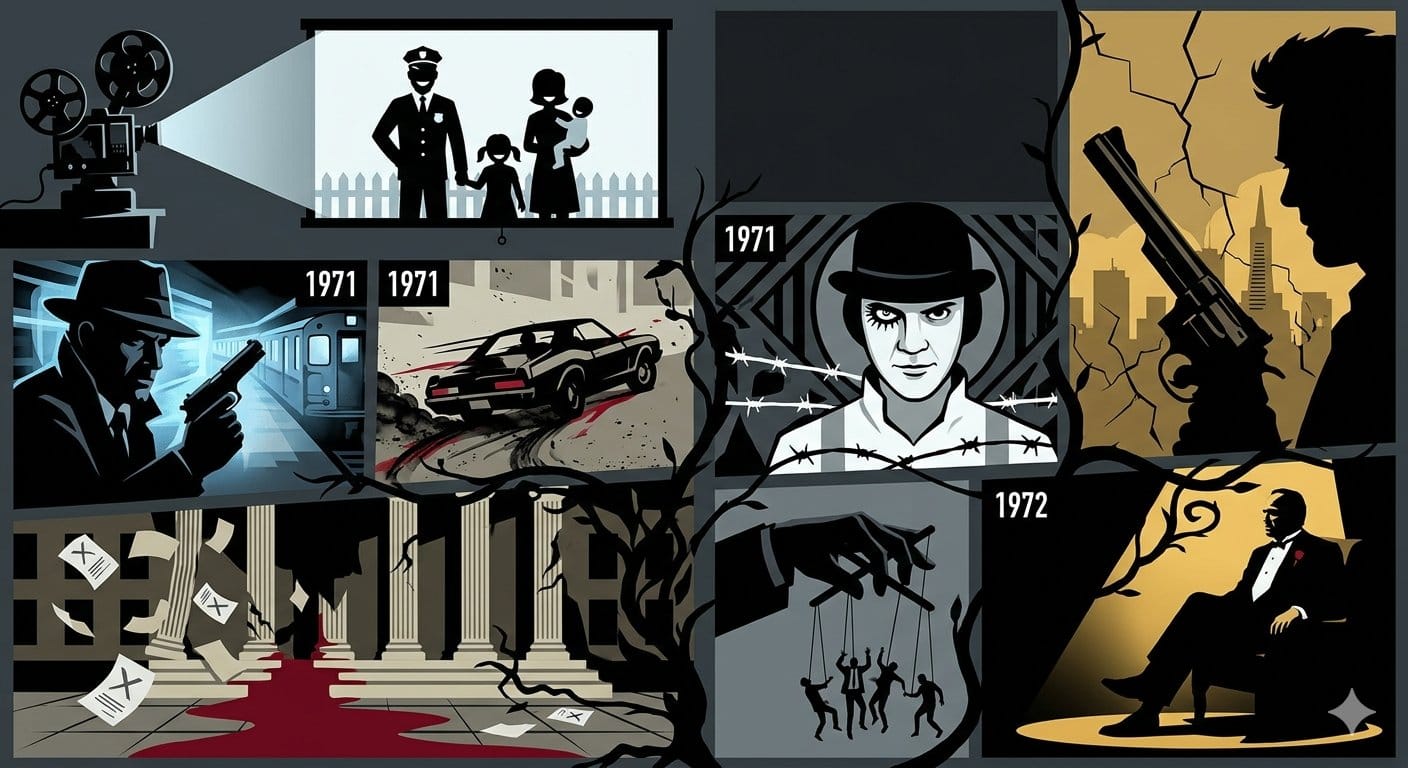
Even a movie as ostensibly straightforward as Straw Dogs, Sam Peckinpah's brutal home-invasion thriller released that same winter, refused to let its audience walk away with a clean read on who deserved sympathy and who deserved condemnation. Peckinpah staged a siege and an act of vigilante violence with a jarring ambiguity that horrified as many critics as it captivated, forcing viewers to confront their own latent thirst for blood. Around the exact same time, Harold and Maude, considerably gentler on its surface but genuinely radical underneath, told the story of a death-obsessed young man and a seventy-nine-year-old Holocaust survivor falling in love. This was a premise so far outside anything a studio would have green-lit a decade earlier that its initial commercial failure and eventual cult-classic afterlife tells its own story about how far ahead of mainstream taste the era's most interesting films were willing to run.
What ties all of this together—Popeye Doyle's moral compromise, Dirty Harry's vigilante fury, A Clockwork Orange's institutional sadism, Straw Dogs' refusal to hand out easy sympathy—is a single, shared conviction running underneath every one of these otherwise wildly different films. The old authorities cannot be trusted to protect you, and the individuals forced to act in their place are themselves deeply, sometimes horrifyingly compromised. That is not a coincidence arriving in the same twelve months that the Pentagon Papers proved, in the government's own words, that four presidential administrations had systematically lied about Vietnam, and that a Supreme Court had to intervene to stop Nixon's administration from silencing the newspaper that exposed it. The films of 1971 are not commenting directly on the Pentagon Papers. They didn't need to. They are commenting on the exact same rot that produced the Pentagon Papers in the first place, the same collapse in institutional trust that was, at that very moment, quietly gathering itself into the Watergate scandal still a year away from breaking into public view.
By 1972, that rot finally gets a name and an address when the break-in happens in June. American film, already primed by everything 1971 had done to soften up the audience for genuine moral complexity, was about to deliver The Godfather. Francis Ford Coppola’s masterpiece made the argument that this whole era keeps circling back to more completely than any single piece of art the decade produces: that power, wherever it actually lives—in the mob, in the government, in a family—corrupts through the exact same mechanisms, and the people running it are never quite the monsters or the heroes either side wants to believe.
Tim
Tim Lowe is a writer, book expert, retired sailor, retail worker, and renaissance man.
He is currently traveling the country and working on his forthcoming book.