
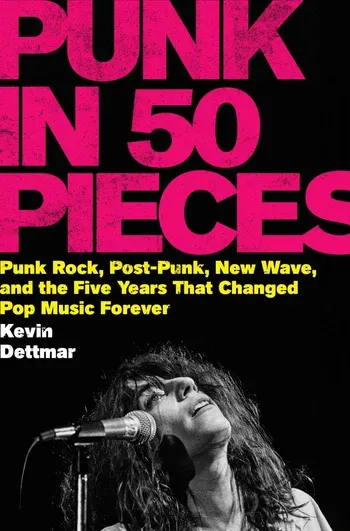
Punk in 50 Pieces

Punk Rock, Post-Punk, New Wave, and the Five Years That Changed Pop Music Forever
There is something fundamentally irrational about commemorating the fiftieth anniversary of a cultural phenomenon whose entire ideological premise was that nothing, under any circumstances, should ever survive long enough to have an anniversary. When the Sex Pistols dropped “Anarchy in the U.K.” into the collective consciousness on November 26, 1976, nobody in that room or on that record thought, “I cannot wait until civil society throws us a golden jubilee in 2026.” To mark half a century of punk rock feels less like a conventional milestone and more like a cosmic punchline, akin to a museum erecting a velvet rope around a Molotov cocktail that failed to go off. Yet here we are, stranded fifty years down the river, staring at the debris of an explosion that everyone agrees happened, but nobody can agree on how to describe. This brings us directly to Kevin Dettmar’s Punk in 50 Pieces, an exhaustive, restless piece of cultural archaeology that tries to solve the central, lingering puzzle of late-twentieth-century music: what the hell was that?
The natural temptation with rock history is to turn it into scripture, which is usually where music criticism goes to die. We tend to want clean, linear narratives where four guys from Queens put on leather jackets, John Lydon buys a ripped sweater, and suddenly rock ’n’ roll is saved from the bloated, twenty-minute synthesizer solos of progressive rock. But that is not how culture works, and it is certainly not how human rebellion works. Greil Marcus, the patron saint of taking rock music with terrifying seriousness, accurately pointed out that Dettmar’s book is an irresistible provocation that will trigger a thousand arguments the second it lands on shelves. That is because Dettmar refuses to treat punk as a fixed stylistic museum piece. Instead, he treats it as an ongoing metaphysical dispute, a violent seismic rupture that fragmented almost immediately into fifty irreconcilable directions.
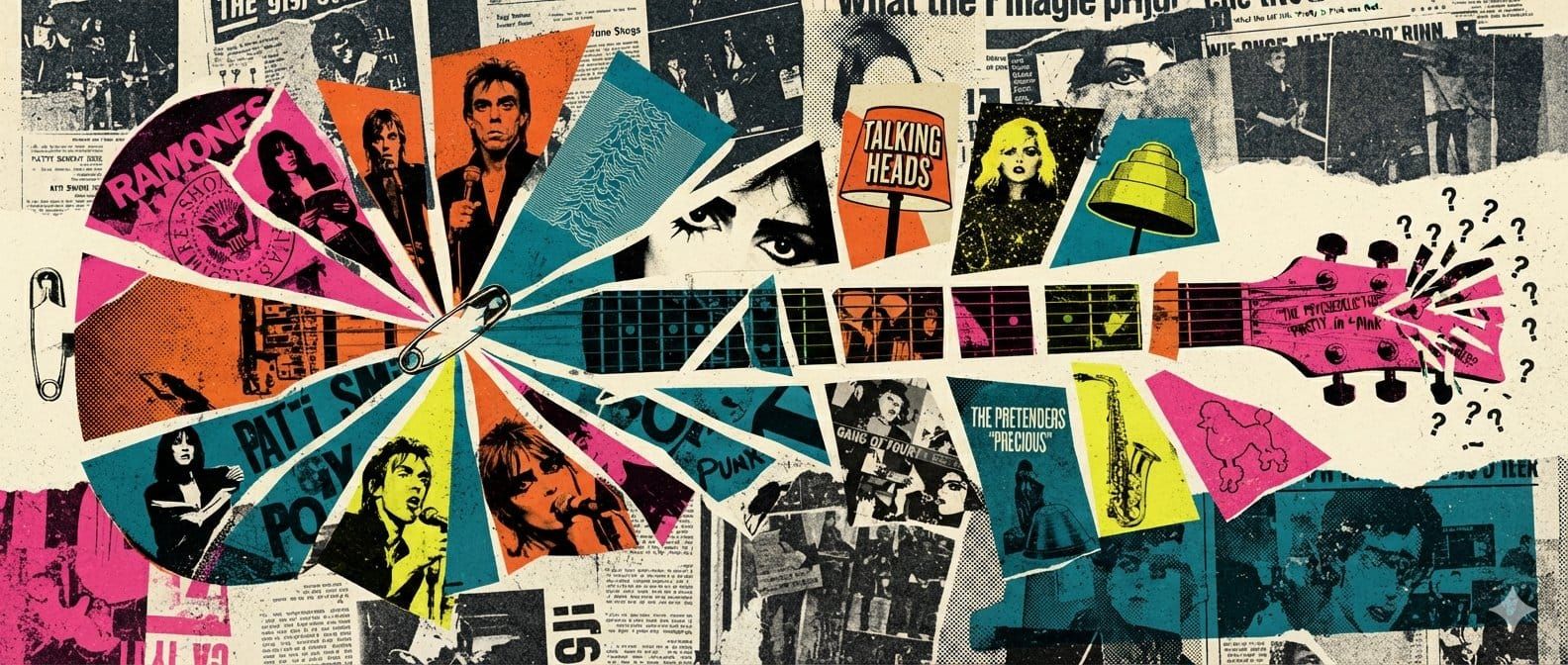
By dissecting fifty pivotal tracks and moments, Dettmar charts the volatile mutation of sound where early, primordial garage noise—channeled through the raw electricity of Iggy Pop, the literary cool of Patti Smith, and the buzzsaw minimalism of the Ramones—refused to stay in its lane. The true genius of the narrative is how it tracks what happened next, when the initial explosion cooled just enough to crystallize into post-punk and New Wave. A lesser critic would insist on gatekeeping, arguing endlessly about whether Sting belongs in the same ideological universe as Poly Styrene. Dettmar, however, understands the deeper, messier truth: punk was not just a sonic format; it was an interpretive virus. It allowed Joy Division to turn inner psychological collapse into architectural post-punk gloom; it let Siouxsie and the Banshees and Gang of Four weaponize rhythm and irony; and it paved the way for Talking Heads, Blondie, and Devo to dismantle American consumerism from inside the neon safety of the pop charts.
Consider the sheer theoretical absurdity of the song selection. In what alternate reality do the primal screams of X-Ray Spex’s “Oh Bondage Up Yours!” share institutional real estate with the sparkling, hyper-caffeinated power-pop of the Go-Go’s playing “We Got the Beat”? How does the bruised, cinematic melancholy of The Cure’s “Boys Don’t Cry” connect to the surf-rock surrealism of the B-52s’ “Rock Lobster,” or the razor-sharp pub-rock cynicism of Elvis Costello singing “Alison”? To the purist who defines punk solely by down-strokes and safety pins, this looks like genre anarchy in the worst way. But to anyone interested in how ideas actually travel through mass media, it is revelatory. It proves that punk was not a wall built to keep outsiders away; it was a sledgehammer that smashed the walls so thoroughly that Chrissie Hynde could walk out with The Pretenders and drop “Precious,” while Public Image Ltd could burn the entire legacy of the Sex Pistols down to the ground to invent something colder, weirder, and far more terrifying.
What places Punk in 50 Pieces alongside standard texts like Legs McNeil and Gillian McCain’s Please Kill Me, Marcus’s own Lipstick Traces, and Simon Reynolds’s Rip It Up and Start Again is its refusal to drown in cheap nostalgia. Most books about this era are written by aging boomers trying to convince eighteen-year-olds that they missed the only cool thing that ever happened on Earth. Dettmar writes from the perspective of an analytical obsessive who knows that the music matters, but who also knows that taking it too seriously is the surest way to kill it. It functions simultaneously as an essential primer for kids who have never heard a feedback screech and an argumentative master playlist for the scarred veterans who stopped slam-dancing when their lower backs gave out. It is a sharp, funny, and deeply perceptive autopsy of an era that changed the world by setting itself on fire, making you realize that the fire never actually went out—it just changed color.