
The 1970s - part one

Chapter One: The Hangover
Every decade thinks it invented the wheel. The fifties looked at televisions and Gibson guitars and acted like they had been hauled down from a mountaintop, the eighties acted like greed was a patented product, and everybody since has looked backward with that specific, thick-headed brand of historical amnesia that assumes nothing happened before they showed up.
The seventies didn't get that luxury. The seventies knew what it was. It was a hangover.
It was the bill coming due for a decade of fresh graves, marches in the streets, bad acid, and footprints in the moon dust, all of it crashing onto the desk at once right as 1970 rolled over the calendar.
History likes to flatten the decade into a joke about disco balls, long gas lines, Watergate, and polyester. But the seventies were a strange and brutal stretch, driven largely by the fact that when the old ways actually break down and institutions stop pretending, people get honest. They get angry. They build things with a bare-knuckled clarity that comfortable eras cannot touch. Comfortable eras don't give you Chinatown. Comfortable decades don't force a president to resign in disgrace.
Look at January 1970.
The sixties hadn't actually died yet. Calendars are terrible record-keepers. The old decade just dragged its wounded, exhausted optimism behind it like a guy who refuses to leave a party after the lights go out. But the air had changed. Woodstock was five months gone, already turning into myth before people had even scrubbed the mud out of their floorboards, and poor Max Yasgur—the dairy farmer who just wanted to sell some alfalfa and do a neighborly favor—was getting sued by those same neighbors for thirty-five thousand dollars over trampled grass. That is the decade right there in a single snapshot. Half a million kids finding a strange, temporary paradise in a cow pasture, followed immediately by the unglamorous invoice: a lawsuit over dead hay.
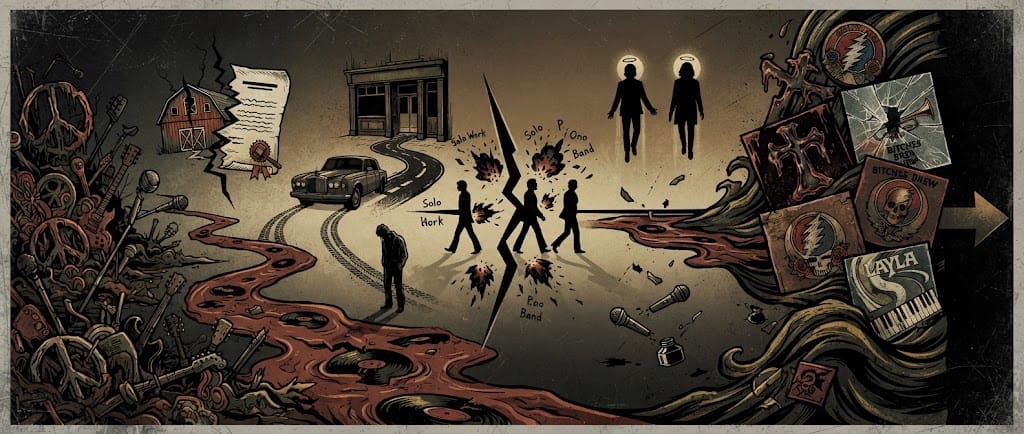
That same month, Keith Moon ran over his own driver outside a pub, panicked behind the wheel of a Bentley he had no business operating, and a man died—a weight Moon carried quietly for the rest of his short, loud life. Diana Ross walked away from the Supremes on a Tuesday night in Las Vegas with zero fanfare. Simon and Garfunkel dropped Bridge Over Troubled Water, their final gasp as a duo, recorded by two guys who could barely look at each other without clenching their jaws.
Doors slamming everywhere you looked.
And yet, the endings were just reassignments. The Beatles blew apart that April, not with some solemn press conference, but via a snarky mock-interview McCartney stuffed into his solo album promos to beat his own bandmates to the punch. It was petty and ugly, ending ten years of musical revolution with lawyers and paper shuffling. But look at what the wreckage bought us. McCartney's homespun solo record. Lennon screaming his guts out in primal therapy on Plastic Ono Band. And George Harrison, finally let out of the basement after years of being told no, dumping a triple album's worth of material onto the table with All Things Must Pass. The band didn't die; it detonated, scattering shrapnel that turned into four distinct careers.
That pattern repeats. Janis Joplin caught a two-hundred-dollar fine in Tampa for swearing—a pathetic little twitch from an old moral guard that didn't realize the target had already moved. Jim Morrison got convicted for a Miami concert that had happened eighteen months prior, a Southern jury trying to draw a chalk line around a culture that had already left town.
Then came autumn. September 18, Jimi Hendrix. October 4, Janis Joplin. Twenty-seven years old, both of them, seventeen days apart. It felt like the decade was turning on its own children, cashing in the chips of anyone who had burned too bright.
Yet the music kept coming. Black Sabbath dropped a debut that critics called sludge, inventing heavy metal while nobody was looking. Miles Davis blew the walls off jazz with Bitches Brew. The Grateful Dead gave us Workingman's Dead and American Beauty in the same twelve months. Clapton, burning with secret misery over his best friend's wife, recorded Layla.
This wasn't magic. This was what happens when an entire generation of artists watches their naive sixtyish dreams curdle into Altamont, Manson, and a meat-grinder war in Vietnam, and decides to stop playing games. The music of 1970 isn't innocent. It is true.
That's where this story starts.
Tomorrow, part two - Four Dead in Ohio....
Tim
Tim Lowe is a writer, book expert, retired sailor, retail worker, and renaissance man.
He is currently traveling the country and working on his forthcoming book.