
The Best Music Ever Made

I want to make an argument here that I know invites eyerolls from people who weren't there and have decided, somewhere along the way, that nostalgia is the only possible explanation for anyone claiming a specific era of music was the best one. So let me make the case with something other than sentiment. Let me make it with evidence.
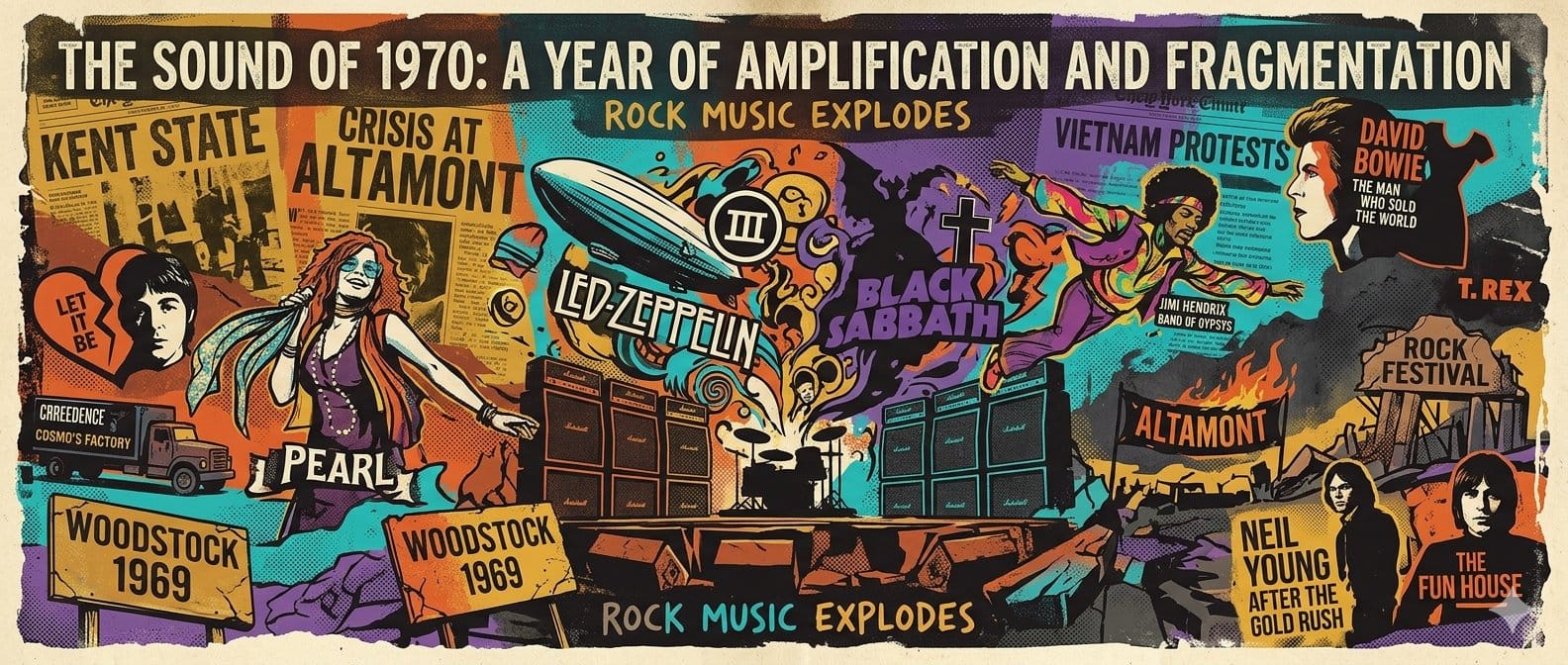
In a single calendar year — 1970, the following records were released: Bridge Over Troubled Water. Let It Be. Deja Vu. Moondance. Bitches Brew. Live at Leeds. Workingman's Dead and American Beauty, both from the same band, in the same year. Black Sabbath's debut and Deep Purple in Rock, the two foundational albums of heavy metal, released within four months of each other. Layla and Other Assorted Love Songs. All Things Must Pass. After the Gold Rush. Sweet Baby James. Tea for the Tillerman. Abraxas. Cosmo's Factory. Paranoid, if you count the very end of the year bleeding into the very start of the next. John Lennon/Plastic Ono Band. Elton John's self-titled breakthrough and Tumbleweed Connection, both in the same twelve months, both establishing an artist who would go on to define the entire middle stretch of the decade. This is not a complete list. This is barely a third of what actually came out that year. No other single year in the history of recorded popular music has ever produced a body of work this deep, this varied, and this durable, and I say that as a statement of fact rather than opinion, because the durability is measurable — every single one of those records is still in print, still streamed, still taught in music schools, still cited by working musicians as foundational to whatever they themselves are trying to build.
Why did this happen in 1970 specifically? The easy answer is that the sixties had built the infrastructure — the studios, the engineers, the record labels finally willing to let artists make albums rather than just chase singles — and 1970 is simply where that infrastructure started firing on every cylinder. That's true, but it's incomplete. The deeper answer, the one that actually explains the quality rather than just the quantity, is that 1970 is the year the music stopped being innocent and started being honest, and honest music, it turns out, ages considerably better than innocent music.
Listen to the difference between, say, "All You Need Is Love" and "Ohio," released just three years apart. One is a genuine, beautiful, but ultimately uncomplicated statement of collective idealism. The other is a direct, furious accusation aimed at a sitting American president for the killing of four college students, written and recorded and released within weeks of the actual event. That compression of time between event and artistic response, and the sheer bluntness of the response itself, tells you something had changed in what musicians believed their job actually was. They weren't just providing a soundtrack for a movement anymore. They were functioning, in real time, as journalists, as historians, as the only institution left in American life that a huge swath of the country actually trusted to tell them the truth about what was happening around them.
You hear that same hard-won honesty everywhere across 1970's best records, even in the ones that aren't explicitly political. Workingman's Dead is a quiet, harmony-drenched, deeply American folk record, and it arrived from a band best known, up to that point, for sprawling twenty-minute psychedelic freakouts. That shift wasn't an accident or a sudden loss of nerve. It was a band responding to a moment — the exhaustion after Altamont, the grief hanging over the whole scene, the sense that the sprawling utopian chaos of the late sixties needed, finally, some solid ground to stand on — with music that offered exactly that solid ground. American Beauty, released later the same year, went even further into warmth and harmony, giving the world "Ripple" and "Box of Rain," songs about mortality and impermanence delivered with a gentleness that reads, in hindsight, like a band consciously choosing tenderness as an antidote to a year that had offered the culture almost none of it.
Or take Derek and the Dominos, a band that existed for exactly one album because Eric Clapton had assembled it specifically to escape the crushing burden of being anointed the greatest guitarist of his generation, a title he'd never asked for and had come to actively resent. And what did he do with that anonymity? He poured an entire album's worth of genuinely forbidden, genuinely painful love for Pattie Boyd, his best friend George Harrison's wife, into a record so emotionally exposed that it barely sold upon release, ignored by an audience and critical establishment that didn't yet understand what they were hearing. It would take years for Layla to be properly recognized as one of the era's defining statements, and the reason it eventually was recognized is precisely because of how uncomfortably honest it is. Clapton wasn't performing heartbreak as a genre exercise. He was documenting an actual, ongoing, deeply inconvenient heartbreak, in real time, and asking the public to listen to it.
Or take George Harrison himself, sitting on years of songs that Lennon and McCartney had simply never made room for, finally freed by the band's collapse to release all of it at once in a triple album that stunned even his harshest critics. All Things Must Pass isn't just a great record because Harrison turned out to be a better songwriter than anyone had given him credit for, though he absolutely was. It's a great record because it is suffused, top to bottom, with the specific, hard-won spiritual searching of a man who had spent a decade inside the most famous band on Earth and had used that decade, quietly, to actually think about what mattered to him rather than just fame. The title track is literally about impermanence, about the certainty that everything — bands, fame, relationships, life itself — eventually passes away. That is not the sentiment of a twenty-two-year-old pop star. That is the sentiment of a man who has actually lived through something and come out the other side with something to say about it.
This is the thread connecting every single one of these records, genuinely different as they sound from each other. Black Sabbath's murky, doom-laden riffs, born out of Tony Iommi losing the tips of two fingers in a factory accident and detuning his guitar to make playing physically bearable, weren't an aesthetic choice made in a vacuum — they were a direct, physical response to working-class industrial Birmingham, a sound that carried the actual sonic texture of the environment that produced it. Miles Davis fusing jazz improvisation with rock instrumentation on Bitches Brew wasn't a commercial calculation — it alienated plenty of his longtime jazz audience and confused plenty of the rock audience he was ostensibly courting, and he did it anyway because he'd concluded, correctly, that the old forms could no longer hold what he was trying to say. Every one of these artists, across wildly different genres, arrived at the same conclusion independently: the old rules, whatever genre you were working in, had stopped being sufficient. Something rawer, something more honest, something willing to sit inside genuine discomfort rather than resolve it too quickly, was required.
And underneath all of it — underneath every one of these records — ran the same grief that had opened the year with a car accident outside a pub and would close it with two of the era's brightest stars gone within seventeen days of each other that autumn. That's not incidental to the greatness of 1970's music. It is, I'd argue, the actual source of it. Grief, when a culture actually metabolizes it honestly instead of suppressing it, produces art of a depth that pure celebration never quite reaches. The sixties gave the world music about what might be possible. 1970 gave the world music about what things actually cost. And fifty-some years later, it's not particularly close which body of work has aged better.
Tomorrow, the Death of Innocence
Tim
Tim Lowe is a writer, book expert, retired sailor, retail worker, and renaissance man.
He is currently traveling the country and working on his forthcoming book.