
The Break-In


The late-night arrest of five men inside the Democratic National Committee headquarters at Washington’s Watergate complex on June 17, 1972, carried all the hallmarks of an isolated, poorly executed stunt. They had cameras, wiretapping gear, and a bizarrely specific agenda. For two years, the Nixon administration treated the event like an annoying flea, a low-level caper completely disconnected from the pristine veneer of the White House. To most of America, that explanation sufficed. Press Secretary Ron Ziegler sneered that it was nothing more than a third-rate burglary, and the public, tired of conflict and craving stability, largely nodded along. By November, they handed Richard Nixon a staggering 49-state landslide victory over George McGovern. Had you stood on a street corner that summer and predicted this botched break-in would trigger the resignation of a sitting president, you would have been laughed into silence.
Yet, beneath the surface of that massive political mandate, a quiet counter-momentum was building. Two young, relatively unproven Washington Post reporters, Bob Woodward and Carl Bernstein, refused to let the thread unravel. They chased the story through a maze of reluctant sources, bureaucratic walls, and deep skepticism from their own newsroom, guided in secret by an anonymous FBI insider whose true identity as Mark Felt would remain a closely guarded mystery for over thirty years. What we see here is the machinery of a changing American press finally clicking into gear. Scorched by the lies of the Vietnam War and the revelations of the Pentagon Papers, journalism had shed its mid-century deference to power. Reporters had learned the hard way that an official government denial was often the first sign of a deeper truth. Turning that hardened skepticism inward, they refused to let the Watergate story die, even as the administration insisted there was nothing to see.
The cultural shift in journalism mirrored a broader, more profound fracture in the American psyche during the early 1970s. The optimistic, collective energy of the previous decade had curdled into deep-seated disillusionment, fed by an endless stream of body counts from Southeast Asia and social unrest at home. For years, the mainstream press had functioned largely as a stenographer for official power, treating the word of the presidency with a polite, unquestioning reverence. But by 1972, that trust was completely shattered. The Pentagon Papers had laid bare a generational pattern of systemic deception by the executive branch, proving that multiple administrations had lied to the public about the scope and success of the Vietnam War. This institutional betrayal forged a new breed of reporter—one that viewed authority not as a source of truth, but as an entity to be structurally cross-examined.
Woodward and Bernstein began looking into the backgrounds of the Watergate burglars, they were not just investigating a break-in; they were testing the boundaries of this new adversarial press. The early days of their investigation were defined by a grinding, unglamorous routine of cold calls, slammed doors, and late-night meetings in dark parking garages. The political establishment in Washington viewed their obsession with the burglary as a partisan distraction, an attempt to breathe life into a dying Democratic campaign. Even within the offices of the Washington Post, there was significant anxiety. Editors worried that pushing too hard against a popular sitting president based on anonymous sources could destroy the paper's credibility and financial stability. Yet, the reporters kept pulling at the frayed edges of the official narrative, uncovering a complex network of secret funds, political sabotage, and espionage that reached deep into the Committee for the Re-election of the President.
It would take until 1974 for the full weight of their reporting, amplified by the theater of the Senate hearings and the shocking disclosure of Nixon’s secret Oval Office tapes, to finally break the presidency. But the foundation was laid in 1972, methodically and out of sight, while the electorate looked the other way. That November landslide is perhaps the most telling piece of the puzzle. It serves as a stark reminder that accountability in American life rarely arrives with a sudden thunderclap. Instead, it is built slowly, piece by piece, by individuals willing to keep digging long after the public has lost interest, looking for all the world like a fringe obsession right up until the moment it becomes a constitutional crisis. Nixon’s historic victory proved the country was blind to the coming storm. The two reporters who kept digging anyway, with no promise of success, proved exactly why the storm was inevitable.
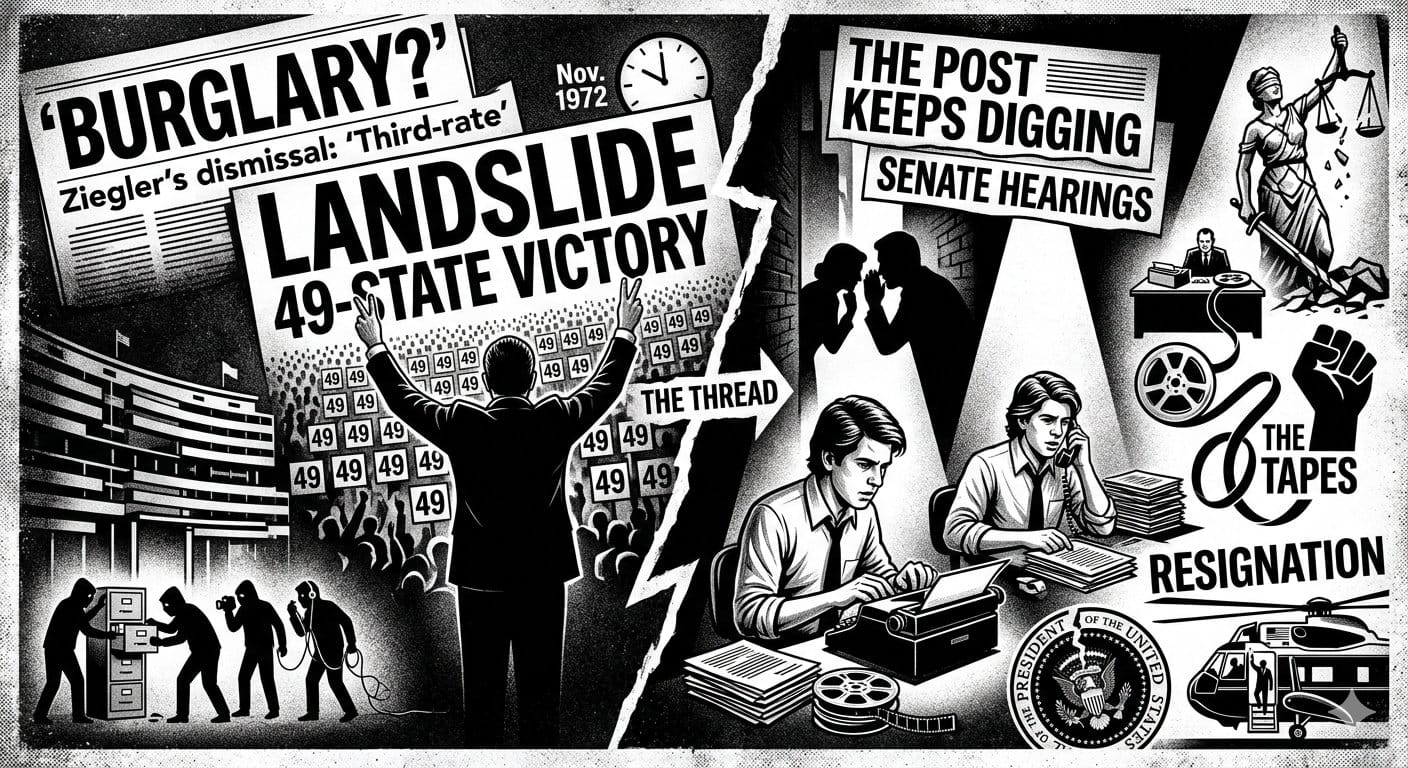
This tension between public apathy and investigative persistence highlights a recurring theme in American history: the lag time between the commission of an institutional crime and the public’s willingness to confront it. In the autumn of 1972, the American electorate was exhausted by controversy and eager to believe that the system was working. Nixon’s promise of peace with honor in Vietnam and his historic trip to China offered a grand narrative of stability that overshadowed a squalid domestic political scandal. The landslide victory was an expression of a collective desire to look forward rather than look too closely at the rot beneath the foundation. It demonstrates that the public consensus is often an unreliable gauge of historical truth, frequently trailing far behind the reality being uncovered by those working on the margins.
In the next segment, we will pivot to the cultural landscape of 1972, exploring the music and cinema that captured this shifting American psyche. The art of this period did not exist in a vacuum; it reflected the very undercurrents of paranoia, power dynamics, and institutional decay that were playing out in the headlines. We will begin with a film that arrived that spring, offering audiences a sweeping, definitive metaphor for the very kind of institutional corruption Woodward and Bernstein were quietly unearthing in the nation's capital. This cinematic masterpiece did not just entertain; it provided a vocabulary for an era defined by the realization that those who swear to protect the community are often the ones running the cartel from behind closed doors.
Tim
Tim Lowe is a writer, book expert, retired sailor, retail worker, and renaissance man.
He is currently traveling the country and working on his forthcoming book.